 ER Basics
Cheat Sheet
Neonatal and Pediatric Respiratory Care
Newborn lung disorders, NICU oxygen targets, CPAP and surfactant, oscillation, oxygenation index, tube and suction sizes
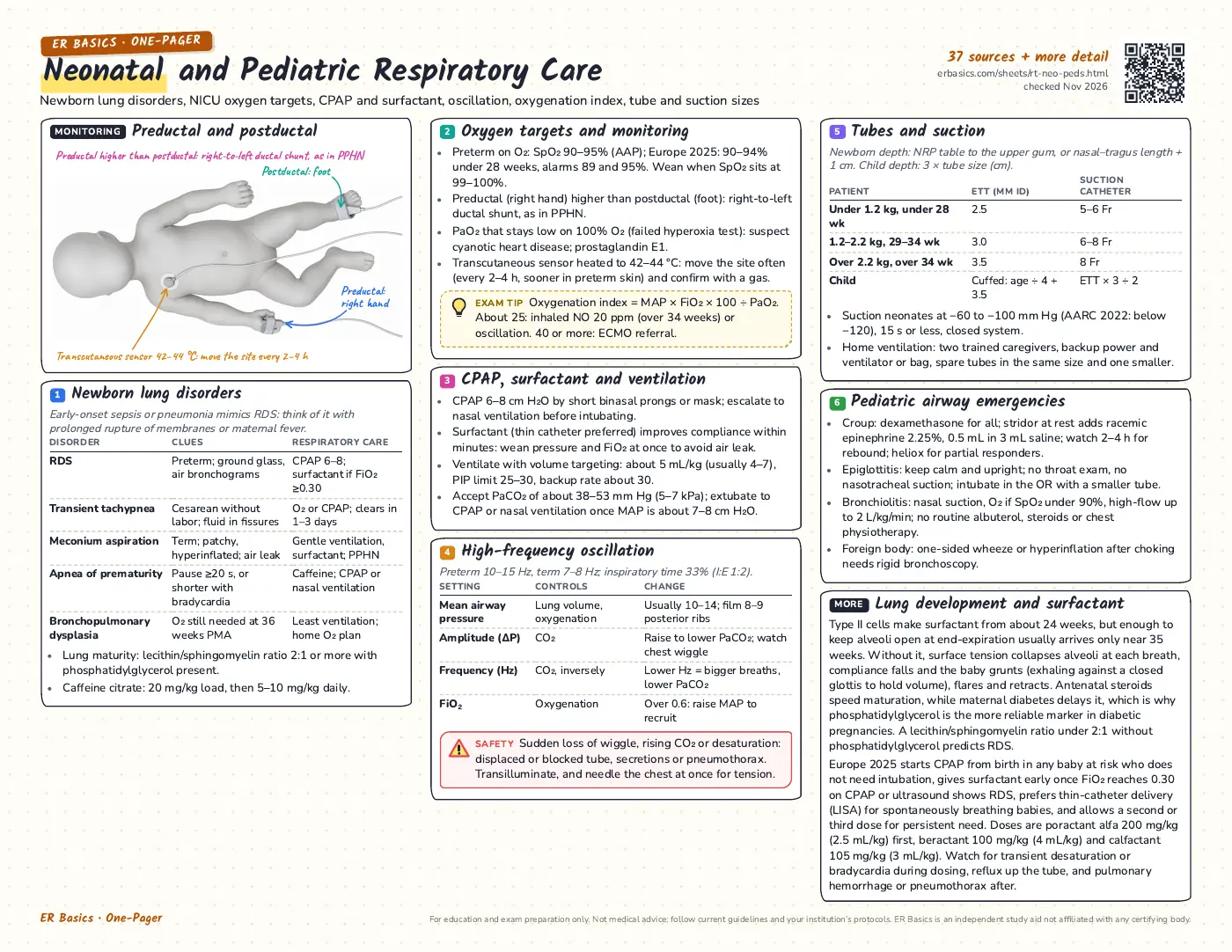
Newborn lung disorders
| Disorder | Clues | Respiratory care |
|---|---|---|
| RDS | Preterm; ground glass, air bronchograms | CPAP 6–8; surfactant if FiO₂ ≥0.30 |
| Transient tachypnea | Cesarean without labor; fluid in fissures | O₂ or CPAP; clears in 1–3 days |
| Meconium aspiration | Term; patchy, hyperinflated; air leak | Gentle ventilation, surfactant; PPHN |
| Apnea of prematurity | Pause ≥20 s, or shorter with bradycardia | Caffeine; CPAP or nasal ventilation |
| Bronchopulmonary dysplasia | O₂ still needed at 36 weeks PMA | Least ventilation; home O₂ plan |
- Lung maturity: lecithin/sphingomyelin ratio 2:1 or more with phosphatidylglycerol present.
- Caffeine citrate: 20 mg/kg load, then 5–10 mg/kg daily.
Oxygen targets and monitoring
- Preterm on O₂: SpO₂ 90–95% (AAP); Europe 2025: 90–94% under 28 weeks, alarms 89 and 95%. Wean when SpO₂ sits at 99–100%.
- Preductal (right hand) higher than postductal (foot): right-to-left ductal shunt, as in PPHN.
- PaO₂ that stays low on 100% O₂ (failed hyperoxia test): suspect cyanotic heart disease; prostaglandin E1.
- Transcutaneous sensor heated to 42–44 °C: move the site often (every 2–4 h, sooner in preterm skin) and confirm with a gas.
CPAP, surfactant and ventilation
- CPAP 6–8 cm H₂O by short binasal prongs or mask; escalate to nasal ventilation before intubating.
- Surfactant (thin catheter preferred) improves compliance within minutes: wean pressure and FiO₂ at once to avoid air leak.
- Ventilate with volume targeting: about 5 mL/kg (usually 4–7), PIP limit 25–30, backup rate about 30.
- Accept PaCO₂ of about 38–53 mm Hg (5–7 kPa); extubate to CPAP or nasal ventilation once MAP is about 7–8 cm H₂O.
High-frequency oscillation
| Setting | Controls | Change |
|---|---|---|
| Mean airway pressure | Lung volume, oxygenation | Usually 10–14; film 8–9 posterior ribs |
| Amplitude (ΔP) | CO₂ | Raise to lower PaCO₂; watch chest wiggle |
| Frequency (Hz) | CO₂, inversely | Lower Hz = bigger breaths, lower PaCO₂ |
| FiO₂ | Oxygenation | Over 0.6: raise MAP to recruit |
Tubes and suction
| Patient | ETT (mm ID) | Suction catheter |
|---|---|---|
| Under 1.2 kg, under 28 wk | 2.5 | 5–6 Fr |
| 1.2–2.2 kg, 29–34 wk | 3.0 | 6–8 Fr |
| Over 2.2 kg, over 34 wk | 3.5 | 8 Fr |
| Child | Cuffed: age ÷ 4 + 3.5 | ETT × 3 ÷ 2 |
- Suction neonates at −60 to −100 mm Hg (AARC 2022: below −120), 15 s or less, closed system.
- Home ventilation: two trained caregivers, backup power and ventilator or bag, spare tubes in the same size and one smaller.
Pediatric airway emergencies
- Croup: dexamethasone for all; stridor at rest adds racemic epinephrine 2.25%, 0.5 mL in 3 mL saline; watch 2–4 h for rebound; heliox for partial responders.
- Epiglottitis: keep calm and upright; no throat exam, no nasotracheal suction; intubate in the OR with a smaller tube.
- Bronchiolitis: nasal suction, O₂ if SpO₂ under 90%, high-flow up to 2 L/kg/min; no routine albuterol, steroids or chest physiotherapy.
- Foreign body: one-sided wheeze or hyperinflation after choking needs rigid bronchoscopy.
In depth
The one-page summary above is what the PDF prints. These sections go further.
Lung development and surfactant
Type II cells make surfactant from about 24 weeks, but enough to keep alveoli open at end-expiration usually arrives only near 35 weeks. Without it, surface tension collapses alveoli at each breath, compliance falls and the baby grunts (exhaling against a closed glottis to hold volume), flares and retracts. Antenatal steroids speed maturation, while maternal diabetes delays it, which is why phosphatidylglycerol is the more reliable marker in diabetic pregnancies. A lecithin/sphingomyelin ratio under 2:1 without phosphatidylglycerol predicts RDS.
Europe 2025 starts CPAP from birth in any baby at risk who does not need intubation, gives surfactant early once FiO₂ reaches 0.30 on CPAP or ultrasound shows RDS, prefers thin-catheter delivery (LISA) for spontaneously breathing babies, and allows a second or third dose for persistent need. Doses are poractant alfa 200 mg/kg (2.5 mL/kg) first, beractant 100 mg/kg (4 mL/kg) and calfactant 105 mg/kg (3 mL/kg). Watch for transient desaturation or bradycardia during dosing, reflux up the tube, and pulmonary hemorrhage or pneumothorax after.
The Silverman–Andersen score grades distress from 0 to 10 using chest lag, intercostal retraction, xiphoid retraction, nasal flaring and expiratory grunt (0–2 each); higher is worse. On film, RDS gives low volumes with diffuse ground glass and air bronchograms; transient tachypnea gives fluid in the fissures and normal or high volumes; meconium aspiration gives patchy densities with hyperinflation and air leaks; neonatal pneumonia can look like any of them.
Bronchopulmonary dysplasia and apnea
Jobe and Bancalari (2001) define BPD in babies born under 32 weeks as oxygen for at least 28 days, graded at 36 weeks postmenstrual age: mild if in room air, moderate if under 30% oxygen, severe if 30% or more or on positive pressure. Prevention means less invasive ventilation, volume targeting, caffeine, avoiding hyperoxia and good nutrition; Europe 2025 considers a short low-dose dexamethasone course for babies still ventilated after 1–2 weeks at high risk of death or BPD. About a fifth of babies with evolving BPD develop pulmonary hypertension, for whom higher saturation alarms are reasonable.
Apnea of prematurity (AAP 2016) is a pause of 20 seconds or more, or a shorter pause with bradycardia, cyanosis or pallor, in a baby under 37 weeks, after infection, anemia, temperature instability, hypoglycemia, seizures and drugs have been excluded. Caffeine reduces apnea, shortens ventilation and lowers BPD; CPAP or nasal ventilation splints the upper airway against obstructive and mixed events. Infants going home on oxygen need caregiver training, written targets and escalation steps, RSV prophylaxis and follow-up.
BPD: 2019 grading, diuretics and RSV protection
Two grading systems are in use and they can grade the same baby differently. The 2001 definition above grades by oxygen need, so a baby on CPAP at 36 weeks is severe. The 2019 definition (Jensen, NICHD Neonatal Research Network, babies born before 32 weeks) grades only by the mode of respiratory support at 36 weeks postmenstrual age, whatever the FiO₂ and however long oxygen was given before, because that grading best predicted death or serious respiratory illness by 18–26 months. Under it a baby on CPAP in room air has grade 2 BPD, and a baby in room air without support has no BPD.
| 2019 grade | Support at 36 weeks postmenstrual age |
|---|---|
| No BPD | Room air, no respiratory support |
| Grade 1 | Nasal cannula at 2 L/min or less |
| Grade 2 | Nasal cannula above 2 L/min, CPAP or nasal ventilation (any noninvasive positive pressure) |
| Grade 3 | Invasive mechanical ventilation |
Supportive care of established BPD often restricts intake to 120–140 mL/kg/day while feeds still supply about 150 kcal/kg/day, and adds a diuretic when that is not enough (Merck Manual). Diuretics improve compliance and resistance in the short term, but the gain does not last once they are stopped, and no randomized trial has shown less BPD, less oxygen use, shorter ventilation or a shorter hospital stay; ATS 2021 suggests against routine diuretics after discharge and, for a baby sent home on one, stopping it in a judicious way. Furosemide is the diuretic tied to kidney stones and metabolic bone disease: prolonged use causes hypercalciuria, with renal calculi, osteoporosis and fractures, and it also causes hypokalemia and hypochloremic alkalosis. When a diuretic has to continue long term, chlorothiazide is preferred, with or without spironolactone, and furosemide is kept for occasional doses when pulmonary edema worsens breathing. Inhaled bronchodilators do not appear to improve long-term outcome and are not used routinely; a trial is kept for a baby with signs of increased airway resistance.
RSV protection is now a long-acting monoclonal antibody, which is not a vaccine (CDC, reviewed August 2025). First season: infants under 8 months born during or entering the season get one IM dose if the mother was not vaccinated in pregnancy, her status is unknown, or she was vaccinated within 14 days of the birth. The dose is nirsevimab 50 mg under 5 kg or 100 mg at 5 kg or more, or clesrovimab 105 mg at any weight. Second season: only nirsevimab is recommended, for children aged 8–19 months at high risk. That group includes chronic lung disease of prematurity that needed medical support (chronic corticosteroids, a diuretic or supplemental oxygen) at any time in the 6 months before the season starts, so a child now off all support can still qualify. Other groups are severe immunocompromise, cystic fibrosis with severe lung disease or weight-for-length under the 10th percentile, and American Indian or Alaska Native children. The second-season dose is nirsevimab 200 mg, given as two 100 mg IM injections, shortly before the season (October–November in most of the continental United States). Clesrovimab is not recommended after 8 months of age, and CDC states that palivizumab, the older monthly injection, is no longer available from December 31, 2025.
Caffeine: levels, toxicity and stopping before discharge
The U.S. label for caffeine citrate (short-term treatment of apnea of prematurity at 28 to under 33 weeks) gives a 20 mg/kg load IV over 30 minutes, then 5 mg/kg every 24 hours IV or by mouth; the dose as caffeine base is half the citrate dose. Levels in the label's trial ran from 8 to 40 mg/L, and serious toxicity is associated with levels above 50 mg/L. Routine levels are usually not needed. Check one when toxicity is suspected or renal function is poor, and before starting in a baby who received theophylline or whose mother used caffeine before delivery.
Signs of excess are tachycardia, jitteriness, fine tremor, tachypnea, vomiting, hyperglycemia and, in overdose, seizures. Preterm babies clear caffeine very slowly: the half-life is about 3–4 days and about 86% leaves unchanged in the urine, so roughly four fifths of a dose is still in the body when the next daily dose is due, and metabolism reaches adult speed only at about 9 months. With signs of toxicity, withhold the dose and measure a level (the Australasian neonatal formulary says to consider withholding at a heart rate above 180/min). With a level above 50 mg/L, the label's range for serious toxicity, hold caffeine and repeat the level before resuming at a lower dose once the level and the signs have settled: with a half-life of days, a smaller dose given the same day only adds to a level that is already toxic. No label lays these steps out in order; they follow from the half-life, the formulary's advice to withhold, and the UK product information, which puts monitoring of levels and supportive care first in overdose and says dose-related adverse effects may need a level and a dose reduction. Exchange transfusion lowers the level and is considered in severe overdose, and seizures are treated with an anticonvulsant.
Apnea of prematurity usually resolves by 34–36 weeks postmenstrual age, but in babies born very early, events can continue to 43–44 weeks. Caffeine is stopped on the basis of postmenstrual age, time since the last event and clinical state, and needs no taper. It does not stop working on that day: levels of 5 mg/L or more persist for 5–10 days after the last dose, and may not be subtherapeutic until day 11–12. Event-free days counted while caffeine is still on board do not show that the baby can breathe reliably without it. Keep cardiorespiratory monitoring going for at least 5–7 days after stopping (most physicians observe a washout of 3–8 days); caffeine may need to be restarted if bradycardia or desaturation returns. In about 1,400 preterm babies an event-free interval of 5–7 days predicted resolution in about 95% (7 days for the whole cohort), with a lower success rate in the most preterm babies. There is no evidence that home apnea monitors or consumer pulse oximeters prevent SIDS, and no data support using them in place of an event-free period in hospital.
Conventional and oscillatory ventilation
Volume-targeted ventilation is the first choice in RDS (Europe 2025, A1). Start near 5 mL/kg with a PIP ceiling of 25–30 cm H₂O and a backup rate near 30; needs rise toward 6–7 mL/kg with age and evolving BPD. After surfactant, compliance improves so fast that a fixed PIP gives rising volumes, the main cause of post-surfactant pneumothorax. Permissive hypercapnia (about 5–7 kPa, or 38–53 mm Hg) speeds extubation, with caffeine given before it.
Oscillators deliver volumes near the dead space at 480–900 breaths a minute around a constant mean pressure. Oxygenation follows MAP and FiO₂; CO₂ removal (DCO₂) is proportional to frequency × tidal volume², so tidal volume matters most. Raising amplitude enlarges each breath; lowering frequency lengthens each cycle so that a piston moves more gas, which is why a lower Hz lowers PaCO₂ unless volume guarantee holds the volume constant. Optimal inflation is usually 8–9 posterior ribs on the film; more flattens the diaphragm and impedes venous return.
Before oscillating, suction and confirm the tube position, because the circuit should stay closed. Get a gas 15–20 minutes after starting and after changes. Wean FiO₂ first, then MAP in 1–2 cm H₂O steps; babies can go straight to CPAP when MAP is about 8–10 cm H₂O with a stable breathing pattern. High-frequency jet ventilation is an alternative for air leak and pulmonary interstitial emphysema.
Pulmonary hypertension and the oxygenation index
In PPHN, pulmonary pressure stays above systemic after birth and blood shunts right to left across the ductus and foramen ovale. Meconium aspiration, sepsis, asphyxia and diaphragmatic hernia are common causes. The preductal saturation exceeds the postductal; treatment is oxygen, avoiding acidosis and hypothermia, sedation, lung recruitment, surfactant for parenchymal disease, blood pressure support and inhaled NO.
Example: MAP 18 cm H₂O, FiO₂ 1.0 and PaO₂ 45 mm Hg give an OI of 18 × 1.0 × 100 ÷ 45 = 40, the conventional ECMO threshold. INOmax is labeled for babies over 34 weeks at 20 ppm; monitor NO₂ and methemoglobin, keep a backup delivery system, and wean in steps rather than stopping, because abrupt withdrawal causes rebound hypoxemia and pulmonary hypertension. In pediatric ARDS an OI of 16 or more is severe.
Inhaled nitric oxide: contraindication, response and weaning
The label has one contraindication: neonates dependent on right-to-left shunting of blood. A pre- to postductal saturation gap usually means PPHN, but the same right-to-left ductal flow is seen when the systemic circulation depends on the duct: hypoplastic left heart syndrome, critical aortic stenosis, interrupted aortic arch and critical coarctation. In those babies the right ventricle supplies the body through the duct, and the contraindication applies. In left-sided obstruction and other causes of pulmonary venous hypertension (for example obstructed anomalous pulmonary venous return), nitric oxide also increases pulmonary edema and worsens gas exchange. Exclude congenital heart disease by echocardiography before starting a pulmonary vasodilator.
Dose and monitoring (label): 20 ppm, for up to 14 days or until the desaturation has resolved; doses above 20 ppm are not recommended. Measure methemoglobin within 4–8 hours of starting and periodically after, and monitor NO₂; nitric oxide can cause pulmonary edema when the left ventricle is failing. In PPHN one center's protocol counts a PaO₂ rise of 20 mm Hg or more, or an SpO₂ rise of 5% or more, as a complete response. If there is no response once lung recruitment, ventilation and blood pressure have been optimized, discontinue nitric oxide instead of raising the dose; continuing it without benefit can down-regulate the baby's own nitric oxide pathway.
Do not stop abruptly: oxygenation can worsen and pulmonary artery pressure can rebound. Reduce the dose in several steps with a pause of several hours at each to watch for hypoxemia (one protocol: 5 ppm every 4 hours down to 5 ppm, then 1 ppm every 4 hours), and return to the previous dose if oxygenation falls. Intravenous sildenafil can be used with nitric oxide, or to prevent rebound as it is withdrawn; one regimen is 0.42 mg/kg over 3 hours, then 0.07 mg/kg/h. It lowers systemic pressure too, so optimize volume first and watch the blood pressure.
Congenital diaphragmatic hernia: gentle ventilation, rescue and repair
The CDH EURO Consortium consensus (2015 update) builds care on gentle ventilation and permissive hypercapnia, which have been reported to improve survival: accept the targets below instead of chasing normal gases. At birth, intubate without bag-mask ventilation, pass an orogastric or nasogastric tube on suction so that gas-filled bowel does not compress the lung, and keep peak pressure at 25 cm H₂O or less. Avoid neuromuscular blockers (compliance fell after they were given) and do not give surfactant routinely.
| Measure | Target | Note |
|---|---|---|
| Preductal SpO₂ | 80–95% | Preferably 85–95% after the first 2 hours; lower the FiO₂ when it is above 95% |
| Postductal SpO₂ | Above 70% | Oxygenation is judged on the preductal value |
| PaCO₂ | 50–70 mm Hg | Permissive hypercapnia; adjust the rate (40–60/min) to stay in range |
| PIP | 25 cm H₂O or less | More than 28 needed: change strategy, do not keep raising it |
| PEEP | 3–5 cm H₂O | Initial setting on pressure control |
| Perfusion | pH above 7.2 | With lactate under 5 mmol/L and urine output above 1 mL/kg/h, a preductal SpO₂ down to 80% is accepted |
Conventional ventilation is the first mode: in the VICI trial, babies started on it had shorter ventilation, less need for nitric oxide or sildenafil and less ECMO than babies started on oscillation. If the CO₂ and saturation targets cannot be reached without a PIP above 28 cm H₂O, change to high-frequency oscillatory ventilation as rescue, or consider ECMO. The consensus ECMO criteria are listed below.
- Preductal SpO₂ cannot be kept above 85%, or postductal above 70%.
- Rising PaCO₂ with respiratory acidosis, pH under 7.15, despite optimized ventilation.
- PIP above 28 cm H₂O or mean airway pressure above 17 cm H₂O needed to reach a saturation above 85%.
- Lactate 5 mmol/L or more with pH under 7.15 (inadequate oxygen delivery).
- Hypotension resistant to fluid and inotropes, with urine output under 0.5 mL/kg/h for 12–24 hours.
- Oxygenation index 40 or more for at least 3 hours.
Echocardiography in the first 24 hours rules out structural heart disease and grades the pulmonary hypertension. Treat pulmonary hypertension when preductal saturation falls below 85% or perfusion is poor. Inhaled nitric oxide at 10–20 ppm for at least 1 hour is considered when there is right-to-left shunting outside the lung and the oxygenation index is 20 or more or the pre- to postductal saturation difference is 10% or more. A response is a 10–20% fall in that difference, a 10–20% rise in PaO₂, a 10% rise in mean blood pressure or a fall in lactate. No consistent dose effect has been shown, and in one study more hernia babies given nitric oxide went on to need ECMO, so in nonresponders nitric oxide is stopped, and intravenous sildenafil, prostacyclin or an endothelin-pathway drug is considered, guided by repeat echocardiography.
Repair of the diaphragm is elective and waits for stabilization: mean arterial pressure normal for gestation, preductal SpO₂ of 85–95% on an FiO₂ below 0.50, lactate below 3 mmol/L and urine output above 1 mL/kg/h. A baby who still needs an FiO₂ of 0.50 or more is not ready. Repair can also be done while the baby is on ECMO.
Pediatric airway and home care
Croup narrows the subglottis, the narrowest part of a child's airway, so a millimeter of swelling raises resistance sharply. Racemic epinephrine works within 30 minutes but wears off in about 2 hours, so children are watched for 2–4 hours after the last dose; L-epinephrine is equivalent. Heliox lowers turbulent resistance but has weak evidence and limits FiO₂. Cool mist has shown no benefit. A child who looks toxic and fails epinephrine may have bacterial tracheitis.
Bronchiolitis care (AAP 2014) is supportive: nasal suction, oxygen when SpO₂ is under 90%, and fluids; albuterol, epinephrine, steroids, antibiotics and chest physiotherapy are not recommended, and hypertonic saline only for inpatients. In PARIS (2018), high-flow at 2 L/kg/min after standard oxygen failed cut escalation of care. Prongs should fill no more than half of each naris.
Children with tracheostomies go home with two trained caregivers, a portable suction unit, a self-inflating bag, spare tubes in the same size and a size smaller, humidification and, if ventilated, a backup ventilator or battery and a notice to the power company. A suction catheter that will not pass means the tube is blocked: change it at once.
Croup and bronchiolitis: oxygen, high flow and escalation
Agitation makes croup substantially worse, so care is arranged to keep the child calm: seated on a parent's lap, examined and treated without being frightened, and given dexamethasone by mouth when possible. Oxygen is for hypoxemia or severe distress, and hypoxemia or cyanosis marks severe croup. Give it in the least upsetting way: blow-by oxygen, from tubing held a few centimeters from the nose and mouth, can usually be given without agitating the child. Mist tents are not used; humidified air does not help, and a tent separates the child from the parent.
| Infant with bronchiolitis | Start oxygen when SpO₂ is persistently |
|---|---|
| Aged 6 weeks or more, otherwise healthy | Under 90% |
| Under 6 weeks of age | Under 92% |
| Under 12 months with an underlying health condition | Under 92% |
The guideline counts chronic lung disease, congenital heart disease, chronic neurological conditions, trisomy 21, diaphragmatic hernia, birth before 37 weeks and younger age among the risk factors for more serious illness. It does not list which underlying health conditions take the 92% line, but chronic lung disease is on that list, so a former preterm infant with BPD is held to 92%. Oxygen treats hypoxemia, not work of breathing alone. Low-flow oxygen comes first. High flow is not routine first-line therapy for a hypoxemic infant with moderate bronchiolitis and is not for infants who are not hypoxemic: consider it when low-flow oxygen has failed, or in severe disease before CPAP. CPAP is considered for impending or severe respiratory failure. Beta-2 agonists are not used for bronchiolitis under 12 months.
Response to low-flow or high-flow oxygen is judged by a fall in respiratory rate, heart rate or early warning score within 4–5 hours, not by SpO₂ alone. In the PARIS trial, failure meant three of four: heart rate unchanged or higher than at enrollment, respiratory rate unchanged or higher, an FiO₂ of 0.40 or more needed on high flow to hold the saturation target, and an early warning tool call for medical review. A normal SpO₂ reached only by turning the FiO₂ up to 0.40 or more, with the rates unchanged, therefore meets the failure definition. In the pilot study, infants who were going to fail did so within 2–3 hours.
Infants under 2 months and those born preterm can present with recurrent apnea before the usual chest signs, which follow over 24–48 hours (Merck Manual). Apnea by history is an indication for admission, with accelerating distress, hypoxia (especially an initial SpO₂ under 90%), an ill appearance and poor intake or dehydration; age under 2 months and underlying heart, lung or immune disease are further reasons. Apnea is rare overall (under 2%), so continuous pulse oximetry is not routine for stable infants who are not hypoxemic, but it is used when apnea has occurred or the infant is at risk of it. Intubation is indicated for severe recurrent apnea, hypoxemia that does not respond to oxygen, CO₂ retention, or inability to clear secretions. When these appear on CPAP, the next step is intubation and ventilation, not a higher pressure.
Pediatric asthma: critical asthma and preschool wheeze
The 2025 AARC and PALISI guideline for children with critical asthma made 11 recommendations, all conditional. For a child who stays hypoxemic or distressed despite treatment, bilevel positive airway pressure is the support it suggests over conventional oxygen; it takes no position on high-flow nasal cannula or heliox.
| Therapy | Recommendation |
|---|---|
| Inhaled SABA | Continuous over frequent intermittent; high-dose or low-dose regimens |
| Systemic steroid | Dexamethasone or methylprednisolone (or equivalent prednisone or prednisolone) |
| IV magnesium | Suggested as an adjunct, intermittent or continuous |
| IV SABA infusion | Suggested as an adjunct |
| IV methylxanthines | No recommendation for or against |
| Bilevel positive airway pressure | Suggested over conventional oxygen for persistent hypoxemia or respiratory distress |
| High-flow nasal cannula | No recommendation for or against, compared with conventional oxygen or with bilevel pressure |
| Heliox | No recommendation for or against |
| Dedicated protocol or pathway | Suggested |
Preschool wheeze with colds (NAEPP 2020 focused update): for children aged 0–4 years with recurrent wheezing triggered by respiratory infections (three or more episodes in a lifetime, or two in the past year) and no symptoms between infections, start a short daily course of an inhaled corticosteroid (7–10 days) at the first sign of an infection, with a SABA as needed, in place of a SABA alone. The recommendation is conditional with high certainty of evidence: the short course cut exacerbations needing systemic steroids by about a third. One studied regimen is budesonide inhalation suspension 1 mg twice daily for 7 days. Findings on growth conflict, so length or height is monitored. The panel made no recommendation between this and a daily inhaled corticosteroid for this pattern.
NBRC emphasis and exam pearls
- Neonatal or pediatric content runs through the exam (about 15–18 items).
- Preterm on CPAP with FiO₂ climbing past 0.30: surfactant.
- Chest rise jumps after surfactant: lower PIP and FiO₂.
- SpO₂ 99–100% on supplemental O₂ in a preterm infant: lower FiO₂.
- HFOV with high PaCO₂: raise amplitude (or lower Hz); low PaO₂: raise MAP or FiO₂.
- Cesarean without labor, fluid in the fissures: transient tachypnea.
- Sudden collapse on the ventilator with unequal chest: transilluminate and decompress.
- OI = MAP × FiO₂ × 100 ÷ PaO₂; 40 means ECMO referral.
- BPD on the 2019 scale is graded by the support at 36 weeks, not the FiO₂: CPAP in room air is grade 2.
- Diaphragmatic hernia: accept PaCO₂ 50–70 mm Hg and preductal SpO₂ 80–95% with PIP 25 cm H₂O or less.
- Saturation gap from duct-dependent systemic flow: no nitric oxide; get an echocardiogram first.
- Croup with a low SpO₂: blow-by oxygen on the parent's lap.
- Bronchiolitis on high flow: falling respiratory and heart rates mean response; a rising FiO₂ does not.
Related cheat sheets
- Obstetric EmergenciesPPH, preeclampsia and eclampsia, late-pregnancy bleeding, delivery emergencies and maternal arrest
- CEN: Genitourinary, Gynecologic and Early-Pregnancy EmergenciesEctopic pregnancy and hCG logic, early pregnancy loss, Rh, hyperemesis, adnexal torsion, ruptured cyst, PID, the acute scrotum, priapism, Fournier gangrene, stones, retention and UTI
- Pediatric Assessment and EmergenciesPAT, vital signs, airway infections, febrile seizures, dehydration, arrest, choking and abuse
- CEN Pediatric Emergencies: Ingestions, GI, Head Injury and FracturesFebrile and jaundiced neonates, toddler ethanol and cannabis ingestions, swallowed coins, magnets and sharp objects, intussusception, volvulus, Hirschsprung enterocolitis, PECARN and return to play, stridor that is not croup, sickle cell fever, SCFE, growth-plate and toddler fractures
Calculators for this topic
Sources
- National Board for Respiratory Care. The Respiratory Therapy Examination Detailed Content Outline, effective January 2027. Link
- Sweet DG, Carnielli VP, Greisen G, et al. European Consensus Guidelines on the Management of Respiratory Distress Syndrome: 2025. Neonatology. 2026;123(4):514-539. Link
- Lee HC, Strand ML, Finan E, et al. Part 5: Neonatal Resuscitation: 2025 American Heart Association and American Academy of Pediatrics Guidelines for Cardiopulmonary Resuscitation and Emergency Cardiovascular Care. Circulation. 2025;152(16 suppl 2):S385-S423. Link
- Lasa JJ, Dhillon GS, Duff JP, et al. Part 8: Pediatric Advanced Life Support: 2025 American Heart Association Guidelines for Cardiopulmonary Resuscitation and Emergency Cardiovascular Care. Circulation. 2025;152(suppl 2):S479-S537. Link
- Cummings JJ, Polin RA; AAP Committee on Fetus and Newborn. Oxygen targeting in extremely low birth weight infants. Pediatrics. 2016;138(2):e20161576. Link
- Eichenwald EC; AAP Committee on Fetus and Newborn. Apnea of prematurity. Pediatrics. 2016;137(1):e20153757. Link
- Jobe AH, Bancalari E. Bronchopulmonary dysplasia. Am J Respir Crit Care Med. 2001;163(7):1723-1729. Link
- Child and Adolescent Health Service, Western Australia. Neonatal guideline: Ventilation: High Frequency Oscillatory Ventilation. Last reviewed March 2024. Link
- INOmax (nitric oxide) gas for inhalation. Prescribing information. DailyMed. Link
- Restrepo RD, Hirst KR, Wittnebel L, Wettstein R. AARC clinical practice guideline: transcutaneous monitoring of carbon dioxide and oxygen: 2012. Respir Care. 2012;57(11):1955-1962. Link
- Blakeman TC, Scott JB, Yoder MA, Capellari E, Strickland SL. AARC Clinical Practice Guidelines: Artificial Airway Suctioning. Respir Care. 2022;67(2):258-271. Link
- American Association for Respiratory Care. AARC Clinical Practice Guideline: Nasotracheal suctioning, 2004 revision and update. Respir Care. 2004;49(9):1080-1084. Link
- Ralston SL, Lieberthal AS, Meissner HC, et al. Clinical practice guideline: the diagnosis, management, and prevention of bronchiolitis. Pediatrics. 2014;134(5):e1474-e1502. Link
- Franklin D, Babl FE, Schlapbach LJ, et al. A randomized trial of high-flow oxygen therapy in infants with bronchiolitis. N Engl J Med. 2018;378(12):1121-1131. Link
- Hou YT, Shi Q, Zhang L, Cheng Q. Clinical advances in racemic epinephrine for pediatric croup: a mini-review of evidence and practice. Front Pediatr. 2025;13:1616521. Link
- Johnson DW. Croup. Am Fam Physician. 2016;94(6):476-478 (Clinical Evidence Handbook). Link
- Jensen EA, Dysart K, Gantz MG, et al. The diagnosis of bronchopulmonary dysplasia in very preterm infants: an evidence-based approach. Am J Respir Crit Care Med. 2019;200(6):751-759. Link
- Cristea AI, Ren CL, Amin R, et al. Outpatient respiratory management of infants, children, and adolescents with post-prematurity respiratory disease: an official American Thoracic Society clinical practice guideline. Am J Respir Crit Care Med. 2021;204(12):e115-e133. Link
- Sakaria RP, Dhanireddy R. Pharmacotherapy in bronchopulmonary dysplasia: what is the evidence? Front Pediatr. 2022;10:820259. Link
- Balest AL. Bronchopulmonary Dysplasia (BPD). Merck Manual Professional Version. Updated September 2025. Link
- Centers for Disease Control and Prevention. RSV Immunization Guidance for Infants and Young Children. Reviewed August 18, 2025. Link
- Moulia DL, Link-Gelles R, Chu HY, et al. Use of clesrovimab for prevention of severe respiratory syncytial virus-associated lower respiratory tract infections in infants: recommendations of the Advisory Committee on Immunization Practices, United States, 2025. MMWR Morb Mortal Wkly Rep. 2025;74(32):508-514. Link
- Caffeine citrate injection and oral solution. Prescribing information. DailyMed. Link
- Australasian Neonatal Medicines Formulary consensus group. Caffeine. Version 4.0, June 2022. Link
- Caffeine Citrate 10 mg/mL Oral Solution. Summary of Product Characteristics (Martindale Pharma). electronic medicines compendium; revised February 2025. Link
- Erickson G, Dobson NR, Hunt CE. Immature control of breathing and apnea of prematurity: the known and unknown. J Perinatol. 2021;41(9):2111-2123. Link
- Lorch SA, Srinivasan L, Escobar GJ. Epidemiology of apnea and bradycardia resolution in premature infants. Pediatrics. 2011;128(2):e366-e373. Link
- Snoek KG, Reiss IK, Greenough A, et al. Standardized postnatal management of infants with congenital diaphragmatic hernia in Europe: the CDH EURO Consortium consensus, 2015 update. Neonatology. 2016;110(1):66-74. Link
- Mathew B, Lakshminrusimha S. Persistent pulmonary hypertension in the newborn. Children (Basel). 2017;4(8):63. Link
- Bjornson CL, Johnson DW. Croup. Lancet. 2008;371(9609):329-339. Link
- Ortiz-Alvarez O; Canadian Paediatric Society Acute Care Committee. Acute management of croup in the emergency department. Paediatr Child Health. 2017;22(3):166-173. Link
- Smith DK, McDermott AJ, Sullivan JF. Croup: diagnosis and management. Am Fam Physician. 2018;97(9):575-580. Link
- Borland ML, Loveys K, Babl FE, et al. Australasian Bronchiolitis Guideline: 2025 update. J Paediatr Child Health. 2025;61(8):1197-1215. Link
- Franklin D, Dalziel S, Schlapbach LJ, et al. Early high flow nasal cannula therapy in bronchiolitis, a prospective randomised control trial (protocol): a Paediatric Acute Respiratory Intervention Study (PARIS). BMC Pediatr. 2015;15:183. Link
- Bhatia R. Bronchiolitis. Merck Manual Professional Version. Updated September 2026. Link
- White BR, Miller AG, Baker J, et al. AARC and PALISI clinical practice guideline: pediatric critical asthma. Respir Care. 2025;70(5):593-609. Link
- Expert Panel Working Group of the NHLBI National Asthma Education and Prevention Program Coordinating Committee. 2020 focused updates to the asthma management guidelines. J Allergy Clin Immunol. 2020;146(6):1217-1270. Link