 ER Basics
Cheat Sheet
Asthma and COPD Exacerbations
Severity signs, first treatments, oxygen targets, NIV and ventilating obstructive lungs
Practice 6 Asthma and COPD Exacerbations questions free
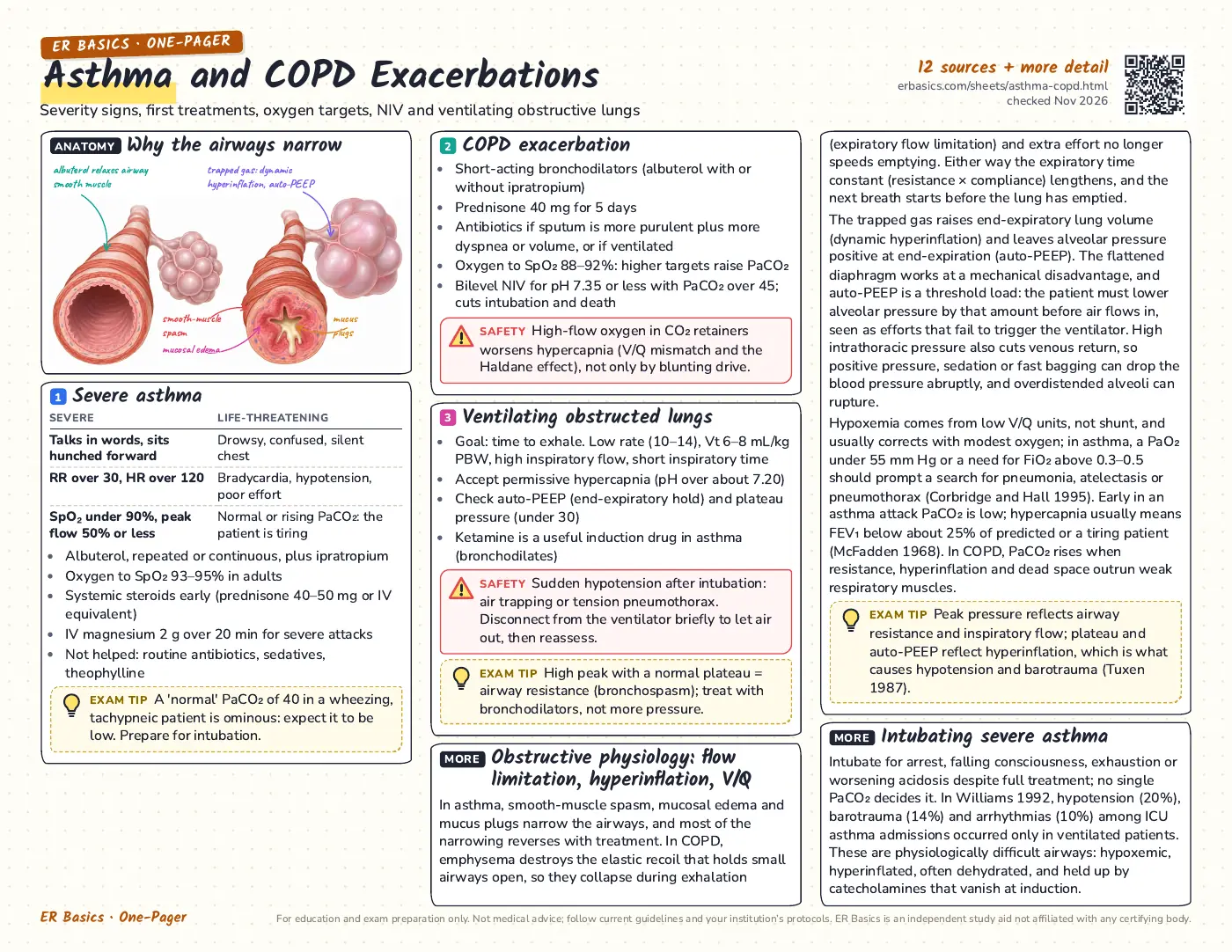
Severe asthma
| Severe | Life-threatening |
|---|---|
| Talks in words, sits hunched forward | Drowsy, confused, silent chest |
| RR over 30, HR over 120 | Bradycardia, hypotension, poor effort |
| SpO₂ under 90%, peak flow 50% or less | Normal or rising PaCO₂: the patient is tiring |
- Albuterol, repeated or continuous, plus ipratropium
- Oxygen to SpO₂ 93–95% in adults
- Systemic steroids early (prednisone 40–50 mg or IV equivalent)
- IV magnesium 2 g over 20 min for severe attacks
- Not helped: routine antibiotics, sedatives, theophylline
COPD exacerbation
- Short-acting bronchodilators (albuterol with or without ipratropium)
- Prednisone 40 mg for 5 days
- Antibiotics if sputum is more purulent plus more dyspnea or volume, or if ventilated
- Oxygen to SpO₂ 88–92%: higher targets raise PaCO₂
- Bilevel NIV for pH 7.35 or less with PaCO₂ over 45; cuts intubation and death
Ventilating obstructed lungs
- Goal: time to exhale. Low rate (10–14), Vt 6–8 mL/kg PBW, high inspiratory flow, short inspiratory time
- Accept permissive hypercapnia (pH over about 7.20)
- Check auto-PEEP (end-expiratory hold) and plateau pressure (under 30)
- Ketamine is a useful induction drug in asthma (bronchodilates)
In depth
The one-page summary above is what the PDF prints. These sections go further.
Obstructive physiology: flow limitation, hyperinflation, V/Q
In asthma, smooth-muscle spasm, mucosal edema and mucus plugs narrow the airways, and most of the narrowing reverses with treatment. In COPD, emphysema destroys the elastic recoil that holds small airways open, so they collapse during exhalation (expiratory flow limitation) and extra effort no longer speeds emptying. Either way the expiratory time constant (resistance × compliance) lengthens, and the next breath starts before the lung has emptied.
The trapped gas raises end-expiratory lung volume (dynamic hyperinflation) and leaves alveolar pressure positive at end-expiration (auto-PEEP). The flattened diaphragm works at a mechanical disadvantage, and auto-PEEP is a threshold load: the patient must lower alveolar pressure by that amount before air flows in, seen as efforts that fail to trigger the ventilator. High intrathoracic pressure also cuts venous return, so positive pressure, sedation or fast bagging can drop the blood pressure abruptly, and overdistended alveoli can rupture.
Hypoxemia comes from low V/Q units, not shunt, and usually corrects with modest oxygen; in asthma, a PaO₂ under 55 mm Hg or a need for FiO₂ above 0.3–0.5 should prompt a search for pneumonia, atelectasis or pneumothorax (Corbridge and Hall 1995). Early in an asthma attack PaCO₂ is low; hypercapnia usually means FEV₁ below about 25% of predicted or a tiring patient (McFadden 1968). In COPD, PaCO₂ rises when resistance, hyperinflation and dead space outrun weak respiratory muscles.
Assessing severity and risk
Judge an asthma attack at the bedside first (see the one-page table). Measure PEF or FEV₁ before treatment and 1 h after: GINA 2025 recommends admission for a pre-treatment value under 25% of predicted or best, or a post-treatment value under 40%. An ABG is not routine; GINA suggests one when PEF or FEV₁ is under 50% or the response is poor, and reads PaO₂ under 60 mm Hg with a normal or rising PaCO₂ as respiratory failure.
GINA 2025 risk factors for asthma death include past near-fatal asthma needing intubation, a hospital or ED visit in the past year, recent oral steroids, no inhaled steroid, more than one albuterol canister a month, psychosocial problems and poor adherence.
| Variable | Mild | Moderate (any 3 of 5) |
|---|---|---|
| Dyspnea, 0–10 scale | Under 5 | 5 or more |
| Respiratory rate | Under 24 | 24 or more |
| Heart rate | Under 95 | 95 or more |
| Resting SpO₂ on usual oxygen | 92% or more, fall ≤3% | Under 92% or fall >3% |
| CRP (mg/L) | Under 10 | 10 or more |
GOLD 2025 ICU criteria for COPD: dyspnea unresponsive to emergency treatment, confusion or coma, PaO₂ under 40 mm Hg or pH under 7.25 despite oxygen and NIV, need for intubation, or need for vasopressors.
Bronchodilators, steroids, magnesium and parenteral β-agonists
| Drug | Typical adult dose | Notes |
|---|---|---|
| Albuterol, nebulized | 2.5–5 mg every 20 min ×3, or 10–15 mg/h | Then 2.5–10 mg every 1–4 h as needed |
| Albuterol, MDI with spacer | 4–10 puffs every 20 min for 1 h | As effective as a nebulizer |
| Ipratropium | 0.5 mg nebulized every 20 min ×3 | Add in severe attacks |
| Prednisone | Asthma 40–50 mg × 5–7 days; COPD 40 mg × 5 days | Oral equals IV; no taper under 2 weeks |
| Methylprednisolone IV | 40–80 mg/day if unable to swallow | Higher doses add nothing |
| Magnesium sulfate IV | 2 g over 20 min, once | Flushing, hypotension |
| Epinephrine or terbutaline | 0.3–0.5 mg or 0.25 mg SC every 20 min ×3 | When inhaled drug cannot get in |
Albuterol relaxes airway smooth muscle within minutes. Side effects scale with dose: tachycardia, tremor, hypokalemia, hyperglycemia and a lactic acidosis that raises the respiratory rate and can be mistaken for worsening asthma. Adding ipratropium in the ED cut admissions (RR 0.72; Kirkland, Cochrane 2017), mostly in severe attacks.
Steroids act over hours, so give them early: within 1 h of ED arrival they cut asthma admissions (OR 0.40, NNT 8; Rowe, Cochrane 2001), and more than 80 mg/day of methylprednisolone added nothing in hospitalized asthma (Manser, Cochrane 2001). In COPD, REDUCE 2013 (n = 314) found 5 days of prednisone 40 mg non-inferior to 14 (re-exacerbation 35.9% vs 36.8%). Trials in ventilated COPD conflict (Alía 2011: less NIV failure; Abroug 2014: no benefit, more hyperglycemia), and methylprednisolone above 240 mg/day brought more insulin use and fungal infection without lower mortality (Kiser 2014, n = 17,239, observational).
GINA 2025 advises against routine IV magnesium but notes fewer admissions in adults with FEV₁ under 25–30% predicted at presentation or persistent hypoxemia after initial treatment. Kew (Cochrane 2014) found 7 fewer admissions per 100 adults treated (OR 0.75), but the 3Mg trial (Goodacre 2013, n = 1,109) missed significance (admission 72% vs 78%), and nebulized magnesium did nothing.
If anaphylaxis is possible, IM epinephrine comes first (GINA 2025); IV terbutaline and aminophylline are not recommended in adults (Mein 2025 review).
COPD specifics: oxygen, CO₂ retention, antibiotics, eosinophils
Titrate oxygen to SpO₂ 88–92% with a Venturi mask (24–28%) or low-flow cannula, drive nebulizers with air, and recheck a blood gas after changes (GOLD 2025; BTS 2017). In Austin 2010 (n = 405, prehospital), titrated oxygen cut mortality in confirmed COPD from 9% to 2% compared with high-flow oxygen. Excess oxygen raises PaCO₂ mainly by releasing hypoxic vasoconstriction, which sends blood to poorly ventilated units, and through the Haldane effect; in Aubier 1980, 100% oxygen raised PaCO₂ by 23 mm Hg although minute ventilation recovered to 93% of baseline.
Chronic retainers compensate: bicarbonate rises about 3.5 mEq/L per 10 mm Hg of chronic PaCO₂ rise (1 mEq/L acutely), so pH falls about 0.03 per 10 mm Hg instead of 0.08; a lower pH means acute-on-chronic failure. On the ventilator, aim for the patient's usual PaCO₂, not 40: overcorrection causes a post-hypercapnic metabolic alkalosis, and the kidney then excretes bicarbonate the patient needs once breathing alone.
Give antibiotics for 5–7 days when purulent sputum comes with more dyspnea or sputum volume, or when NIV or intubation is needed: an aminopenicillin with clavulanate, a macrolide or a tetracycline, with sputum culture and antipseudomonal cover considered in frequent exacerbators, severe airflow obstruction or ventilated patients (GOLD 2025). In ventilated COPD, ofloxacin cut hospital mortality from 22% to 4% (Nouira 2001, n = 93).
Low blood eosinophils predict a weak steroid response. CORTICO-COP 2019 (n = 318, hospitalized) gave prednisolone after day 1 only on days with eosinophils ≥300/µL: days alive and out of hospital were similar (8.9 vs 9.3 of 14) and median steroid days fell from 5 to 2. GOLD 2025 notes the weaker benefit but does not advise withholding steroids, and the guided approach is untested in critically ill patients (Mein 2025).
Rule out mimics: pneumonia, heart failure, pneumothorax, arrhythmia and pulmonary embolism, found in 5.9% of hospitalized exacerbations (Couturaud 2021) and 16.1% of unexplained ones (Aleva 2017). Give VTE prophylaxis (GOLD 2025).
NIV and high-flow nasal oxygen
Bilevel NIV unloads tired muscles: EPAP offsets auto-PEEP so efforts trigger sooner, and pressure support raises Vt. Across 17 trials (Osadnik, Cochrane 2017; n = 1,264), NIV for hypercapnic COPD cut mortality (RR 0.54, NNT 12) and intubation (RR 0.36, NNT 5). ERS/ATS 2017 recommends it for pH ≤7.35 with hypercapnia and as a trial before intubation unless the patient is deteriorating fast, and suggests against it for hypercapnia without acidosis.
- Oronasal mask; typical starting settings are EPAP 4–5 and IPAP 10–15 cm H₂O; raise pressure support toward a Vt of 6–8 mL/kg (Mein 2025) and a falling RR; oxygen to SpO₂ 88–92%
- Blood gas at 1–2 h; a pH still under 7.25 after 2 h sharply raises the risk of failure (Confalonieri 2005, n = 1,033)
- Maximize hours on NIV in the first 24 h, then taper over 2–3 days (BTS/ICS 2016)
- One nurse per two NIV patients for the first 24 h; check leak, skin under the mask, gastric distension, secretions and mental status (BTS/ICS 2016)
HFNC (up to 60 L/min) flushes CO₂ from upper-airway dead space and adds a little PEEP. In moderate hypercapnia (pH 7.25–7.35), Cortegiani 2020 (n = 79) found PaCO₂ fell almost as much as on NIV, but 32% switched to NIV within 6 h; Tan 2024 (n = 225) found more failure (25.7% vs 14.3%) and intubation (14.2% vs 5.4%) with HFNC. ERS 2022 suggests trying NIV first in hypercapnic COPD; HFNC suits NIV breaks, NIV intolerance and post-extubation support.
In asthma, NIV is unproven: ERS/ATS 2017 makes no recommendation, BTS/ICS 2016 advises against it in hypercapnic asthma, and GINA 2025 says to watch the patient closely and never sedate to make the mask tolerable. Observational data are favorable (Althoff 2020, 53,654 ICU admissions: NIV linked to less intubation), yet 22% of NIV patients still needed intubation. A short supervised trial in an alert, cooperative patient is reasonable if it does not delay intubation (Mein 2025).
Intubating severe asthma
Intubate for arrest, falling consciousness, exhaustion or worsening acidosis despite full treatment; no single PaCO₂ decides it. In Williams 1992, hypotension (20%), barotrauma (14%) and arrhythmias (10%) among ICU asthma admissions occurred only in ventilated patients. These are physiologically difficult airways: hypoxemic, hyperinflated, often dehydrated, and held up by catecholamines that vanish at induction.
- Most experienced operator; preoxygenate with NIV or HFNC; give a fluid bolus and draw up a vasopressor
- Rapid sequence: ketamine 1–2 mg/kg (bronchodilates, less hypotension) or propofol, with rocuronium 1–1.2 mg/kg or succinylcholine
- Largest tube that fits, ideally 8.0 mm: adjusted mortality was 26.7% with 7.0 mm or smaller vs 11.0% with 8.0 mm or larger (Kashiouris 2022, retrospective)
- Bag slowly with small breaths and long pauses; confirm with waveform capnography; set the ventilator for obstruction before handing over
In cardiac arrest: disconnect, let the chest empty, ventilate slowly, and decompress either side if tension pneumothorax cannot be excluded.
Ventilating obstructed lungs
Ventilate to let the lungs empty, not to normalize PaCO₂: Darioli and Perret 1984 accepted hypercapnia and had no deaths in 34 episodes, and Tuxen 1987 showed that trapping and hypotension rose with rate, Vt and slower inspiratory flow, while peak pressure tracked flow, not lung volume.
| Setting | Typical start | Reason |
|---|---|---|
| Mode | Volume control (or pressure control) | Allows plateau checks |
| Vt | 6–8 mL/kg PBW | Smaller breaths trap less |
| Rate | 10–12/min | Main lever on expiratory time |
| Inspiratory flow | 60–100 L/min, square wave | Shortens inspiration |
| I:E | 1:3 or longer | Time to exhale |
| External PEEP | 5, or 50–80% of auto-PEEP | Keep only if plateau does not rise |
| Targets | Plateau under 30; low auto-PEEP | Accept a high PaCO₂ |
Accept a pH down to about 7.20 unless intracranial pressure is raised; sources differ on the floor (BTS/ICS 2016 aims for 7.20–7.25, Mein 2025 for 7.25–7.30). Lowering the rate buys more exhalation time than raising flow: with Vt 500 mL at 60 L/min, inspiration takes 0.5 s, leaving 4.5 s to exhale at 12 breaths/min. Raising flow to 100 L/min adds 0.2 s; dropping the rate to 10 adds 1 s. Gains shrink below about 8–12 breaths/min because most trapped gas leaves in the first seconds (Mein 2025).
- Plateau: inspiratory hold of about 0.5–1 s in volume control; keep under 30 cm H₂O. It tracks end-inspiratory lung volume, which above 1.4 L (about 20 mL/kg) predicted hypotension and barotrauma (Williams 1992)
- Auto-PEEP: end-expiratory hold until pressure levels off; total PEEP minus set PEEP. Patient effort falsifies both holds
- Flow waveform: expiratory flow not back to zero when the next breath starts means trapping
- Peak − plateau: resistive pressure; a falling gap means bronchodilation is working
- Hidden auto-PEEP: closed airways can make auto-PEEP read low while plateau stays high (Leatherman and Ravenscraft 1996); believe the plateau
In a patient who triggers breaths, auto-PEEP causes missed triggers. With flow limitation, typical of COPD, external PEEP up to about 80% of measured auto-PEEP narrows that gap without adding hyperinflation (the waterfall effect). In passive patients the response varies: Caramez 2005 saw PEEP raise, leave unchanged or paradoxically lower plateau and total PEEP, so add it in 2 cm H₂O steps and keep it only if plateau does not rise; BTS/ICS 2016 advises not exceeding 12 cm H₂O.
| Problem | Likely cause | Action |
|---|---|---|
| Hypotension | Hyperinflation, pneumothorax, hypovolemia | Disconnect 30–60 s; fluids; lower rate |
| Plateau rising | More trapping, pneumothorax, mainstem tube | Lower rate or Vt; breath sounds, CXR |
| Peak up, plateau unchanged | Bronchospasm, secretions, bitten tube | Bronchodilator, suction, bite block |
Give bronchodilators by MDI with a spacer in the inspiratory limb or by mesh nebulizer, with the HME out during treatment. Each shift record peak, plateau, auto-PEEP and Vt, and check potassium, magnesium, phosphate and lactate.
Sedation, paralysis and rescue therapies
Deep sedation early suppresses the air hunger that drives a fast rate and dyssynchrony. Propofol (bronchodilating, but hypotensive) with fentanyl is common; ketamine adds bronchodilation with less hypotension but more secretions; avoid morphine, which releases histamine. Lighten sedation as obstruction resolves.
Use neuromuscular blockade only when deep sedation fails to control dyssynchrony or hyperinflation, preferably as boluses and briefly. With steroids, acute myopathy is common: weakness in 20 of 69 paralyzed asthma patients vs 0 of 38 given steroids alone (Leatherman 1996, 107 episodes), with odds rising 2.1-fold per extra day of paralysis (Behbehani 1999); atracurium was no safer than aminosteroids. Monitor train-of-four and protect the eyes.
Heliox (80:20 is about one-third as dense as air) lowers the pressure needed for turbulent flow but helps only while FiO₂ stays under about 0.3–0.4. It showed no overall benefit in non-intubated asthma (Rodrigo, Cochrane 2006), and in COPD on NIV it sped improvement in pH without reducing NIV failure (Jolliet 2017, n = 445: 14.7% vs 14.5%). Use ventilators calibrated for heliox; an oxygen flowmeter under-reads it (multiply by 1.8 for 80:20, 1.6 for 70:30).
Low-dose ketamine (0.1–0.2 mg/kg, then 0.5 mg/kg/h) added nothing in non-intubated ED patients (Howton 1996, n = 53); higher-dose infusions in ventilated patients rest on case series, as do inhaled anesthetics (isoflurane, sevoflurane), which need an anesthesia ventilator or anesthetic-conserving device (Mein 2025).
VV-ECMO removes CO₂ so the ventilator can rest the lungs; ELSO 2021 lists severe asthma and suggests ECMO for pH under 7.25 with PaCO₂ ≥60 despite optimal ventilation. In the ELSO registry (Yeo 2017, n = 272) survival to discharge was 83.5%, with complications in 65% (bleeding 28%). Lower PaCO₂ gradually: a fall over 50% in the first 24 h was linked to more neurologic complications (Cavayas 2020: 9.8% vs 6.4%).
ECCO₂R removes CO₂ through smaller cannulas at lower blood flow. In COPD failing NIV it avoided intubation in 14 of 25 patients but caused major bleeding in 9 (ECLAIR, Braune 2016); VENT-AVOID (Duggal 2024, n = 113, stopped early) found no gain in ventilator-free days and higher mortality in the NIV stratum (22% vs 0%).
Liberation, discharge and follow-up
Start liberation when the peak–plateau gap, plateau and auto-PEEP have fallen and PaCO₂ drops at the same minute ventilation. Extubate hypercapnic COPD patients straight to NIV: ERS/ATS 2017 suggests NIV to wean hypercapnic patients and to prevent post-extubation failure in high-risk patients, with HFNC if NIV is not tolerated. Rescue NIV for established post-extubation failure raised mortality (Esteban 2004), so use it preventively. Post-extubation support in asthma is untested.
Before an asthma patient leaves hospital: start or step up inhaled-steroid treatment (GINA 2025 prefers ICS–formoterol as maintenance and reliever), finish 5–7 days of oral steroid, check inhaler technique, give a written action plan and arrange review within 2–7 days. Past near-fatal asthma is a lasting risk factor for death (GINA 2025); refer to a specialist.
Before a COPD patient leaves: long-acting bronchodilators started, inhaler technique checked, steroid and antibiotic stop dates clear, oxygen need reassessed, smoking treated, vaccines updated, rehabilitation arranged, and follow-up within 1 month and again at about 3 months (GOLD 2025).
Persistent hypercapnia (PaCO₂ over 53 mm Hg) 2–4 weeks after the acidosis resolves identifies candidates for home NIV: in HOT-HMV 2017 (n = 116), home NIV plus oxygen cut 12-month readmission or death from 80.4% to 63.4%. About half of patients die within 5 years of a COPD admission (GOLD 2025), so discuss goals of care before discharge.
Poor asthma control: look for the cause before stepping up
When asthma stays uncontrolled on inhaled-steroid treatment, GINA 2026 says to assess and correct the common problems before considering any step up: incorrect inhaler technique, poor adherence, persistent exposure at home or work (allergens, tobacco smoke, air pollution), medicines such as beta-blockers or, in some patients, NSAIDs, comorbid conditions and an incorrect diagnosis.
| Cause | Clues | First move |
|---|---|---|
| Beta-blocker, eye drops included | Control lost after a new drug, such as timolol drops for glaucoma | Have the prescriber review the drop before adding asthma drugs |
| Aspirin-exacerbated respiratory disease | Nasal polyps, lost sense of smell, attack within 2 hours of an NSAID | Treat as acute asthma; avoid aspirin and NSAIDs afterward |
| Allergic bronchopulmonary aspergillosis | Brownish sputum plugs, fleeting opacities, eosinophilia, bronchiectasis | Aspergillus-specific IgE and serum total IgE |
| Occupational asthma | Adult onset; better on weekends and vacations | Peak flow readings at work and away from work; refer |
Beta-blockers, including topical ophthalmic preparations, can cause bronchospasm and have been implicated in some asthma deaths, so GINA 2026 advises always asking people with asthma about every medicine they take, eye drops included. Timolol is a nonselective (beta₁ and beta₂) blocker that is absorbed systemically from the eye: its label contraindicates it in bronchial asthma, a history of bronchial asthma and severe COPD, and reports death from bronchospasm after ophthalmic use. If a patient with asthma may benefit from an oral or ophthalmic beta-blocker, GINA leaves the decision to a specialist, case by case and under close supervision; asthma is not an absolute contraindication to a cardioselective beta-blocker given for an acute coronary event.
Aspirin-exacerbated respiratory disease (AERD, also called NSAID-exacerbated respiratory disease) starts with nasal congestion and loss of smell, progresses to chronic rhinosinusitis with nasal polyps that regrow rapidly after surgery, and then adds asthma with hypersensitivity to aspirin and other NSAIDs. Within minutes to 1–2 hours of a dose an asthma attack develops, usually with rhinorrhea, nasal obstruction, conjunctival irritation and a scarlet flush of the head and neck; it can progress to severe bronchospasm, shock and respiratory arrest. GINA 2026 puts the prevalence at 7% of adults with asthma and 15% of those with severe asthma. Afterward the patient avoids aspirin, other NSAIDs and any drug that inhibits cyclooxygenase-1 (COX-1); when an anti-inflammatory or analgesic is needed, acetaminophen or a COX-2 inhibitor may be considered, with observation for at least 2 hours after the dose. Aspirin and NSAIDs are not generally contraindicated in asthma unless there has been a previous reaction.
Allergic bronchopulmonary aspergillosis (ABPA) is a hypersensitivity response to Aspergillus fumigatus, most often diagnosed in people with asthma or cystic fibrosis. It causes repeated episodes of wheezing, fleeting pulmonary opacities, brownish sputum plugs and, over time, bronchiectasis. Testing starts with A. fumigatus-specific IgE and, if that is 0.35 kUA/L or more, serum total IgE. The 2024 ISHAM criteria require both, with a total IgE of 500 IU/mL or more, plus any two of: IgG against A. fumigatus, a blood eosinophil count of 500 cells/µL or more, and compatible imaging (bronchiectasis, mucus plugging, high-attenuation mucus or fleeting opacities). Acute ABPA is treated with oral prednisolone or itraconazole for about 4 months, with the two combined for recurrent exacerbations rather than as first-line therapy (ISHAM 2024); GINA 2026 lists oral corticosteroids as first-line. Itraconazole inhibits cytochrome P450, which raises the risk of adverse effects from inhaled corticosteroids (adrenal suppression) and from salmeterol and vilanterol.
Occupational asthma: an estimated 5–20% of new adult-onset asthma can be attributed to exposure at work, and rhinitis often comes first. Asking whether symptoms improve away from work (weekends or vacation) is the essential screening question. Because the diagnosis may mean a change of occupation, with legal and economic consequences, GINA 2026 says to confirm it objectively: frequent PEF monitoring at work and away from work is often used, and specialist referral is usually necessary. Once a patient is sensitized, very low exposures can provoke symptoms and continued exposure can leave persistent symptoms and airflow limitation that no longer responds, so the sensitized patient is removed from further exposure as early as possible.
Asthma with exercise and in pregnancy
Exercise-induced bronchoconstriction typically worsens after exercise stops. Regular ICS treatment, training and a sufficient warm-up reduce it (GINA 2026, Evidence A). A patient with mild asthma who is prescribed as-needed low-dose ICS-formoterol takes 1 inhalation of the same inhaler before exercise if needed and does not need a separate SABA for pre-exercise use (Evidence B): in a 6-week study, budesonide-formoterol taken as needed and before exercise was non-inferior to daily ICS with as-needed SABA. A SABA or LABA taken before exercise also prevents it, but tolerance to the protection develops with regular use more than once daily, and regular or frequent LABA without ICS is strongly discouraged in asthma because of the risk of exacerbations.
Breakthrough exercise symptoms often indicate poorly controlled asthma; stepping up ICS-containing treatment, after checking inhaler technique and adherence, generally reduces them. Reliever taken before exercise is not counted when symptom control is assessed. Shortness of breath or wheeze during exercise can also come from lack of fitness, obesity or inducible laryngeal obstruction.
In pregnancy, asthma worsens in about one-third of women, improves in one-third and is unchanged in one-third. Exacerbations are common, particularly in the second trimester, and often follow stopping or cutting back medicines because the mother or the clinician is worried about them. Poor control and exacerbations are associated with preterm delivery, low birth weight, increased perinatal mortality and pre-eclampsia, while use of ICS, beta₂-agonists, montelukast or theophylline is not associated with more fetal abnormalities.
- ICS-containing treatment is not stopped in preparation for pregnancy or during it: ICS reduce exacerbations in pregnancy, and stopping ICS is a significant risk factor for them (GINA 2026).
- Stepping down is a low priority until after delivery; review control every 4–6 weeks.
- Tell the patient that poorly controlled asthma and exacerbations are a much greater risk to the baby than current asthma treatments.
- Treat an exacerbation aggressively with SABA, oxygen and early systemic corticosteroids to avoid fetal hypoxia.
- In labor, usual maintenance medicines continue; if high doses of SABA were given, the baby's blood glucose is monitored for the first 24 hours, especially if preterm.
Theophylline: narrow window, many interactions
Sustained-release theophylline has only weak efficacy in asthma and side effects are common, and GINA 2026 says IV aminophylline and theophylline should not be used for exacerbations. Patients who still take it are at risk because the window is narrow and clearance changes easily. Bronchodilation occurs over serum concentrations of 5–20 mcg/mL and peaks of 10–15 mcg/mL give most of the benefit. Above 20 mcg/mL adverse reactions become more frequent and more severe: persistent vomiting, cardiac arrhythmias and intractable seizures. Sinus tachycardia, hypokalemia and hyperglycemia are frequent findings in reported overdoses.
| Change | Serum level | Examples from the label |
|---|---|---|
| Drug that inhibits its metabolism is added | Rises | Ciprofloxacin 40%, cimetidine 70%, erythromycin 35%, clarithromycin 25% |
| Illness that slows clearance | Rises | Heart failure (clearance down 50% or more), fever of 102 °F or more for 24 hours, cor pulmonale, acute pulmonary edema |
| Patient stops smoking | Rises | Clearance falls about 40% after 1 week without tobacco |
| Age over 60 | Rises | Clearance averages 30% lower than in young adults |
| Smoking or an enzyme inducer | Falls | Tobacco or marijuana smoking, carbamazepine, rifampin |
Related chronic lung problems: surgery, lung transplant, hypersensitivity pneumonitis
Before surgery: current smokers have more postoperative pulmonary complications than ex-smokers and non-smokers, and the risk rises with pack-years. The benefit of stopping grows with time: cessation for more than 4 weeks before surgery lowered pulmonary complications by 23% and more than 8 weeks by 47%, and abstaining for at least 3 to 4 weeks reduces respiratory and wound-healing complications (Lee and Lee 2025). A patient seen weeks before an operation is therefore advised to stop smoking now. Patients with stable COPD continue their usual medicines without interruption, including on the day of surgery; an exacerbation is treated first, and elective surgery is postponed until symptoms return to baseline. Lung expansion techniques reduce pulmonary complications, and preoperative inspiratory muscle training lowered atelectasis and pneumonia after cardiac and major abdominal surgery.
After lung transplant: patients measure FEV₁ at home once or twice a day and are taught to report a persistent fall to the transplant center rather than wait for the next clinic visit. A drop in FEV₁ of more than 10% from baseline calls for further examination for an acute event such as rejection or infection, which may include bronchoscopy with lavage and transbronchial biopsy. Acting on that smaller fall matters because acute rejection and infection can trigger chronic lung allograft dysfunction, which is diagnosed by a decline in FEV₁ of more than 20% from the post-transplant baseline and is considered irreversible.
Hypersensitivity pneumonitis (HP) develops in susceptible people after repeated exposure to an inciting agent, usually a protein antigen from birds (droppings, serum, feathers, feather bedding), fungi or bacteria, as in bird fancier's disease and farmer's lung (moldy hay). It causes dyspnea, cough and midinspiratory squeaks. In nonfibrotic HP, high-resolution CT typically shows ill-defined centrilobular nodules under 5 mm, ground-glass opacity and mosaic attenuation on inspiratory images, with air trapping on expiratory images.
The ATS/JRS/ALAT 2020 guideline rests the diagnosis of HP on three domains: an identified exposure (a thorough history, supported by serum IgG against the suspected antigen), the CT pattern, and bronchoalveolar lavage (BAL) lymphocytosis or histology. It recommends BAL fluid lymphocyte analysis in suspected nonfibrotic HP, and a patient with an identified exposure, a typical CT pattern and BAL lymphocytosis has a high-confidence diagnosis and needs no further testing. Healthy nonsmokers have about 10–15% lymphocytes in BAL fluid; the committee considered 30% a reasonable threshold. Patients with nonfibrotic HP who avoid further exposure to the inciting agent can stabilize or recover fully, which is why finding the antigen and ending the exposure matters.
Exam pearls
- A 'normal' PaCO₂ in a wheezing, tachypneic asthmatic means fatigue
- SpO₂ targets: COPD 88–92%; asthma 93–95% (GINA 2025)
- Oxygen-induced hypercapnia is mostly V/Q worsening and the Haldane effect, not loss of hypoxic drive
- NIV first for COPD with pH ≤7.35 and PaCO₂ >45; it cuts intubation and death
- COPD steroid: prednisone 40 mg for 5 days (REDUCE); oral works as well as IV
- Auto-PEEP: measure with an end-expiratory hold; lowering the rate is the strongest fix
- High peak with normal plateau = resistance; high plateau = hyperinflation, pneumothorax or stiff lung
- Hypotension after intubating an asthmatic: disconnect first, then think tension pneumothorax
- COPD antibiotics: purulent sputum plus more dyspnea or volume, or any ventilation; 5–7 days
Related cheat sheets
- ABG Interpretation in 6 StepspH, PaCO₂, HCO₃⁻, compensation, anion gap and oxygenation, with worked examples
- Ventilator Modes and SettingsModes, lung-protective targets, peak vs plateau, alarms and SBT readiness
- ARDSBerlin and Global definitions, lung-protective ventilation, PEEP, proning, paralysis, steroids, ECMO and the nursing care
- Pulmonary EmbolismESC 2019 and AHA/ACC 2026 risk classes, diagnosis, anticoagulation, lysis, catheter therapy and RV support
- Chest Tubes and PneumothoraxTension pneumothorax, the drainage system, bubbling and tidaling, troubleshooting and removal
- CapnographyNormal values, waveform patterns, CPR and ROSC, tube checks and sedation monitoring
Sources
- Global Initiative for Asthma. Global Strategy for Asthma Management and Prevention, 2025 update. Link
- Global Initiative for Chronic Obstructive Lung Disease. Global Strategy for the Diagnosis, Management, and Prevention of COPD, 2025 report. Link
- Rochwerg B, Brochard L, Elliott MW, et al. Official ERS/ATS clinical practice guidelines: noninvasive ventilation for acute respiratory failure. Eur Respir J. 2017;50(2):1602426. Link
- O'Driscoll BR, Howard LS, Earis J, Mak V. BTS guideline for oxygen use in adults in healthcare and emergency settings. Thorax. 2017;72(Suppl 1):ii1-ii90. Link
- Global Initiative for Asthma. Global Strategy for Asthma Management and Prevention, 2026 update (sections on occupational asthma, medications that worsen asthma, exercise, pregnancy, AERD and ABPA). Link
- Agarwal R, Sehgal IS, Muthu V, et al. Revised ISHAM-ABPA working group clinical practice guidelines for diagnosing, classifying and treating allergic bronchopulmonary aspergillosis/mycoses. Eur Respir J. 2024;63(4):2400061. Link
- Raghu G, Remy-Jardin M, Ryerson CJ, et al. Diagnosis of hypersensitivity pneumonitis in adults: an official ATS/JRS/ALAT clinical practice guideline. Am J Respir Crit Care Med. 2020;202(3):e36-e69. Link
- Lee HJ, Lee HW. Comprehensive strategies for preoperative pulmonary risk evaluation and management. Tuberc Respir Dis (Seoul). 2025;88(1):90-108. Link
- Shinohara Y, Yamaguchi M, Wannous M, et al. Criteria for identifying acute respiratory events based on FEV1 decline in home spirometry for lung transplant patients. BMC Pulm Med. 2025;25(1):176. Link
- Robson KS, West AJ. Improving survival outcomes in lung transplant recipients through early detection of bronchiolitis obliterans: daily home spirometry versus standard pulmonary function testing. Can J Respir Ther. 2014;50(1):17-22. Link
- Theophylline extended-release tablets. Prescribing information. DailyMed, US National Library of Medicine. Link
- Timolol maleate ophthalmic solution. Prescribing information. DailyMed. Link