 ER Basics
Cheat Sheet
Pediatric Assessment and Emergencies
PAT, vital signs, airway infections, febrile seizures, dehydration, arrest, choking and abuse
Practice 46 Pediatric Assessment and Emergencies questions free
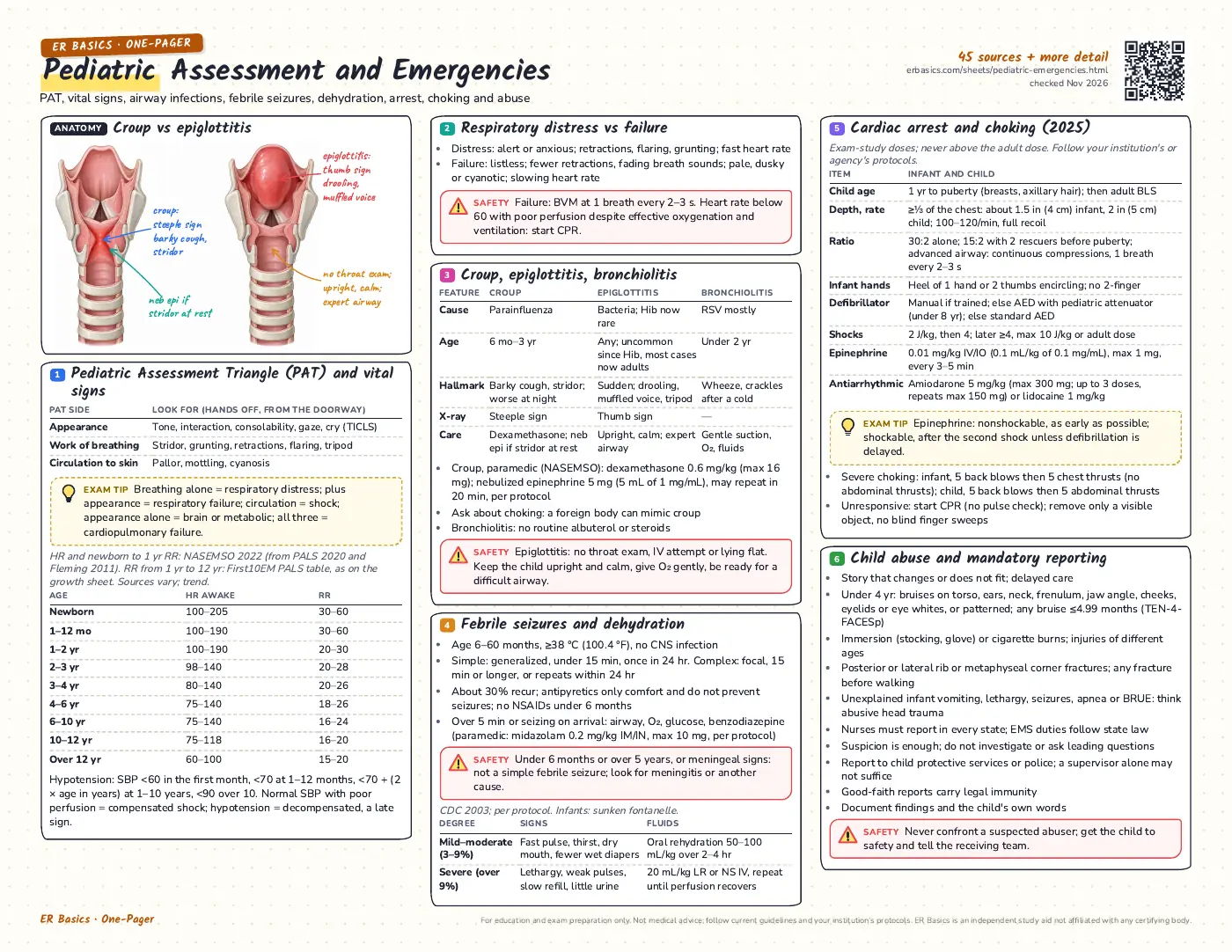
Pediatric Assessment Triangle (PAT) and vital signs
| PAT side | Look for (hands off, from the doorway) |
|---|---|
| Appearance | Tone, interaction, consolability, gaze, cry (TICLS) |
| Work of breathing | Stridor, grunting, retractions, flaring, tripod |
| Circulation to skin | Pallor, mottling, cyanosis |
| Age | HR awake | RR |
|---|---|---|
| Newborn | 100–205 | 30–60 |
| 1–12 mo | 100–190 | 30–60 |
| 1–2 yr | 100–190 | 20–30 |
| 2–3 yr | 98–140 | 20–28 |
| 3–4 yr | 80–140 | 20–26 |
| 4–6 yr | 75–140 | 18–26 |
| 6–10 yr | 75–140 | 16–24 |
| 10–12 yr | 75–118 | 16–20 |
| Over 12 yr | 60–100 | 15–20 |
Hypotension: SBP <60 in the first month, <70 at 1–12 months, <70 + (2 × age in years) at 1–10 years, <90 over 10. Normal SBP with poor perfusion = compensated shock; hypotension = decompensated, a late sign.
Respiratory distress vs failure
- Distress: alert or anxious; retractions, flaring, grunting; fast heart rate
- Failure: listless; fewer retractions, fading breath sounds; pale, dusky or cyanotic; slowing heart rate
Croup, epiglottitis, bronchiolitis
| Feature | Croup | Epiglottitis | Bronchiolitis |
|---|---|---|---|
| Cause | Parainfluenza | Bacteria; Hib now rare | RSV mostly |
| Age | 6 mo–3 yr | Any; uncommon since Hib, most cases now adults | Under 2 yr |
| Hallmark | Barky cough, stridor; worse at night | Sudden; drooling, muffled voice, tripod | Wheeze, crackles after a cold |
| X-ray | Steeple sign | Thumb sign | — |
| Care | Dexamethasone; neb epi if stridor at rest | Upright, calm; expert airway | Gentle suction, O₂, fluids |
- Croup, paramedic (NASEMSO): dexamethasone 0.6 mg/kg (max 16 mg); nebulized epinephrine 5 mg (5 mL of 1 mg/mL), may repeat in 20 min, per protocol
- Ask about choking: a foreign body can mimic croup
- Bronchiolitis: no routine albuterol or steroids
Febrile seizures and dehydration
- Age 6–60 months, ≥38 °C (100.4 °F), no CNS infection
- Simple: generalized, under 15 min, once in 24 hr. Complex: focal, 15 min or longer, or repeats within 24 hr
- About 30% recur; antipyretics only comfort and do not prevent seizures; no NSAIDs under 6 months
- Over 5 min or seizing on arrival: airway, O₂, glucose, benzodiazepine (paramedic: midazolam 0.2 mg/kg IM/IN, max 10 mg, per protocol)
| Degree | Signs | Fluids |
|---|---|---|
| Mild–moderate (3–9%) | Fast pulse, thirst, dry mouth, fewer wet diapers | Oral rehydration 50–100 mL/kg over 2–4 hr |
| Severe (over 9%) | Lethargy, weak pulses, slow refill, little urine | 20 mL/kg LR or NS IV, repeat until perfusion recovers |
Cardiac arrest and choking (2025)
| Item | Infant and child |
|---|---|
| Child age | 1 yr to puberty (breasts, axillary hair); then adult BLS |
| Depth, rate | ≥⅓ of the chest: about 1.5 in (4 cm) infant, 2 in (5 cm) child; 100–120/min, full recoil |
| Ratio | 30:2 alone; 15:2 with 2 rescuers before puberty; advanced airway: continuous compressions, 1 breath every 2–3 s |
| Infant hands | Heel of 1 hand or 2 thumbs encircling; no 2-finger |
| Defibrillator | Manual if trained; else AED with pediatric attenuator (under 8 yr); else standard AED |
| Shocks | 2 J/kg, then 4; later ≥4, max 10 J/kg or adult dose |
| Epinephrine | 0.01 mg/kg IV/IO (0.1 mL/kg of 0.1 mg/mL), max 1 mg, every 3–5 min |
| Antiarrhythmic | Amiodarone 5 mg/kg (max 300 mg; up to 3 doses, repeats max 150 mg) or lidocaine 1 mg/kg |
- Severe choking: infant, 5 back blows then 5 chest thrusts (no abdominal thrusts); child, 5 back blows then 5 abdominal thrusts
- Unresponsive: start CPR (no pulse check); remove only a visible object, no blind finger sweeps
Child abuse and mandatory reporting
- Story that changes or does not fit; delayed care
- Under 4 yr: bruises on torso, ears, neck, frenulum, jaw angle, cheeks, eyelids or eye whites, or patterned; any bruise ≤4.99 months (TEN-4-FACESp)
- Immersion (stocking, glove) or cigarette burns; injuries of different ages
- Posterior or lateral rib or metaphyseal corner fractures; any fracture before walking
- Unexplained infant vomiting, lethargy, seizures, apnea or BRUE: think abusive head trauma
- Nurses must report in every state; EMS duties follow state law
- Suspicion is enough; do not investigate or ask leading questions
- Report to child protective services or police; a supervisor alone may not suffice
- Good-faith reports carry legal immunity
- Document findings and the child's own words
In depth
The one-page summary above is what the PDF prints. These sections go further.
How children differ: airway, breathing and circulation
The infant airway is small, high and soft: a large occiput flexes the neck when supine, the tongue is large, and the larynx sits high and anterior under a long, floppy epiglottis. By Poiseuille's law, 1 mm of circumferential edema in a 4-mm infant airway raises resistance 16-fold, against about 3-fold in an 8-mm adult airway. The trachea is only 4–5 cm long at birth, so neck flexion pushes a tube toward the right main bronchus and extension pulls it out.
The diaphragm does most of the work against a compliant chest wall, so gastric distension from bag-mask air impairs ventilation; decompress it with a gastric tube. Oxygen consumption is about double the adult rate (6–8 vs 3–4 mL/kg/min) and functional residual capacity is small, so an apneic infant desaturates fast.
Infant stroke volume is relatively fixed, so cardiac output follows heart rate and bradycardia means falling output, usually from hypoxia. Tachycardia and vasoconstriction hold blood pressure while perfusion fails; in trauma, hypotension means loss of more than 45% of blood volume (ATLS 10th edition). Fever adds about 10–14 beats/min per °C (Thompson 2009).
| Age | Normal SBP | Hypotension |
|---|---|---|
| Newborn | 67–84 | <60 in the first month |
| Up to 1 yr | 72–104 | <70 |
| 1–3 yr | 86–106 | <70 + (2 × age in years) |
| 3–6 yr | 89–112 | <70 + (2 × age in years) |
| 6–10 yr | 97–115 | <70 + (2 × age in years) |
| 10–12 yr | 102–120 | <90 |
| Over 12 yr | 110–131 | <90 |
First look: PAT, primary assessment and weight
The PAT is a hands-off look from the doorway, done in under a minute, that assigns a physiologic category and the first intervention (Dieckmann 2010). Appearance (TICLS: tone, interactiveness, consolability, look or gaze, speech or cry) is the strongest marker of severity. Triage nurses using it reliably identified high-acuity children in a 528-child study (Horeczko 2013).
In the hands-on ABCDE, grunting (expiration against a partly closed glottis) signals alveolar disease or impending failure. Compare central with peripheral pulses, expect capillary refill of 2 s or less and urine output of at least 1 mL/kg/h, check glucose in any child with altered consciousness, and treat fever with purpura as meningococcemia until proven otherwise.
Weigh and record in kilograms only (Joint Commission Sentinel Event Alert 39). Without a scale, parent estimates are the most accurate, then length-based methods, with age formulas such as (age + 4) × 2 last (Young 2016). PALS 2025 notes that Broselow, PAWPER XL and Mercy tapes fall within 10–20% of measured weight and tend to underestimate total body weight while approximating ideal body weight.
Respiratory failure: airway, bronchiolitis, croup, asthma, foreign body
Most pediatric arrests are asphyxial, and respiratory failure is often quiet: a tiring child breathes slower, retracts less and grows drowsy as PaCO₂ rises, while oximetry on oxygen stays reassuring until late. Add capnography or a venous gas.
| Airway item | Practice |
|---|---|
| Tube | Cuffed preferred (PALS 2025, 2a); cuff <20–25 cm H₂O |
| Cuffed size | 3.0 under 1 yr, 3.5 at 1–2 yr, then age/4 + 3.5 |
| Depth at lip | About 3 × tube size, in cm |
| Confirmation | Exhaled CO₂ in every setting (PALS 2025) |
| Cricoid pressure | Not routine (PALS 2025: no benefit) |
| Atropine premedication | May consider 0.02 mg/kg, no minimum (PALS 2025, 2b) |
Bronchiolitis peaks on days 3–5, and infants under about 2 months or born preterm can present with apnea. Care is superficial suction, oxygen and nasogastric or IV fluids; albuterol, epinephrine, routine steroids, antibiotics and hypertonic saline in the ED are not recommended (AAP 2014; Australasian 2025). High-flow nasal cannula reduced ward escalation in PARIS without shortening stay, and Australasian 2025 uses it after low-flow oxygen fails, with CPAP for impending failure.
Judge a high-flow response by the respiratory and heart rates, not the saturation alone. PARIS ran high flow at 2 L/kg/min (maximum 25 L/min) and defined failure as 3 of 4: heart rate unchanged or higher, respiratory rate unchanged or higher, an FiO₂ of 0.40 or more to hold SpO₂ at 92% or more, and an early-warning review. Infants who fail usually do so within 2 to 3 hours, so a normal SpO₂ bought by turning the FiO₂ up to 0.40 while both rates stay high meets the failure definition.
The Westley croup score (0–17) adds stridor 0–2, retractions 0–3, air entry 0–2, cyanosis 0–5 and consciousness 0 or 5: 2 or less is mild, 3–5 moderate, 6–11 severe, 12 or more impending failure. Every child gets dexamethasone; stridor at rest adds nebulized epinephrine, which wears off in about 2 hours, so observe 2–4 hours after the last dose. Repeated doses or an oxygen need means PICU; intubate with a tube 0.5–1 mm smaller than predicted. A toxic child unresponsive to epinephrine may have bacterial tracheitis.
Status asthmaticus: albuterol every 20 minutes or continuously (0.5 mg/kg/h), ipratropium with the first 3 doses, an early systemic steroid, then IV magnesium 25–75 mg/kg (max 2 g) (EPR-3). Drowsiness, a silent chest or PaCO₂ of 42 mm Hg or more in a tachypneic child signals failure. If intubation is unavoidable, use ketamine, a low rate and a long expiratory time; for hypotension after intubation, disconnect the circuit to release trapped air and look for a pneumothorax.
Foreign-body aspiration peaks at 1–3 years, usually food. A witnessed choking episode is the most sensitive clue; cough, wheeze and one-sided decreased breath sounds are often not all present, and most objects are radiolucent, so a normal film does not exclude it. Rigid bronchoscopy confirms and removes it.
Shock, fluids and sepsis (Phoenix 2024)
Hypovolemia is the most common pediatric shock; distributive, cardiogenic and obstructive shock can coexist (PALS 2025). Give isotonic fluid in 10 or 20 mL/kg aliquots and reassess after every bolus (Class 1) for response and overload: crackles, a descending liver edge, a gallop, a rising oxygen need. Give 5–10 mL/kg over 10–20 minutes if cardiogenic shock is suspected. A neonate in shock with weak femoral pulses or a pre- to postductal saturation gap may be ductal-dependent: start alprostadil 0.05–0.1 mcg/kg/min and be ready for apnea.
FEAST (Maitland 2011) gave 3,141 African children with febrile illness and poor perfusion 20–40 mL/kg boluses or none; 48-hour mortality was 10.6% (albumin), 10.5% (saline) and 7.3% (no bolus), mainly from cardiovascular collapse. Without ICU care, SSC children's guidelines advise no bolus unless the child is hypotensive; with it, up to 40–60 mL/kg in the first hour, stopped at signs of overload. PALS 2025 accepts balanced or unbalanced crystalloid (PRoMPT BOLUS found no difference), while SSC children's guidelines suggest balanced.
For fluid-refractory septic shock start epinephrine or norepinephrine (PALS 2025, 2a), peripherally until central access is in (SSC); dopamine only if neither is available. Stress-dose hydrocortisone may be considered once vasoactives are needed (2b) and is given early for known adrenal insufficiency. Check glucose and ionized calcium.
Phoenix (Schlapbach 2024) replaced the SIRS-based 2005 definitions for children under 18, excluding preterm newborns: sepsis is suspected infection with a score of 2 or more, and septic shock is sepsis with at least 1 cardiovascular point. In-hospital mortality was 7.1% in higher-resource and 28.5% in lower-resource settings for sepsis, and 10.8% and 33.5% for septic shock (Sanchez-Pinto 2024).
| System | Finding | Points |
|---|---|---|
| Respiratory | P/F <400 or S/F <292 on any support | 1 |
| Respiratory | On IMV: P/F <200 or S/F <220 | 2 |
| Respiratory | On IMV: P/F <100 or S/F <148 | 3 |
| Cardiovascular | Vasoactives: 1 drug / 2 or more | 1 / 2 |
| Cardiovascular | Lactate 5–10.9 / 11 or more mmol/L | 1 / 2 |
| Cardiovascular | MAP low / very low for age (next table) | 1 / 2 |
| Coagulation | Platelets <100, INR >1.3, D-dimer >2, fibrinogen <100 | 1 each, max 2 |
| Neurologic | GCS 10 or less / both pupils fixed | 1 / 2 |
| Age | MAP for 1 point | MAP for 2 points |
|---|---|---|
| Under 1 mo | 17–30 | <17 |
| 1–11 mo | 25–38 | <25 |
| 1 yr | 31–43 | <31 |
| 2–4 yr | 32–44 | <32 |
| 5–11 yr | 36–48 | <36 |
| 12–17 yr | 38–51 | <38 |
Give antimicrobials ideally within 1 hour for septic shock and, after rapid evaluation, within 3 hours for sepsis without shock (SSC children's guidelines).
Fluid choice (SSC children's 2026): crystalloids rather than albumin for initial resuscitation (conditional, moderate certainty), and balanced or buffered crystalloids such as lactated Ringer's over 0.9% saline (conditional, very low certainty). Saline is a suitable alternative when balanced fluid is not at hand, and 0.9% saline may be preferred for a child with hyponatremia or concern for raised intracranial pressure, such as a CNS infection.
Congenital heart disease emergencies and transport
Shunt size depends on the size of the defect and the resistance downstream. Pulmonary vascular resistance is high at birth and falls over the first weeks, so a large VSD that was quiet in the nursery floods the lungs and causes heart failure at about 4 to 6 weeks: tachypnea, dyspnea with feeding, failure to thrive, a gallop, crackles and hepatomegaly (Merck). Diuretics, digoxin and ACE inhibitors control symptoms, and a large VSD with pulmonary hypertension is usually repaired within the first year; left alone, rising resistance finally reverses the shunt (Eisenmenger syndrome).
| Lesion or crisis | Recognize | Transport priorities |
|---|---|---|
| Tet spell (tetralogy of Fallot) | Triggered by crying, defecation, a sudden fall in SVR, tachycardia or hypovolemia; deep cyanosis, hyperpnea, and the murmur fades or disappears | Knee-chest position first, a calm setting, oxygen and IV fluid; if it persists, morphine 0.1 mg/kg, phenylephrine and a beta-blocker (esmolol or propranolol) |
| Shunt thrombosis after stage I (Norwood with an aortopulmonary shunt) | A sudden, marked fall in saturation or an inaudible shunt murmur; 8–12% of infant shunts, life-threatening unless quickly resolved | While intervention is arranged, push blood through the narrowed shunt: FiO₂ 1.0, volume and phenylephrine to raise systemic resistance and pressure, and sedation with paralysis to cut oxygen use. Heparin bolus 50–100 units/kg IV, then consider an infusion; catheter intervention, surgical revision or ECMO if it does not resolve; go to a center that can do all three |
| Pulmonary hypertensive crisis (for example after septal defect repair) | Hypoxemia, hypercapnia, acidosis, pain and agitation raise PVR; desaturation, hypotension and low output follow | Correct hypoxemia, hypercapnia and acidosis; treat pain and agitation; inhaled nitric oxide or prostacyclin as the first pulmonary vasodilator; ECMO if refractory |
| HLHS before surgery (parallel circulation on prostaglandin) | Cardiogenic shock in the single ventricle: tachypnea, weak pulses, pallor, metabolic acidosis, oliguria or anuria | Keep PVR relatively high and SVR low; avoid hyperoxia, alkalosis and hypocarbia; minimize vasoconstrictors such as epinephrine or high-dose dopamine; milrinone, which adds inotropy and dilates systemic vessels, plus diuretics |
| Bidirectional Glenn | The superior vena cava drains passively into the pulmonary arteries, and much of that blood comes from the brain | Hypocapnia constricts cerebral vessels and so cuts pulmonary flow; mild hypercarbia raises it. In a 2026 survey, 69% of pediatric cardiac intensive care providers targeted PaCO₂ 46–55 mm Hg in a hypoxemic patient after a Glenn. Positive pressure raises PVR, so use the least airway pressure that keeps the lungs open |
| Obstructed TAPVR | The infracardiac type is invariably severely obstructed: marked cyanosis unresponsive to oxygen, respiratory distress, pulmonary edema, and a small heart on x-ray | Obstructed neonates need emergent surgical repair; support ventilation and perfusion and go straight to a cardiac surgical center |
| Coarctation of the aorta | Usually just beyond the left subclavian artery; upper-limb hypertension, low or absent leg pressures, weak or delayed femoral pulses; the left arm may read lower, though above the legs | The right arm shows the pressure proximal to the narrowing, the one the brain and heart see; beta-blockers treat hypertension in nonemergent cases |
| Eisenmenger syndrome | Reversed shunt with secondary erythrocytosis; hyperviscosity, stroke, thromboembolism | Avoid volume depletion and high altitude; phlebotomy only for symptomatic polycythemia, with simultaneous normal saline; anticoagulation is individualized because of pulmonary hemorrhage; oxygen may help |
| Williams syndrome (supravalvar aortic stenosis) | Fixed outflow obstruction, often with coronary ostial stenosis; sudden death risk 25–100 times the general population, mostly around procedures | Keep preload, afterload and heart rate steady at induction, because a fall in SVR lowers diastolic coronary flow to a thick ventricle. Induce slowly and titrate: propofol and volatile agents lower SVR and are used sparingly, while midazolam, ketamine and etomidate barely change vascular resistance and can be combined (Spiro 2024); a 2026 case report used low-dose ketamine with midazolam in a titrated co-induction, phenylephrine running. In a 2026 series both deaths followed inhalational induction. Emergency drugs such as epinephrine drawn up as boluses and infusions, and a team experienced in Williams syndrome |
| 22q11.2 deletion (DiGeorge) | Interrupted aortic arch, truncus arteriosus, tetralogy or septal defects; low-set ears, a small receding mandible, absent thymus | Parathyroid hypoplasia causes hypocalcemic tetany within 24 to 48 hours of birth; check calcium before departure; T-cell deficiency |
A right-to-left shunt removes the lung's filter, so venous air crosses to the systemic arteries and can lodge in the cerebral or coronary circulation (Marsh 2023). Purge air from every line and syringe (inadequately primed lines have caused fatal cerebral air embolism), use screw-on connections kept tight, use air filters on IV lines, and place central access cautiously (Ladouceur 2025; Dey 2023).
Because a fall in systemic vascular resistance or a sudden tachycardia can start a tet spell, the treatments push the other way: knee-chest positioning and phenylephrine raise systemic resistance so less blood shunts right to left, and a beta-blocker slows the heart (Merck).
PALS: arrest, bradycardia, tachycardia and IO access
In hospital, pediatric survival to discharge is 38% after pulseless arrest and 66% when CPR is started for bradycardia with poor perfusion (PALS 2025). With an advanced airway give 20–30 breaths/min. With an arterial line, aim for diastolic pressure of at least 25 mm Hg in infants and 30 from age 1, and never stop resuscitation on an ETCO₂ value alone.
| Drug or energy | Dose |
|---|---|
| Epinephrine (arrest, bradycardia) | 0.01 mg/kg IV/IO (0.1 mL/kg of 0.1 mg/mL), max 1 mg |
| Atropine (vagal, AV block) | 0.02 mg/kg, repeat once; min 0.1 mg, max single 0.5 mg |
| Adenosine (SVT) | 0.1 mg/kg rapid (max 6 mg), then 0.2 mg/kg (max 12 mg) |
| Synchronized cardioversion | 0.5–1 J/kg, then 2 J/kg; sedate without delaying |
| Defibrillation | 2 J/kg, then 4 J/kg; up to 10 J/kg or adult maximum |
| Amiodarone or lidocaine | 5 mg/kg (max 300 mg) or 1 mg/kg, shock-refractory VF/pVT |
| Glucose | 0.5–1 g/kg (D10 5–10 mL/kg) |
| Calcium chloride 10% | 20 mg/kg (0.2 mL/kg): low Ca²⁺, high K⁺, CCB toxicity |
Bradycardia is usually hypoxic, so oxygenate and ventilate first. A heart rate below 60 with cardiopulmonary compromise despite effective ventilation means CPR and epinephrine; atropine is for increased vagal tone or primary AV block, and pacing may be considered for complete heart block or sinus node dysfunction (PALS 2025).
SVT starts abruptly, with absent or abnormal P waves and a fixed rate, usually 220/min or more in infants and 180 or more in children; sinus tachycardia has P waves, a variable rate and a cause. Without compromise try vagal maneuvers (ice water to an infant's face, never ocular pressure), then adenosine with a rapid flush; with compromise, cardiovert. QRS over 0.09 s is wide: cardiovert if compromised, otherwise consult. New in 2025: adenosine for a regular monomorphic wide rhythm and IV sotalol for refractory SVT.
After ROSC, PALS 2025 keeps SBP and MAP above the 10th percentile for age (Class 1; the 5th in 2020), SpO₂ at 94–99% and central temperature at or below 37.5 °C; for comatose children a 5-day course of 32–34 °C then 36–37.5 °C, or 36–37.5 °C throughout, is reasonable. Base prognosis on several tests over days, never on GCS or pupils in the first 24 hours.
Choose IV or IO by availability, expertise and speed; unlike the 2025 adult guideline, PALS does not rank IV first. Use the anteromedial proximal tibia, distal femur or tibia, or the humerus in older children, avoiding fractured or recently punctured bone and infected skin. With the tip on bone, at least one 5-mm mark must show above the skin; the needle should stand alone and flush without swelling. If the child is responsive give preservative-free 2% lidocaine 0.5 mg/kg (max 40 mg) over 2 minutes; watch for extravasation and compartment syndrome and remove within 24 hours (Teleflex).
DKA, cerebral edema and status epilepticus
ISPAD 2022 defines pediatric DKA as glucose over 200 mg/dL, venous pH below 7.3 or bicarbonate below 18 mmol/L, and ketosis (β-hydroxybutyrate 3 mmol/L or more, or moderate to large ketonuria); pH below 7.1 or bicarbonate below 5 is severe. Give 10–20 mL/kg of isotonic fluid over 20–30 minutes, replace the deficit over 24–48 hours, and start insulin at 0.05–0.1 unit/kg/h without a bolus at least 1 hour after fluids. Potassium 40 mmol/L starts with insulin (before it if low, after urine output if high), and dextrose is added when glucose falls to 250–300 mg/dL.
Clinically apparent cerebral injury occurs in 0.5–0.9% of episodes with 21–24% mortality, usually within 12 hours of starting treatment (ISPAD 2022), and PECARN FLUID found that neither saline strength nor infusion rate changed it. Headache, renewed vomiting, a falling heart rate, rising blood pressure or falling consciousness suggest cerebral edema; treat on suspicion with mannitol 0.5–1 g/kg or 3% saline 2.5–5 mL/kg over 10–15 minutes (criteria on the DKA sheet).
Treat convulsive status epilepticus at 5 minutes (ILAE 2015) with a full weight-based benzodiazepine dose, repeat it once, then move to a second-line drug (AES 2016); underdosing and delay are the usual errors. Check glucose at once.
| Phase | Drug | Dose |
|---|---|---|
| 5–20 min | Lorazepam IV | 0.1 mg/kg (max 4 mg), may repeat once |
| 5–20 min | Midazolam IM | 5 mg if 13–40 kg; 10 mg if over 40 kg |
| 20–40 min | Levetiracetam IV | 60 mg/kg (max 4,500 mg) |
| 20–40 min | Fosphenytoin IV | 20 mg PE/kg (max 1,500 mg PE) |
| 20–40 min | Valproate IV | 40 mg/kg (max 3,000 mg) |
| Over 40 min | Anesthetic infusion | Midazolam, pentobarbital or propofol, with EEG |
In children, ConSEPT and EcLiPSE (2019) found no difference between levetiracetam 40 mg/kg over 5 minutes and phenytoin 20 mg/kg over 20 minutes as the second-line drug.
Trauma and non-accidental injury
Injury is the leading cause of death after age 1, mostly through head injury. A large head and weak neck concentrate force on the brain and upper cervical spine, and a compliant chest lets lungs bruise without rib fractures, so a rib fracture means high energy. Pad under the shoulders and torso of young children to keep the spine neutral. ATLS (10th edition) gives one 20 mL/kg warmed crystalloid bolus, then blood products at 10–20 mL/kg; PALS 2025 prefers blood products for ongoing resuscitation of hypotensive hemorrhage (2a).
Blunt splenic injury in children (WSES 2017): nonoperative management is the standard for a hemodynamically stable child, with splenic preservation in 95–100% at pediatric centers. In a stable child with an isolated splenic injury, splenectomy should be avoided (grade 1A), and most children do not need angiography or embolization for a CT blush or a moderate to severe injury (1C); this differs from adult practice. Nonoperative care belongs where there is continuous monitoring, angiography, trained surgeons, an immediately available operating room and blood, so moderate to severe injuries are considered for transfer to a pediatric trauma center once stable (2A). WSES gauges stability by a normal systolic pressure of about 90 mm Hg plus twice the age in years.
PECARN (Kuppermann 2009) for minor head trauma under age 2: GCS 14, other altered mentation or a palpable skull fracture means CT (4.4% risk of important brain injury); a nonfrontal scalp hematoma, loss of consciousness of 5 seconds or more, a severe mechanism or not acting normally allows observation or CT (0.9%); none of these means no CT (under 0.02%). In severe TBI the Brain Trauma Foundation (2019) treats ICP over 20 mm Hg, keeps CPP at least 40, gives 3% saline 2–5 mL/kg and avoids PaCO₂ below 30 in the first 48 hours.
In Sheets 2013, 27.5% of abused infants had an earlier sentinel injury, such as a small bruise or a torn frenulum, against none of the infants found not abused. Classic metaphyseal lesions and posterior rib, scapular, spinous process and sternal fractures are highly specific. Under 2 years, suspected abuse calls for a skeletal survey repeated about 2 weeks later, neuroimaging considered even without neurologic signs, and screening for abdominal injury (AAP 2015); AST or ALT over 80 IU/L prompts abdominal CT (Lindberg 2009).
- Take each caregiver's history separately, with times, in their own words
- Measure and diagram every injury; photograph per policy
Family-centered care and development
PALS 2025 (Class 1) says to offer parents the option of being present during resuscitation, with a designated team member to support them, and to ask them to leave only if their presence harms care. After a sudden unexplained death it recommends a full autopsy, postmortem genetic testing if no cause is found, and cardiac referral of first-degree relatives.
| Age | Main fear | Approach |
|---|---|---|
| Infant | Separation; strangers from 6–8 mo | Exam on a parent's lap; sucrose for needles |
| Toddler | Separation, loss of control | Be quick, use simple words, allow a toy |
| Preschool | Bodily harm; illness as punishment | Let them touch equipment; offer a bandage |
| School age | Loss of control | Explain why; offer real choices |
| Adolescent | Privacy, body image | Interview alone; explain confidentiality limits |
Score pain with FLACC from 2 months to 7 years or in nonverbal children, Wong-Baker FACES from about age 3 and a 0–10 numeric scale from about 8. Children treated in the most pediatric-ready EDs had 60% (injury) and 76% (illness) lower odds of in-hospital death than in the least ready (Newgard 2023).
Evidence and controversies
| Study | Finding | What changed |
|---|---|---|
| FEAST 2011 | Boluses raised 48-h mortality (RR 1.45) | No reflex 60 mL/kg; reassess each bolus |
| PRoMPT BOLUS 2026 | >9,000 children: 3.4% balanced vs 3.0% saline | Either crystalloid is acceptable |
| Evans 2018 | 1,179 children: 1-h bundle, OR 0.59 for death | Culture, antibiotic, fluid within 1 h |
| PARIS 2018 | High flow: 12% vs 23% escalation | High flow after low-flow O₂ fails |
| PECARN FLUID 2018 | No arm differed; brain injury 0.9% overall | Fluid choice is not the culprit in DKA |
| THAPCA-OH 2015 | 33 vs 36.8 °C: 20% vs 12% good outcome, NS | Fever prevention is the core |
| ESETT 2019 | Each second-line drug stops about half | Second line by availability |
| NEOLEV2 2020 | Phenobarbital 80% vs levetiracetam 28% | Phenobarbital first in neonates |
Still unsettled: the fluid ceiling where ICU care exists; hydrocortisone for refractory septic shock (SHIPSS has not reported); epinephrine or norepinephrine first; how long post-arrest temperature control should last; whether IV should precede IO in children, as adult 2025 guidance advises; and dosing in obesity. Phoenix was derived retrospectively, and its use at triage is still being studied.
Exam pearls
- Hypotension: SBP <70 + (2 × age) at 1–10 yr; it is late, so act on tachycardia and slow refill
- Bradycardia in a sick child usually means hypoxia; HR <60 with poor perfusion despite ventilation = CPR
- Fluids 10–20 mL/kg isotonic, reassessing after each; 5–10 mL/kg if cardiogenic
- Phoenix: sepsis = infection + score ≥2; septic shock adds ≥1 cardiovascular point
- Epinephrine 0.01 mg/kg (0.1 mL/kg of 0.1 mg/mL); shocks 2 then 4 J/kg; adenosine 0.1 then 0.2 mg/kg
- SVT: infant ≥220, child ≥180, fixed rate, no visible P waves; cardiovert 0.5–1 then 2 J/kg
- Cuffed tube age/4 + 3.5, depth 3 × tube size; no routine cricoid pressure
- Pediatric DKA: no insulin bolus; headache, falling heart rate or rising BP suggests cerebral edema
- Status epilepticus: benzodiazepine at 5 min, at most 2 doses, then levetiracetam, fosphenytoin or valproate
- Any bruise in a non-cruising infant, or a story that does not fit development, needs an abuse evaluation
Related cheat sheets
- Obstetric EmergenciesPPH, preeclampsia and eclampsia, late-pregnancy bleeding, delivery emergencies and maternal arrest
- CEN: Genitourinary, Gynecologic and Early-Pregnancy EmergenciesEctopic pregnancy and hCG logic, early pregnancy loss, Rh, hyperemesis, adnexal torsion, ruptured cyst, PID, the acute scrotum, priapism, Fournier gangrene, stones, retention and UTI
- CEN Pediatric Emergencies: Ingestions, GI, Head Injury and FracturesFebrile and jaundiced neonates, toddler ethanol and cannabis ingestions, swallowed coins, magnets and sharp objects, intussusception, volvulus, Hirschsprung enterocolitis, PECARN and return to play, stridor that is not croup, sickle cell fever, SCFE, growth-plate and toddler fractures
- Neonatal and Pediatric Respiratory CareNewborn lung disorders, NICU oxygen targets, CPAP and surfactant, oscillation, oxygenation index, tube and suction sizes
Calculators for this topic
- Cerebral Perfusion Pressure (CPP)
- Pediatric Resuscitation Doses
- Pediatric Safe Dose Range
- Pediatric Vital Sign Ranges
- Pediatric Weight Estimate
- Infusion Time
Sources
- Peddy SB, Kleinman ME, Chameides L, Schexnayder SM, McMillan KN, DeAngelis M, et al. Acute Hypoxemia in Infants With Cyanotic Complex Cardiac Anatomy: Simulation Cases for Pediatric Fellows. MedEdPORTAL. 2018;14:10706. Link
- Kiran U, Aggarwal S, Choudhary A, Uma B, Kapoor PM. The Blalock and Taussig shunt revisited. Ann Card Anaesth. 2017. Link
- Hu, Chen, Lv, Zhu, et al. Clinical Application of Inhaled Nitric Oxide in Conditions of Excessive Right Heart Load: A Review from Neonatal Pulmonary Hypertension to Perioperative Cardiac Surgery Management. J Cardiovasc Dev Dis. 2026. Link
- Marsh PL, Moore EE, Moore HB, et al. Iatrogenic air embolism: pathoanatomy, thromboinflammation, endotheliopathy, and therapies. Front Immunol. 2023. Link
- Dey, Anand, et al. Perioperative Management of Emergency Craniotomes in Children With Cyanotic Congenital Heart Disease: A Case Series. Cureus. 2023. Link
- Santucci J, Mullaguri N, Battineni A, Guddeti RR, Newey CR, et al. Paradoxical and Retrograde Air Embolism from Pressurized Peripheral Bolus. Case Rep Neurol Med. 2021. Link
- Abdelhamid, Abuamra, et al. Pathophysiology-Driven Anesthetic Management of Williams Syndrome for Combined Oral Surgery: A Case Report. Cureus. 2026. Link
- Weiss SL, Peters MJ, Oczkowski SJ, et al. Surviving Sepsis Campaign International Guidelines for the Management of Sepsis and Septic Shock in Children 2026. Pediatr Crit Care Med. 2026. doi:10.1097/PCC.0000000000003927 (statements read on the SCCM guideline page). Link
- Franklin D, et al. A Randomized Trial of High-Flow Oxygen Therapy in Infants with Bronchiolitis. N Engl J Med. 2018;378(12):1121-1131 (abstract). Link
- Franklin D, et al. Early high flow nasal cannula therapy in bronchiolitis, a prospective randomised control trial (protocol): A Paediatric Acute Respiratory Intervention Study (PARIS). BMC Pediatr. 2015;15:183. Link
- Coccolini F, Montori G, Catena F, et al. Splenic trauma: WSES classification and guidelines for adult and pediatric patients. World J Emerg Surg. 2017. Link
- Merck Manual Professional Edition. Tetralogy of Fallot (full review April 2023). Link
- Merck Manual Professional Edition. Eisenmenger Syndrome (full review April 2023, updated March 2024). Link
- Merck Manual Professional Edition. Coarctation of the Aorta (full review April 2023). Link
- Merck Manual Professional Edition. Hypoplastic Left Heart Syndrome (full review April 2023, updated October 2025). Link
- Merck Manual Professional Edition. Ventricular Septal Defect (VSD) (full review April 2023, updated September 2026). Link
- Merck Manual Professional Edition. Total Anomalous Pulmonary Venous Return (TAPVR) (full review April 2023). Link
- Merck Manual Professional Edition. DiGeorge Syndrome (full review October 2024, updated April 2026). Link
- Abdelghani E, Cua CL, Giver J, Rodriguez V. Thrombosis Prevention and Anticoagulation Management in the Pediatric Patient with Congenital Heart Disease. Cardiol Ther. 2021. Link
- Severe Pulmonary Hypertension in Critically Ill Children: A 10-Year Single-Center Case Series and Practical Management Considerations. Cureus. 2026. Link
- Weinerman, Kwon, Cheung, Park, et al. Post-operative practice patterns after the bidirectional Glenn surgery: a survey. Cardiol Young. 2026. Link
- Spiro, Bauerle, Njoku. Anaesthesia for children with congenital heart disease undergoing non-cardiac surgery. BJA Educ. 2024. Link
- Collins, Gravenhorst, Faury, Kwiatkowska, et al. Clinical Care for Cardiovascular Disease in Patients With Williams-Beuren Syndrome. J Am Heart Assoc. 2024. Link
- Kopparapu, Khajuria, Babu, Sukesan. Evaluation of Perioperative Anesthetic Outcomes in Patients with Williams Syndrome Based on the Risk Stratification. Ann Card Anaesth. 2026. Link
- Ladouceur, Valacco, Ltaief, Rutz, et al. Perioperative Risk in Adults with Congenital Heart Disease Undergoing Non-Cardiac Surgery: Challenges and Tailored Strategies. J Clin Med. 2025. Link
- Joyner BL, Dewan M, Bavare A, de Caen A, et al. Part 6: Pediatric Basic Life Support: 2025 American Heart Association and American Academy of Pediatrics Guidelines for Cardiopulmonary Resuscitation and Emergency Cardiovascular Care. Circulation. 2025;152(suppl 2):S424-S447. doi:10.1161/CIR.0000000000001370 Link
- Lasa JJ, Dhillon GS, Duff JP, Hayes J, Kamath-Rayne BD, Levy A, et al. Part 8: Pediatric Advanced Life Support: 2025 American Heart Association Guidelines for Cardiopulmonary Resuscitation and Emergency Cardiovascular Care. Circulation. 2025;152(suppl 2):S479-S537. doi:10.1161/CIR.0000000000001368. Includes Figure 2, Pediatric Cardiac Arrest Algorithm. Link
- National Registry of EMTs. How the 2025 AHA Guidelines Impact National Registry Certification Examinations. October 27, 2025. Link
- NASEMSO Medical Directors Council. National Model EMS Clinical Guidelines, Version 3.0, March 2022 (Universal Care Table 1; Abuse and Maltreatment; Seizures; Pediatric Respiratory Distress, Bronchiolitis and Croup; Shock; Appendix VII). Link
- Horeczko T, Enriquez B, McGrath NE, Gausche-Hill M, Lewis RJ. The Pediatric Assessment Triangle: accuracy of its application by nurses in the triage of children. J Emerg Nurs. 2013;39(2):182-189. doi:10.1016/j.jen.2011.12.020 Link
- Dieckmann RA, Brownstein D, Gausche-Hill M. The pediatric assessment triangle: a novel approach for the rapid evaluation of children. Pediatr Emerg Care. 2010;26(4):312-315. Link
- Walker A, Hanna A. Kids Really Are Just Small Adults: Utilizing the Pediatric Triangle with the Classic ABCD Approach to Assess Pediatric Patients. Cureus. 2020;12(3):e7424. Link
- Rath S, Alsabri M, Alhaddad J, Patel A, Chacko MM, Bucciarelli B. Clinical accuracy and applications of the Pediatric Assessment Triangle in emergency care: a narrative review. Int J Emerg Med. 2026;19:103. doi:10.1186/s12245-026-01169-2 Link
- Kadam SJ, Daley SF, Carr B. Croup. StatPearls [Internet]. Updated June 2, 2025. Link
- Sutton AE, Waseem M. Epiglottitis. StatPearls [Internet]. Updated October 5, 2024. Link
- Borland ML, Loveys K, Babl FE, Cotterell E, et al. Australasian Bronchiolitis Guideline: 2025 Update. J Paediatr Child Health. 2025;61(8):1197-1215. Link
- Subcommittee on Febrile Seizures, American Academy of Pediatrics. Neurodiagnostic evaluation of the child with a simple febrile seizure. Pediatrics. 2011;127(2):389-394. Link
- Steering Committee on Quality Improvement and Management, Subcommittee on Febrile Seizures, AAP. Febrile seizures: clinical practice guideline for the long-term management of the child with simple febrile seizures. Pediatrics. 2008;121(6):1281-1286. Link
- Kim SS. Lumbar puncture or not: when does febrile seizure require a neurodiagnostic evaluation? Clin Exp Pediatr. 2023;66(2):68-69. Link
- Offringa M, Newton R, Nevitt SJ, Vraka K. Prophylactic drug management for febrile seizures in children. Cochrane Database Syst Rev. 2021;6:CD003031. Link
- King CK, Glass R, Bresee JS, Duggan C; CDC. Managing acute gastroenteritis among children: oral rehydration, maintenance, and nutritional therapy. MMWR Recomm Rep. 2003;52(RR-16):1-16. Link
- Pierce MC, Kaczor K, Lorenz DJ, Bertocci G, et al. Validation of a Clinical Decision Rule to Predict Abuse in Young Children Based on Bruising Characteristics. JAMA Netw Open. 2021;4(4):e215832. Link
- Daley SF, Gonzalez D, Bethencourt Mirabal A, Afzal M. Child Abuse and Neglect. StatPearls [Internet]. Updated April 11, 2025. Link
- Child Welfare Information Gateway. Mandatory Reporting of Child Abuse and Neglect. State Statutes Series, current through May 2023. Link
- Child Welfare Information Gateway. Immunity for Persons Who Report Child Abuse and Neglect. State Statutes Series, current through January 2023. Link