 ER Basics
Cheat Sheet
Toxidromes and Antidotes
Toxidromes, antidotes and decontamination for exam review
Practice 70 Toxidromes and Antidotes questions free
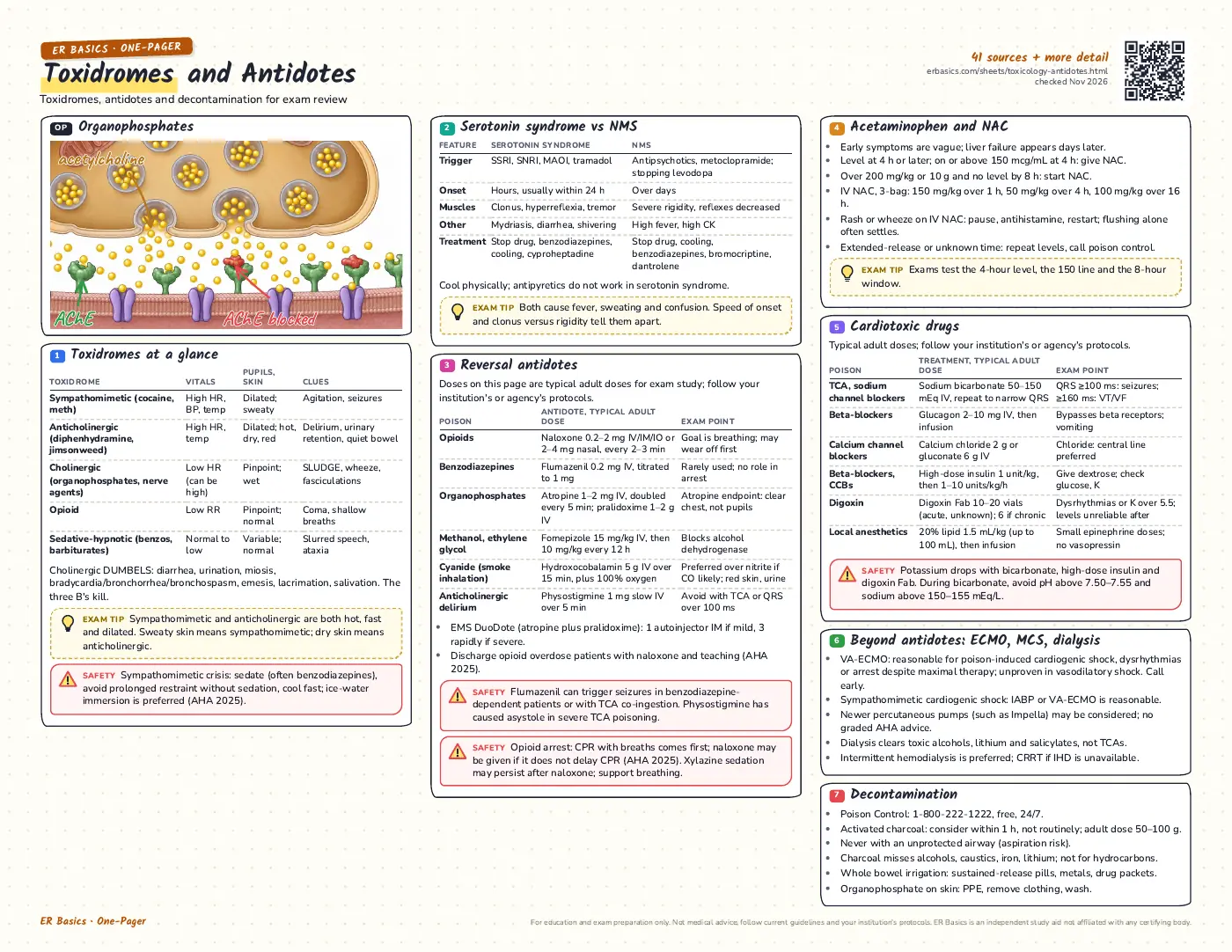
Toxidromes at a glance
| Toxidrome | Vitals | Pupils, skin | Clues |
|---|---|---|---|
| Sympathomimetic (cocaine, meth) | High HR, BP, temp | Dilated; sweaty | Agitation, seizures |
| Anticholinergic (diphenhydramine, jimsonweed) | High HR, temp | Dilated; hot, dry, red | Delirium, urinary retention, quiet bowel |
| Cholinergic (organophosphates, nerve agents) | Low HR (can be high) | Pinpoint; wet | SLUDGE, wheeze, fasciculations |
| Opioid | Low RR | Pinpoint; normal | Coma, shallow breaths |
| Sedative-hypnotic (benzos, barbiturates) | Normal to low | Variable; normal | Slurred speech, ataxia |
Cholinergic DUMBELS: diarrhea, urination, miosis, bradycardia/bronchorrhea/bronchospasm, emesis, lacrimation, salivation. The three B's kill.
Serotonin syndrome vs NMS
| Feature | Serotonin syndrome | NMS |
|---|---|---|
| Trigger | SSRI, SNRI, MAOI, tramadol | Antipsychotics, metoclopramide; stopping levodopa |
| Onset | Hours, usually within 24 h | Over days |
| Muscles | Clonus, hyperreflexia, tremor | Severe rigidity, reflexes decreased |
| Other | Mydriasis, diarrhea, shivering | High fever, high CK |
| Treatment | Stop drug, benzodiazepines, cooling, cyproheptadine | Stop drug, cooling, benzodiazepines, bromocriptine, dantrolene |
Cool physically; antipyretics do not work in serotonin syndrome.
Reversal antidotes
Doses on this page are typical adult doses for exam study; follow your institution's or agency's protocols.
| Poison | Antidote, typical adult dose | Exam point |
|---|---|---|
| Opioids | Naloxone 0.2–2 mg IV/IM/IO or 2–4 mg nasal, every 2–3 min | Goal is breathing; may wear off first |
| Benzodiazepines | Flumazenil 0.2 mg IV, titrated to 1 mg | Rarely used; no role in arrest |
| Organophosphates | Atropine 1–2 mg IV, doubled every 5 min; pralidoxime 1–2 g IV | Atropine endpoint: clear chest, not pupils |
| Methanol, ethylene glycol | Fomepizole 15 mg/kg IV, then 10 mg/kg every 12 h | Blocks alcohol dehydrogenase |
| Cyanide (smoke inhalation) | Hydroxocobalamin 5 g IV over 15 min, plus 100% oxygen | Preferred over nitrite if CO likely; red skin, urine |
| Anticholinergic delirium | Physostigmine 1 mg slow IV over 5 min | Avoid with TCA or QRS over 100 ms |
- EMS DuoDote (atropine plus pralidoxime): 1 autoinjector IM if mild, 3 rapidly if severe.
- Discharge opioid overdose patients with naloxone and teaching (AHA 2025).
Acetaminophen and NAC
- Early symptoms are vague; liver failure appears days later.
- Level at 4 h or later; on or above 150 mcg/mL at 4 h: give NAC.
- Over 200 mg/kg or 10 g and no level by 8 h: start NAC.
- IV NAC, 3-bag: 150 mg/kg over 1 h, 50 mg/kg over 4 h, 100 mg/kg over 16 h.
- Rash or wheeze on IV NAC: pause, antihistamine, restart; flushing alone often settles.
- Extended-release or unknown time: repeat levels, call poison control.
Cardiotoxic drugs
Typical adult doses; follow your institution's or agency's protocols.
| Poison | Treatment, typical adult dose | Exam point |
|---|---|---|
| TCA, sodium channel blockers | Sodium bicarbonate 50–150 mEq IV, repeat to narrow QRS | QRS ≥100 ms: seizures; ≥160 ms: VT/VF |
| Beta-blockers | Glucagon 2–10 mg IV, then infusion | Bypasses beta receptors; vomiting |
| Calcium channel blockers | Calcium chloride 2 g or gluconate 6 g IV | Chloride: central line preferred |
| Beta-blockers, CCBs | High-dose insulin 1 unit/kg, then 1–10 units/kg/h | Give dextrose; check glucose, K |
| Digoxin | Digoxin Fab 10–20 vials (acute, unknown); 6 if chronic | Dysrhythmias or K over 5.5; levels unreliable after |
| Local anesthetics | 20% lipid 1.5 mL/kg (up to 100 mL), then infusion | Small epinephrine doses; no vasopressin |
Beyond antidotes: ECMO, MCS, dialysis
- VA-ECMO: reasonable for poison-induced cardiogenic shock, dysrhythmias or arrest despite maximal therapy; unproven in vasodilatory shock. Call early.
- Sympathomimetic cardiogenic shock: IABP or VA-ECMO is reasonable.
- Newer percutaneous pumps (such as Impella) may be considered; no graded AHA advice.
- Dialysis clears toxic alcohols, lithium and salicylates, not TCAs.
- Intermittent hemodialysis is preferred; CRRT if IHD is unavailable.
Decontamination
- Poison Control: 1-800-222-1222, free, 24/7.
- Activated charcoal: consider within 1 h, not routinely; adult dose 50–100 g.
- Never with an unprotected airway (aspiration risk).
- Charcoal misses alcohols, caustics, iron, lithium; not for hydrocarbons.
- Whole bowel irrigation: sustained-release pills, metals, drug packets.
- Organophosphate on skin: PPE, remove clothing, wash.
In depth
The one-page summary above is what the PDF prints. These sections go further.
The first hour: approach to the poisoned patient
Stabilize first, identify second. Support airway and breathing, check a fingerstick glucose in anyone with altered mental status, and titrate naloxone to breathing, not full arousal. Give thiamine 100 mg IV with dextrose to malnourished or alcohol-dependent patients (Merck). Start continuous ECG and SpO₂, get a 12-lead, measure core temperature and call the poison center (1-800-222-1222) early, one of AHA 2023's top 10 messages.
- Every intentional overdose: acetaminophen (silent early) and salicylate levels, electrolytes with anion gap, measured osmolality, ethanol, venous gas with lactate, CK, ECG and a pregnancy test.
- Co-oximetry (COHb, MetHb) after smoke exposure or for cyanosis with a normal PaO₂; drug levels (digoxin, lithium, valproate, iron) when the history fits.
- Urine immunoassays show exposure, not cause; standard opiate screens miss fentanyl, methadone, buprenorphine and often oxycodone.
A high anion gap points to toxic alcohols, salicylates, metformin, iron, isoniazid, or lactate from cyanide or CO. The osmolar gap is measured osmolality minus (2 × Na + glucose ÷ 18 + BUN ÷ 2.8 + ethanol ÷ 3.7), normally under 10 (Berend 2014). Baseline gaps vary (−2 ± 6 mOsm in 305 ED patients, Hoffman 1993), and the gap shrinks as a toxic alcohol becomes acid, so a normal osmolar gap never excludes one.
| ECG finding | Think of | First move |
|---|---|---|
| QRS ≥100 ms; R in aVR ≥3 mm | TCAs, diphenhydramine, cocaine, flecainide | Sodium bicarbonate bolus |
| QTc over 500 ms, torsades | Methadone, antipsychotics, citalopram, sotalol | Magnesium, potassium, overdrive pacing |
| Bradycardia, AV block | β-blockers, CCBs, digoxin, clonidine, organophosphates | Atropine, then the specific antidote |
| Bidirectional VT; atrial tachycardia with block | Digoxin | Digoxin Fab |
Decontamination, enhanced elimination and ECMO
Activated charcoal is considered for a potentially toxic dose of an adsorbable drug, ideally within 1 h (AACT/EAPCCT 2005), only in a patient who is awake or intubated; the window is often extended for delayed-release products (beyond 4 h for extended-release or high-risk acetaminophen, Dart 2023). Gastric lavage 'should not be performed routinely, if at all' (AACT/EAPCCT 2013).
- Multiple-dose charcoal: only for life-threatening carbamazepine, dapsone, phenobarbital, quinine or theophylline (AACT/EAPCCT 1999); needs a protected airway and a working gut.
- Whole bowel irrigation: polyethylene glycol solution by NG tube until the effluent is clear, for sustained-release or enteric-coated drugs, iron, lithium, potassium and drug packets; not with ileus, obstruction, perforation, instability or an unprotected airway (AACT/EAPCCT 2015).
- Urine alkalinization to pH 7.5 or higher: first-line for salicylate poisoning that does not meet dialysis criteria; hypokalemia is its commonest complication (AACT/EAPCCT 2004).
Extracorporeal removal suits small, water-soluble, weakly protein-bound poisons with a small volume of distribution, not drugs held in tissue or on protein: EXTRIP recommends against it for TCAs, digoxin, calcium channel blockers and propranolol, and suggests it for atenolol or sotalol only with kidney impairment and refractory instability. Intermittent hemodialysis is EXTRIP's preferred modality; CRRT is the fallback.
Metformin-associated lactic acidosis (EXTRIP): extracorporeal treatment is recommended for a lactate above 20 mmol/L, a pH of 7.0 or less, or failure of standard supportive care, and suggested at a lactate above 15 or a pH of 7.1 or less; shock, impaired kidney function, liver failure or a decreased level of consciousness lower the threshold. Intermittent hemodialysis with a bicarbonate bath is preferred first; continuous therapy is considered when hemodialysis is unavailable. The start and stop thresholds differ: treatment continues until the lactate is below 3 mmol/L and the pH above 7.35, so a large fall after one session is not the end point, and a handover states which targets are still unmet.
VA-ECMO supports a structurally normal heart while the liver and kidneys clear the drug. AHA 2023 rates it reasonable (2a) for poison-induced cardiogenic shock, arrest or dysrhythmias refractory to maximal therapy, but unproven (2b) for vasodilatory shock or cellular poisons, which flow does not correct. Evidence is observational: 12 of 14 (86%) ECLS patients survived versus 23 of 48 (48%) treated without it (Masson 2012).
Acetaminophen: nomogram, regimens and stopping rules
CYP2E1 turns a small fraction of each dose into NAPQI, which glutathione neutralizes; in overdose glutathione runs out and NAPQI kills zone 3 hepatocytes. Nausea or nothing on day 1, rising AST and ALT at 24–72 h, peak injury with coagulopathy, encephalopathy and AKI at 72–96 h, recovery after day 5 (Merck). In probable-risk patients, hepatotoxicity was 6.1% when NAC started within 10 h versus 26.4% at 10–24 h (Smilkstein 1988, 2,540 patients).
The US treatment line starts at 150 mcg/mL at 4 h and halves every 4 h; it applies only to a single acute ingestion at a known time, and a level drawn before 4 h cannot be plotted. The 2023 US–Canada consensus (Dart 2023) adds a high-risk line starting at 300 and these rules:
- Extended-release product, or anticholinergic or opioid co-ingestion: repeat a level that is under the line but over 10 mcg/mL 4–6 h later.
- Repeated supratherapeutic ingestion: treat a level over 20 mcg/mL or an abnormal AST/ALT.
- Above the 300 line many clinicians give more NAC; the evidence sets no dose.
| Regimen | Doses | Notes |
|---|---|---|
| IV 3-bag, 21 h | 150 mg/kg over 1 h, 50 over 4 h, 100 over 16 h | US label; reactions cluster in bag 1 |
| IV 2-bag, 20 h | 200 mg/kg over 4 h, then 100 over 16 h | Label option at 41 kg or more; fewer reactions |
| IV SNAP, 12 h | 100 mg/kg over 2 h, then 200 over 10 h | UK trial regimen; not on the US label |
| Oral, 72 h | 140 mg/kg, then 70 mg/kg every 4 h × 17 | Vomiting limits it |
Anaphylactoid reactions (flushing, urticaria, wheeze) are concentration-related histamine release: in SNAP (Bateman 2014, 222 patients) the 12-h regimen cut severe reactions from 31 patients to 5, and vomiting, retching or rescue antiemetic at 2 h from 71 of 109 to 39 of 108. A prior reaction does not rule out NAC in a later overdose (Dart 2023).
NAC does not stop automatically at 20–21 h: stop only when the level is under 10 mcg/mL, INR under 2.0, AST/ALT normal or 25–50% below peak, and the patient is well (Dart 2023; ACMT 2026); otherwise continue the last bag's rate. Hemodialysis is added for a level of 900 mcg/mL or more with acidosis or altered consciousness (Dart 2023). Call a transplant center for arterial pH under 7.30 after resuscitation; INR over 6.5 with creatinine over 3.4 mg/dL and grade III–IV encephalopathy; or lactate over 3.5 mmol/L early or 3.0 after fluids (King's College; Bernal 2002; Merck).
Salicylates, toxic alcohols and lithium
Salicylate stimulates the respiratory center and uncouples oxidative phosphorylation: hyperpnea with a respiratory alkalosis plus high-gap metabolic acidosis, then fever, noncardiogenic pulmonary edema, cerebral edema and low brain glucose despite a normal serum glucose. Enteric-coated tablets delay the peak; repeat levels every 2 h until clearly falling. Chronic toxicity in older adults mimics sepsis or delirium and kills at lower levels.
Alkalinize to a urine pH of 7.5–8.5 (Merck), replace potassium (hypokalemic kidneys cannot make alkaline urine), give dextrose for any neurologic change and involve nephrology early.
| Poison | Dialysis recommended (EXTRIP) | Dialysis suggested |
|---|---|---|
| Salicylate level | Over 100 mg/dL, or over 90 with impaired kidneys | Over 90, or over 80 with impaired kidneys |
| Salicylate, clinical | Altered mental status, new hypoxemia, failed therapy | pH 7.20 or less |
| Methanol, clinical | Coma, seizures, new vision loss, pH ≤7.15, AG over 24 | — |
| Methanol level | Over 70 mg/dL on fomepizole; 50 with no ADH blocker | — |
| Ethylene glycol | Coma, seizures, AKI, anion gap over 27 | AG 23–27; level over 310 mg/dL on fomepizole |
| Lithium (mEq/L) | Over 4.0 with impaired kidneys; coma, seizures, dysrhythmia | Over 5.0, confusion, or over 36 h to reach 1.0 |
Methanol and ethylene glycol are harmless until alcohol dehydrogenase converts them: methanol to formic acid (optic nerve and putamen injury, 'snowfield' vision after a 12–18 h latent period, Merck), ethylene glycol to glycolic acid, most of the gap, and oxalate (calcium oxalate crystals, AKI, hypocalcemia with long QT). Isopropanol becomes acetone: ketosis and an osmolar gap without acidosis. Fomepizole goes to 15 mg/kg every 12 h after four maintenance doses (autoinduction), every 4 h during dialysis, until the level is under 20 mg/dL with a normal pH (label); add folic or folinic acid for methanol, thiamine and pyridoxine for ethylene glycol. On fomepizole, normal kidneys clear ethylene glycol (Brent 1999), but methanol's half-life is 54 h (Brent 2001), so methanol is dialyzed more often.
Lithium (label target 0.8–1.2 mEq/L) is handled like sodium, so dehydration, AKI, thiazides, ACE inhibitors, ARBs and NSAIDs raise levels. Acute overdose in a lithium-naive patient causes vomiting and diarrhea with high levels that redistribute; chronic toxicity causes tremor, hyperreflexia, ataxia, confusion and seizures at lower levels, because lithium is already in the brain. Give isotonic saline, stop interacting drugs, irrigate the bowel for large sustained-release ingestions (charcoal does not bind lithium) and dialyze by EXTRIP; cerebellar deficits can persist (label).
Cardiotoxic drugs: TCAs, β-blockers, CCBs, digoxin, LAST
TCAs block fast sodium channels (wide QRS, VT, low contractility), α1 receptors (hypotension), muscarinic receptors (delirium, tachycardia), potassium channels (long QT) and GABA-A receptors (seizures). In Boehnert 1985 (49 patients), no one with a limb-lead QRS under 100 ms had seizures or ventricular dysrhythmias, 34% at 100 ms or more seized, and ventricular dysrhythmias occurred only at 160 ms or more; a terminal R in aVR of 3 mm or more was 81% sensitive (Liebelt 1995). Deterioration is abrupt; observe at least 6 h with serial ECGs.
Hypertonic sodium bicarbonate works through the sodium load and the alkalemia: AHA 2023 class 1 for TCAs, 2a for other sodium channel blockers (diphenhydramine, flecainide, lamotrigine, venlafaxine). Bolus until the QRS narrows, within AHA's ceilings (pH 7.50–7.55, sodium 150–155). Treat seizures with benzodiazepines, not phenytoin, and never give physostigmine. For refractory cases, lidocaine (class Ia or Ic agents) and lipid emulsion are 2b, VA-ECMO 2a.
β-blockers lower cAMP: bradycardia, AV block, poor contractility and, mainly in children, hypoglycemia; propranolol also blocks sodium channels and sotalol prolongs QT. Verapamil and diltiazem slow the heart and depress output; dihydropyridines dilate arterioles with reflex tachycardia until large doses erase the difference. CCBs block insulin release, so glucose rises with severity (Levine 2007), unlike β-blockers. Sustained-release ingestions can deteriorate late; 24-h observation is common.
| Therapy | β-blocker (AHA 2023) | CCB (AHA 2023) |
|---|---|---|
| Vasopressors | 1 | 1 |
| High-dose insulin | 1 | 1 |
| Calcium | Not graded | 2a |
| Glucagon | 2a | 2b (uncertain) |
| Atropine | 2b | 2a |
| VA-ECMO, refractory shock | 2a | 2a |
| Lipid emulsion | 3: No benefit | 3: No benefit (routine use) |
High-dose insulin is an inotrope: the poisoned myocardium switches to glucose, and insulin lets it in. Give 1 unit/kg with dextrose, then 1–10 units/kg/h (AHA 2023), started early alongside vasopressors because its effect builds slowly. Hypoglycemia and hypokalemia were common in a case series (Holger 2011); typical protocols check glucose every 15–30 min during titration and potassium every 1–2 h.
Digoxin inhibits Na⁺/K⁺-ATPase: hyperkalemia in acute poisoning and increased automaticity with AV block (PVCs, atrial tachycardia with block, bidirectional VT); chronic toxicity adds confusion and yellow-green vision. Before Fab, potassium above 5.5 in acute poisoning predicted death (Bismuth 1973). Fab resolves dysrhythmias in 50–90%, usually within 30–45 min; calcium for the hyperkalemia appears neither harmful nor helpful, and dialysis does not remove digoxin (AHA 2023). After Fab, potassium can fall fast and total digoxin levels mislead for days (label).
Local anesthetic systemic toxicity (LAST) usually starts with perioral numbness, tinnitus, agitation or seizures but can present as dysrhythmia or arrest; bupivacaine is the most cardiotoxic. ASRA 2020: over 70 kg, about 100 mL of 20% lipid over 2–3 min then 250 mL over 15–20 min (under 70 kg, 1.5 mL/kg then 0.25 mL/kg/min); rebolus and double the rate if unstable, up to 12 mL/kg. Benzodiazepines for seizures, epinephrine under 1 mcg/kg, no vasopressin, β-blockers, CCBs or local anesthetics; observe 4–6 h after cardiovascular instability.
Opioids and sympathomimetics
Opioids kill by hypoventilation, hypoxemia and arrest. Fentanyl is 50–100 times as potent as morphine (CDC), acts within minutes, can cause chest-wall rigidity with rapid IV doses and is missed by standard opiate screens; carfentanil and nitazenes may need repeated naloxone. Naloxone's half-life is 30–81 min (label), shorter than methadone or extended-release opioids, so watch for re-sedation: repeat doses or an infusion of two-thirds of the waking dose per hour (AHA 2023), and observe until mental status and vital signs normalize.
Buprenorphine is a high-affinity partial agonist with a ceiling on respiratory depression in adults unless combined with benzodiazepines, alcohol or other sedatives; because it dissociates slowly, reversal needs large naloxone doses (label). After the overdose, ED-initiated buprenorphine kept 78% in treatment at 30 days versus 37% with referral (D'Onofrio 2015), and every patient should leave with naloxone (AHA 2025).
Cocaine, methamphetamine, MDMA and synthetic cathinones kill through hyperthermia, dysrhythmias, coronary vasospasm, stroke, dissection and rhabdomyolysis. Sedate first (benzodiazepines, antipsychotics or ketamine; AHA 2023 class 1), because agitation makes the heat, and cool fast. Cocaine also blocks sodium channels: wide-complex tachycardia gets bicarbonate or lidocaine (2a), and vasospasm gets nitrates, phentolamine or a CCB (2a). β-blockers remain contested, with studies showing both benefit and harm (AHA 2023). MDMA adds hyponatremia from vasopressin release and water loading.
Naloxone in practice: nasal devices, non-response and pulmonary edema
Each naloxone nasal spray device holds a single dose (4 mg in 0.1 mL in the common product) and cannot be primed, tested or reused. If the patient does not respond, or responds and then relapses into respiratory depression, give another dose from a new device every 2 to 3 minutes, alternating nostrils with each dose, until help arrives (label). Naloxone is added to breathing support and does not replace it: a patient with a pulse who is not breathing adequately still needs rescue breaths or bag-mask ventilation between doses.
No response is information. The injection label repeats 0.4 to 2 mg IV every 2 to 3 minutes and states that if 10 mg has been given without a response, the diagnosis of opioid toxicity should be questioned. Coma with pinpoint pupils does not prove an opioid: a large hemorrhage in the posterior fossa (brainstem or cerebellum) can cause pinpoint pupils, stertorous breathing and coma, often after an abrupt headache (Merck). Keep ventilating and look for the other cause instead of giving more naloxone; an intracerebral hemorrhage is diagnosed by CT or MRI of the head.
Abrupt reversal has its own complications: nausea, vomiting, sweating, tachycardia, hypertension, seizures, VT or VF, pulmonary edema and cardiac arrest (label). The pulmonary edema is thought to resemble neurogenic pulmonary edema: a centrally mediated catecholamine surge shifts blood volume into the pulmonary vessels and raises hydrostatic pressure. Most reported events were in patients with cardiovascular disease or on other cardiotoxic drugs, and the label asks that such patients be monitored in a healthcare setting after reversal. Case reports call it noncardiogenic pulmonary edema and cite rates of 0.2% to 3.6% (Jiwa 2018).
| Worse after naloxone | Breathing and mental status | Other clues |
|---|---|---|
| Pulmonary edema after reversal | Usually awake, breathing fast, hypoxemic | Crackles and bilateral infiltrates within minutes to a few hours of the dose |
| Opioid effect returning | Sedation and slow, shallow breathing come back | Long-acting opioid or patch; naloxone half-life 30–81 min |
| Precipitated withdrawal | Awake and agitated | Body aches, sweating, yawning, vomiting, diarrhea, tachycardia |
Treatment of the edema is supportive: oxygen, and noninvasive or invasive ventilation if the hypoxemia requires it. In the case reports cited here the patients needed bilevel NIV or a few hours of mechanical ventilation, were also given furosemide, and improved quickly, with extubation after 6 to 7 hours in two of them (Jiwa 2018; Al-Azzawi 2021). A fourth patient, managed with oxygen by nasal cannula and furosemide, was on room air by the third day (Elkattawy 2021).
Opioids that outlast naloxone: fentanyl patches and gabapentinoids
A fentanyl patch is worn for 72 hours and delivers the drug through the skin, and heat speeds delivery. Heat applied over the patch raised mean fentanyl exposure by 120% and the average peak level by 61% in healthy adults, and a body temperature of 40 °C could raise serum levels by about one-third (label). Heating pads, electric blankets, heat lamps, hot baths, saunas, hot tubs and sunbathing over a patch have caused fatal overdose, and a patient who develops a fever while wearing one is watched closely for sedation and respiratory depression.
Overdose in a patient wearing a patch: airway and ventilation first, naloxone for clinically significant respiratory or circulatory depression, then examine the patient and remove every patch. Fentanyl keeps being absorbed from the skin after removal, so serum levels fall only about 50% in 20 to 27 hours. Naloxone wears off long before that, so respiratory depression can return, and the label calls for monitoring for at least 72 to 96 hours beyond the overdose.
Gabapentin and pregabalin add to opioid respiratory depression. FDA warned in December 2019 of serious breathing problems in patients with respiratory risk factors: an opioid or another CNS depressant, a condition that reduces lung function such as COPD, and older age. It advises starting the gabapentinoid at the lowest dose and monitoring for sedation and respiratory depression when it is given with an opioid or a benzodiazepine. Warning signs are confusion, unusual dizziness, extreme sleepiness and slow, shallow or difficult breathing, so new confusion or sleepiness with slow, shallow breathing in a patient who takes a gabapentinoid with an opioid, or who has lung disease, should bring the drug to mind. Management is close observation, supportive care, and reducing or stopping the CNS depressants, the gabapentinoid included (pregabalin label).
Aspirated and inhaled poisons: hydrocarbons and ammonia
Swallowed petroleum distillates (gasoline, kerosene, lamp oil, paint thinner) cause little systemic toxicity; the danger is aspiration pneumonitis. Risk depends mainly on viscosity: thin liquids such as gasoline and mineral spirits spread quickly over a large surface and are the most likely to be aspirated (Merck). Coughing, choking or vomiting right after the swallow is the usual first sign.
- Timing: signs of pneumonitis can appear a few hours before infiltrates show on a radiograph, so oximetry and a chest radiograph are done about 6 hours after the ingestion, sooner if symptoms are severe.
- Disposition: a patient with no pneumonitis and no other symptoms after 4 to 6 hours is discharged; a patient with symptoms is admitted for supportive care. Correct electrolyte abnormalities, particularly hypokalemia, before discharge.
- Do not empty the stomach (it raises the risk of aspiration); charcoal is not recommended; antibiotics and corticosteroids are not indicated (Merck).
- Inhaled (huffed) halogenated hydrocarbons sensitize the heart to catecholamines and can cause sudden VF: standard ACLS, with cautious use of epinephrine (Merck).
For irritant gases, water solubility decides where the injury is and how soon it shows. Highly soluble gases (ammonia, chlorine, sulfur dioxide, hydrogen chloride) dissolve in the upper airway and irritate at once, which warns the patient to escape; heavy exposure adds laryngospasm, pulmonary edema and ARDS. Poorly soluble gases (phosgene, nitrogen dioxide) spare the upper airway, give little warning and injure the lower airway after a lag of several hours (Merck).
Ammonia dissolves in the moisture of the eyes and airway to form ammonium hydroxide, an alkali that burns on contact: burning eyes, nose and throat, tearing, runny nose and cough begin rapidly, and upper airway swelling or pulmonary edema can obstruct the airway. There is no antidote. Treatment is humidified oxygen, bronchodilators for bronchospasm, airway management and copious irrigation of the eyes and skin (ATSDR). In the emergency department, patients treated for an inhalation exposure are observed for 6 to 12 hours for signs of upper airway obstruction, a chest radiograph and oximetry or blood gases are advised after a severe exposure, and lung injury can keep evolving over 18 to 24 hours. A patient exposed only to the gas who has no symptoms, or whose mild symptoms have been treated, may be released with instructions to seek care promptly if symptoms develop or recur (ATSDR).
A high potassium during a resuscitation: cause or consequence?
Timing separates the two. A potassium of 6.5 mmol/L or more before or early in a resuscitation makes hyperkalemia a potential cause of the arrest, to be treated as a reversible cause. Hyperkalemia that first appears late in a long resuscitation may be the consequence of progressive acidosis and hypoxia, and may not be the precipitant of the arrest or need specific treatment (UK Kidney Association 2026). The team keeps up high-quality CPR and ventilation and keeps looking for and treating the other reversible causes.
Related points elsewhere in the app: AHA 2025 rates calcium and bicarbonate for hyperkalemic arrest only as therapies that may be considered (ACLS Algorithms sheet); in acute digoxin poisoning an early high potassium marks severity and calls for Fab (above); and the potassium cutoff once used to judge futility, above 12 mmol/L, belongs to hypothermic arrest (Hypothermia, Heat Stroke and Drowning sheet).
Serotonin toxicity, NMS and malignant hyperthermia
| Feature | Serotonin toxicity | NMS | Malignant hyperthermia |
|---|---|---|---|
| Trigger | Serotonergic drug started, raised or combined | Dopamine blocker, or stopping levodopa | Volatile anesthetic or succinylcholine |
| Onset | Usually within 6 h (Merck) | Over days; most in the first 2 weeks | During or soon after anesthesia |
| Tone, reflexes | Clonus and hyperreflexia, legs more than arms | Lead-pipe rigidity, sluggish reflexes | Masseter or generalized rigidity |
| Early clue | Agitation, tremor, diarrhea, mydriasis | Confusion, labile BP, high CK | EtCO₂ rising despite more ventilation |
| Specific drug | Cyproheptadine, weak evidence | Bromocriptine or amantadine; dantrolene | Dantrolene 2.5 mg/kg, repeated |
| Course | Usually 24–72 h after stopping (Merck) | Days; about 5% die by 30 days (Merck) | ICU for at least 24 h (MHAUS) |
Hunter criteria (Dunkley 2003; 84% sensitive, 97% specific): with a serotonergic drug, any of spontaneous clonus; inducible or ocular clonus with agitation or diaphoresis; tremor with hyperreflexia; or hypertonia with temperature above 38 °C plus ocular or inducible clonus. Anticholinergic toxicity has normal tone and reflexes with dry skin. Stop the drugs, give benzodiazepines and cool physically; with temperature above 39 °C plus rigidity or agitation (Chiew and Isbister 2025; IBCC uses about 41 °C), intubate and paralyze with a nondepolarizing agent, never succinylcholine.
Malignant hyperthermia is a pharmacogenetic crisis: an RYR1 variant floods muscle with calcium on exposure to a trigger. MHAUS: stop triggers, hyperventilate with 100% oxygen at 10 L/min, give dantrolene 2.5 mg/kg IV and repeat until signs resolve (more than 10 mg/kg is occasionally needed), cool above 39 °C and stop below 38 °C, treat hyperkalemia, and call the hotline (1-800-644-9737).
Carbon monoxide, cyanide, methemoglobin and organophosphates
CO displaces oxygen from hemoglobin, shifts the dissociation curve left and impairs mitochondrial respiration. Standard pulse oximeters read COHb as oxyhemoglobin, so SpO₂ and PaO₂ look normal; diagnose by co-oximetry. COHb half-life is about 4.5 h on room air, 1.5 h on 100% oxygen and 20 min at 3 atm (Merck). Consider hyperbaric oxygen for loss of consciousness, neurologic or cardiac findings, COHb over 25%, or pregnancy at lower levels (Merck). In Weaver 2002 (152 patients) three hyperbaric sessions cut 6-week cognitive sequelae from 46% to 25%; other trials were negative (Scheinkestel 1999, Annane 2011).
Cyanide blocks cytochrome oxidase, so cells cannot use oxygen: lactate climbs and venous blood stays bright red. In fire victims a lactate over 10 mmol/L was a sensitive marker of toxic cyanide levels (Baud 1991). Give hydroxocobalamin on suspicion (AHA 2023 class 1) with 100% oxygen; a second 5 g dose may follow (label). It reddens skin and urine (urine for up to 35 days), disturbs colorimetric labs and dialysis blood-leak detectors, and raises BP.
Methemoglobinemia (benzocaine sprays, dapsone, nitrites) gives chocolate-brown blood and an SpO₂ near 85%; methylene blue 1–2 mg/kg is class 1 (AHA 2023) but may fail or cause hemolysis in G6PD deficiency (about 2% of Americans).
Organophosphates inhibit acetylcholinesterase, producing muscarinic, nicotinic (fasciculations, weakness, paralysis) and CNS effects. The inhibited enzyme 'ages' into a permanent form, while carbamates release it within about 48 h (Merck). Atropinize to a clear chest, HR over 80 and SBP over 80, then infuse 10–20% of the loading dose per hour, up to 2 mg/h in adults (AHA 2023). Pralidoxime is 'reasonable' (2a), yet in a 235-patient placebo-controlled trial mortality was 24.8% with it and 15.8% without (Eddleston 2009, not significant). Intubate early with rocuronium, not succinylcholine; the intermediate syndrome (neck flexor, proximal, cranial nerve and respiratory weakness) follows at 24–96 h (Senanayake 1987).
Withdrawal syndromes in brief
Withdrawal mimics sepsis, serotonin toxicity and NMS; ask about home drugs, pumps and last doses.
| Withdrawal | Timing | Dangers | Treatment |
|---|---|---|---|
| Alcohol | Tremor by 6 h, seizures 6–48 h, DTs 48–72 h | Seizures, delirium tremens | Benzodiazepines or phenobarbital; thiamine |
| Benzodiazepine | Days; later with long-acting drugs | Seizures, delirium | Reload, then slow taper |
| Intrathecal baclofen | Hours to days after pump or catheter failure | Fever, rigidity, rhabdomyolysis, death | Restore intrathecal dosing; oral baclofen, benzodiazepines |
| Opioid | Hours (fentanyl, heroin) to days (methadone) | Rarely life-threatening in adults | Buprenorphine or methadone; clonidine |
Exam pearls
- Every intentional overdose gets an acetaminophen level; plot only levels drawn at 4 h or later.
- Salicylates: respiratory alkalosis plus high-gap acidosis; never let PaCO₂ rise after intubation.
- QRS ≥100 ms or R in aVR ≥3 mm: sodium bicarbonate; no physostigmine for TCAs.
- CCB poisoning raises glucose; high-dose insulin needs dextrose and potassium checks.
- Digoxin: acute hyperkalemia or bidirectional VT calls for Fab; levels mislead after Fab.
- Toxic alcohols: osmolar gap early, anion gap late; methanol blinds, ethylene glycol makes oxalate crystals and AKI.
- CO: normal SpO₂ and PaO₂; COHb half-life about 4.5 h on air, 1.5 h on 100% oxygen.
- Organophosphates: atropine until the chest is dry, not to pupil size; avoid succinylcholine.
- Serotonin toxicity is fast with clonus; NMS is slow with rigidity; malignant hyperthermia starts with rising EtCO₂.
Related cheat sheets
- Neuro: ICP and StrokeICP, herniation, EVD care, osmotics, GCS, stroke and seizures
- Subarachnoid HemorrhageAneurysmal SAH: diagnosis, grading, rebleeding, nimodipine, vasospasm and DCI, sodium and nursing care
- Meningitis and EncephalitisFirst-hour care, empiric antibiotics, dexamethasone, CT before LP, CSF patterns, HSV and autoimmune encephalitis, isolation and ICU complications
- Myasthenic Crisis and Guillain-Barré SyndromeNeuromuscular respiratory failure, NIV or intubation, IVIG and plasma exchange, crisis drugs and ICU care
- Sedation, Pain and Delirium ScalesRASS, CPOT, BPS, CAM-ICU, ICDSC, SAT/SBT, and PADIS 2018 with the 2025 update
- Mental Health: Meds and CommunicationPsychotropic classes, serotonin syndrome vs NMS, therapeutic communication, suicide safety, restraints and alcohol withdrawal
Calculators for this topic
Sources
- Lavonas EJ, et al. 2023 American Heart Association Focused Update on the Management of Patients With Cardiac Arrest or Life-Threatening Toxicity Due to Poisoning. Circulation. 2023;148:e149–e184. Link
- Heart and Stroke Foundation of Canada. Highlights of the 2025 American Heart Association Guidelines for CPR and ECC (Heart & Stroke edition). Link
- Cao D, et al. Part 10: Adult and Pediatric Special Circumstances of Resuscitation: 2025 AHA Guidelines for CPR and ECC. Circulation. 2025;152(16 suppl 2):S578–S672 (PubMed record). Link
- America's Poison Centers. Poison Help. Link
- Dart RC, et al. Management of Acetaminophen Poisoning in the US and Canada: A Consensus Statement. JAMA Netw Open. 2023;6(8):e2327739. Link
- ACETADOTE (acetylcysteine) injection prescribing information, DailyMed (Dosage and Administration revised 11/2024; label rev. 7/2025). Link
- Flumazenil Injection, USP prescribing information, DailyMed (rev. 7/2026). Link
- Fomepizole injection prescribing information, DailyMed. Link
- CYANOKIT (hydroxocobalamin) prescribing information, DailyMed (rev. 5/2023). Link
- DIGIFAB (digoxin immune fab) prescribing information, DailyMed. Link
- Naloxone hydrochloride injection prescribing information, DailyMed. Link
- DUODOTE (atropine and pralidoxime chloride) prescribing information, DailyMed (rev. 6/2022). Link
- Utah Poison Control Center. Physostigmine (Antilirium) fact sheet, updated 11/8/2023. Link
- Merck Manual Professional Edition. General Principles of Poisoning (last updated 3/2026). Link
- Merck Manual Professional Edition. Organophosphate and Carbamate Poisoning (last updated 4/2025). Link
- Merck Manual Professional Edition. Hydrocarbon Poisoning. Link
- Merck Manual Professional Edition. Benzodiazepines and Barbiturates. Link
- Merck Manual Professional Edition. Serotonin Syndrome (last updated 5/2025). Link
- Merck Manual Professional Edition. Neuroleptic Malignant Syndrome (last updated 11/2025). Link
- Farkas J. Serotonin syndrome. Internet Book of Critical Care (EMCrit). Link
- American Society of Regional Anesthesia and Pain Medicine. Checklist for Treatment of Local Anesthetic Systemic Toxicity, 2020 v1.1. Link
- EXTRIP Workgroup. Metformin recommendations (indications, modality and cessation criteria). Link
- EXTRIP Workgroup. Salicylates recommendations. Link
- EXTRIP Workgroup. Methanol recommendations. Link
- EXTRIP Workgroup. Ethylene glycol recommendations. Link
- EXTRIP Workgroup. Lithium recommendations. Link
- EXTRIP Workgroup. Tricyclic antidepressants recommendations. Link
- Boehnert MT, Lovejoy FH Jr. Value of the QRS duration versus the serum drug level in predicting seizures and ventricular arrhythmias after an acute overdose of tricyclic antidepressants. N Engl J Med. 1985;313:474–479. Link
- Chyka PA, et al. Position paper: Single-dose activated charcoal (AACT/EAPCCT). Clin Toxicol. 2005;43:61–87. Link
- CDC. Xylazine Clinical Management and Harm Reduction fact sheet. Link
- NARCAN (naloxone hydrochloride) nasal spray prescribing information, DailyMed (Emergent Devices; label version of December 2025). Link
- Fentanyl transdermal system prescribing information, DailyMed (SpecGx; label version of April 2026). Link
- FDA Drug Safety Communication. Neurontin, Gralise, Horizant (gabapentin) and Lyrica, Lyrica CR (pregabalin): Serious Breathing Problems. Posted December 19, 2019. Link
- LYRICA (pregabalin) prescribing information, DailyMed (section 5.4, Respiratory Depression). Link
- Jiwa N, Sheth H, Silverman R. Naloxone-Induced Non-Cardiogenic Pulmonary Edema: A Case Report. Drug Saf Case Rep. 2018;5(1):20. Link
- Al-Azzawi M, Alshami A, Douedi S, et al. Naloxone-Induced Acute Pulmonary Edema is Dose-Dependent: A Case Series. Am J Case Rep. 2021;22:e929412. Link
- Elkattawy S, Alyacoub R, Ejikeme C, Noori MAM, Remolina C. Naloxone induced pulmonary edema. J Community Hosp Intern Med Perspect. 2021;11(1):139–142. Link
- Merck Manual Professional Edition. Intracerebral Hemorrhage (last updated 12/2025). Link
- Merck Manual Professional Edition. Irritant Gas Inhalation Injury (last updated 5/2026). Link
- Agency for Toxic Substances and Disease Registry (ATSDR). Medical Management Guidelines for Ammonia. Link
- Alfonzo A, Harrison A, Baines R, et al. UK Kidney Association Clinical Practice Guidelines: Treatment of Acute Hyperkalaemia in Adults. Updated July 2026. Link