 ER Basics
Cheat Sheet
Preventing ICU Infections
CLABSI, CAUTI, VAE, C. difficile and MDRO bundles, isolation by organism, hand hygiene and quality measures
Practice 8 Preventing ICU Infections questions free
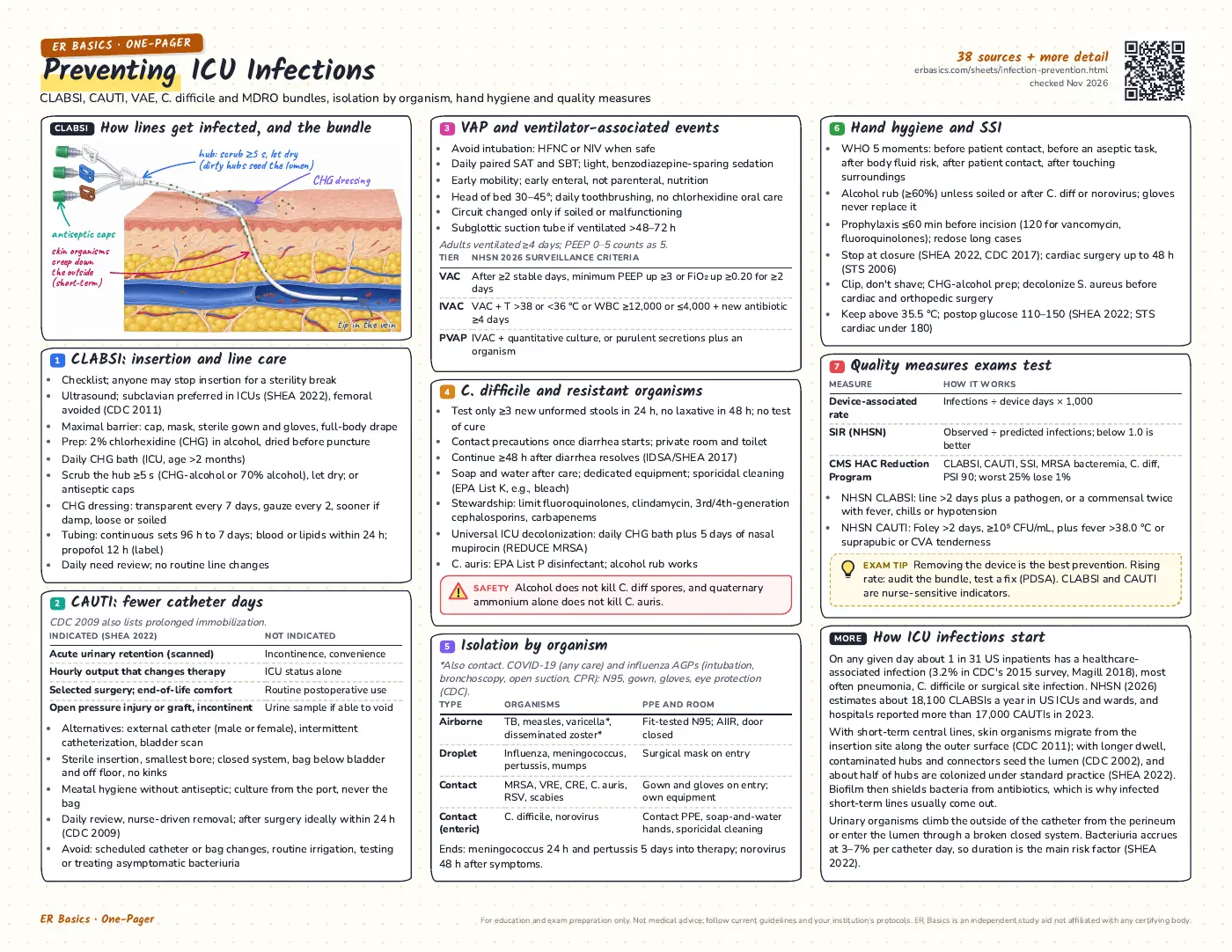
CLABSI: insertion and line care
- Checklist; anyone may stop insertion for a sterility break
- Ultrasound; subclavian preferred in ICUs (SHEA 2022), femoral avoided (CDC 2011)
- Maximal barrier: cap, mask, sterile gown and gloves, full-body drape
- Prep: 2% chlorhexidine (CHG) in alcohol, dried before puncture
- Daily CHG bath (ICU, age >2 months)
- Scrub the hub ≥5 s (CHG-alcohol or 70% alcohol), let dry; or antiseptic caps
- CHG dressing: transparent every 7 days, gauze every 2, sooner if damp, loose or soiled
- Tubing: continuous sets 96 h to 7 days; blood or lipids within 24 h; propofol 12 h (label)
- Daily need review; no routine line changes
CAUTI: fewer catheter days
| Indicated (SHEA 2022) | Not indicated |
|---|---|
| Acute urinary retention (scanned) | Incontinence, convenience |
| Hourly output that changes therapy | ICU status alone |
| Selected surgery; end-of-life comfort | Routine postoperative use |
| Open pressure injury or graft, incontinent | Urine sample if able to void |
- Alternatives: external catheter (male or female), intermittent catheterization, bladder scan
- Sterile insertion, smallest bore; closed system, bag below bladder and off floor, no kinks
- Meatal hygiene without antiseptic; culture from the port, never the bag
- Daily review, nurse-driven removal; after surgery ideally within 24 h (CDC 2009)
- Avoid: scheduled catheter or bag changes, routine irrigation, testing or treating asymptomatic bacteriuria
VAP and ventilator-associated events
- Avoid intubation: HFNC or NIV when safe
- Daily paired SAT and SBT; light, benzodiazepine-sparing sedation
- Early mobility; early enteral, not parenteral, nutrition
- Head of bed 30–45°; daily toothbrushing, no chlorhexidine oral care
- Circuit changed only if soiled or malfunctioning
- Subglottic suction tube if ventilated >48–72 h
| Tier | NHSN 2026 surveillance criteria |
|---|---|
| VAC | After ≥2 stable days, minimum PEEP up ≥3 or FiO₂ up ≥0.20 for ≥2 days |
| IVAC | VAC + T >38 or <36 °C or WBC ≥12,000 or ≤4,000 + new antibiotic ≥4 days |
| PVAP | IVAC + quantitative culture, or purulent secretions plus an organism |
C. difficile and resistant organisms
- Test only ≥3 new unformed stools in 24 h, no laxative in 48 h; no test of cure
- Contact precautions once diarrhea starts; private room and toilet
- Continue ≥48 h after diarrhea resolves (IDSA/SHEA 2017)
- Soap and water after care; dedicated equipment; sporicidal cleaning (EPA List K, e.g., bleach)
- Stewardship: limit fluoroquinolones, clindamycin, 3rd/4th-generation cephalosporins, carbapenems
- Universal ICU decolonization: daily CHG bath plus 5 days of nasal mupirocin (REDUCE MRSA)
- C. auris: EPA List P disinfectant; alcohol rub works
Isolation by organism
| Type | Organisms | PPE and room |
|---|---|---|
| Airborne | TB, measles, varicella*, disseminated zoster* | Fit-tested N95; AIIR, door closed |
| Droplet | Influenza, meningococcus, pertussis, mumps | Surgical mask on entry |
| Contact | MRSA, VRE, CRE, C. auris, RSV, scabies | Gown and gloves on entry; own equipment |
| Contact (enteric) | C. difficile, norovirus | Contact PPE, soap-and-water hands, sporicidal cleaning |
Ends: meningococcus 24 h and pertussis 5 days into therapy; norovirus 48 h after symptoms.
Hand hygiene and SSI
- WHO 5 moments: before patient contact, before an aseptic task, after body fluid risk, after patient contact, after touching surroundings
- Alcohol rub (≥60%) unless soiled or after C. diff or norovirus; gloves never replace it
- Prophylaxis ≤60 min before incision (120 for vancomycin, fluoroquinolones); redose long cases
- Stop at closure (SHEA 2022, CDC 2017); cardiac surgery up to 48 h (STS 2006)
- Clip, don't shave; CHG-alcohol prep; decolonize S. aureus before cardiac and orthopedic surgery
- Keep above 35.5 °C; postop glucose 110–150 (SHEA 2022; STS cardiac under 180)
Quality measures exams test
| Measure | How it works |
|---|---|
| Device-associated rate | Infections ÷ device days × 1,000 |
| SIR (NHSN) | Observed ÷ predicted infections; below 1.0 is better |
| CMS HAC Reduction Program | CLABSI, CAUTI, SSI, MRSA bacteremia, C. diff, PSI 90; worst 25% lose 1% |
- NHSN CLABSI: line >2 days plus a pathogen, or a commensal twice with fever, chills or hypotension
- NHSN CAUTI: Foley >2 days, ≥10⁵ CFU/mL, plus fever >38.0 °C or suprapubic or CVA tenderness
In depth
The one-page summary above is what the PDF prints. These sections go further.
How ICU infections start
On any given day about 1 in 31 US inpatients has a healthcare-associated infection (3.2% in CDC's 2015 survey, Magill 2018), most often pneumonia, C. difficile or surgical site infection. NHSN (2026) estimates about 18,100 CLABSIs a year in US ICUs and wards, and hospitals reported more than 17,000 CAUTIs in 2023.
With short-term central lines, skin organisms migrate from the insertion site along the outer surface (CDC 2011); with longer dwell, contaminated hubs and connectors seed the lumen (CDC 2002), and about half of hubs are colonized under standard practice (SHEA 2022). Biofilm then shields bacteria from antibiotics, which is why infected short-term lines usually come out.
Urinary organisms climb the outside of the catheter from the perineum or enter the lumen through a broken closed system. Bacteriuria accrues at 3–7% per catheter day, so duration is the main risk factor (SHEA 2022).
An endotracheal tube holds the cords apart, so secretions pooled above the cuff leak past it and the tube grows biofilm; sedation, lying flat and a weak cough remove the rest of the defenses. VAP's attributable mortality is about 13%, highest in surgical patients and near zero in trauma and medical patients (Melsen 2013).
C. difficile spores on hands, rails and equipment resist alcohol; antibiotics that strip the colonic flora let swallowed spores germinate and release toxins A and B. MRSA, VRE and CRE spread the same way, and every antibiotic course selects for them.
Surveillance definitions and quality measures
NHSN definitions are built for consistent counting, not bedside diagnosis. An infection is device-associated only when the device had been in more than 2 consecutive calendar days and was present on the event date or the day before.
| Event | NHSN criteria (January 2026) |
|---|---|
| CLABSI | Eligible central line >2 days; LCBI not from another site |
| LCBI 1 | Recognized pathogen in ≥1 blood culture |
| LCBI 2 | Same commensal in ≥2 draws + fever, chills or hypotension |
| Not central lines | Arterial lines (unless PA or aorta), ECMO, IABP, VAD |
| CAUTI | Foley >2 days, in place or removed the day before |
| CAUTI culture | ≤2 species, at least one bacterium ≥10⁵ CFU/mL |
| CAUTI signs | Fever >38.0 °C, suprapubic or CVA tenderness |
Rates are infections per 1,000 device days. The standardized infection ratio (SIR) divides observed by predicted infections from national NHSN data for similar units, so an SIR below 1.0 beats the prediction; the standardized utilization ratio does the same for device days (SHEA 2022).
Since October 2008 Medicare pays nothing extra for CAUTI, vascular catheter infection or certain surgical site infections (mediastinitis after CABG, some orthopedic and bariatric operations) not present on admission. The HAC Reduction Program scores CLABSI, CAUTI, colon and hysterectomy SSI, MRSA bacteremia, C. difficile and the PSI 90 composite; the worst-scoring quartile loses 1% of Medicare payments (CMS 2026). CLABSI and CAUTI are classic nurse-sensitive indicators, benchmarked in NDNQI.
CLABSI: the evidence behind the bundle
In the Keystone ICU project (Pronovost 2006), a checklist of five practices (hand hygiene, maximal barriers, chlorhexidine prep, avoiding the femoral site, removing unneeded lines) cut the mean rate in 103 Michigan ICUs from 7.7 to 1.4 per 1,000 catheter days, a sustained drop of up to 66%.
In 3SITES (Parienti 2015; 3,471 ICU catheters), bloodstream infection plus symptomatic thrombosis ran 1.5, 3.6 and 4.6 per 1,000 catheter days for subclavian, jugular and femoral lines, but subclavian lines caused more pneumothorax needing a chest tube (1.5% vs 0.5% jugular). SHEA 2022 prefers subclavian in the ICU and CDC 2011 says avoid femoral in adults; ultrasound mainly prevents mechanical complications, and PICCs are not a CLABSI-prevention strategy (SHEA 2022).
Chlorhexidine-alcohol beat povidone-iodine-alcohol for skin prep (CLEAN, Mimoz 2015: 0.28 vs 1.77 infections per 1,000 catheter days). Chlorhexidine sponge dressings cut major catheter-related infection from 1.1% to 0.5%, and 7-day changes were noninferior to 3-day changes for colonization (Timsit 2009). Daily chlorhexidine bathing reduced hospital-acquired bloodstream infection by 28% (Climo 2013), but a 9,340-patient trial found no change in combined device infections and C. difficile (Noto 2015); SHEA 2022 still grades ICU bathing essential, with resistance an open question.
Scrub hubs and connectors with alcoholic chlorhexidine (preferred) or 70% alcohol for at least 5 seconds and let them dry, or use antiseptic caps (SHEA 2022). In RSVP (Rickard 2021; 2,944 patients), 7-day administration sets matched 4-day sets (catheter-related bloodstream infection with central lines 1.78% vs 1.46%); CDC 2011 keeps 24 h for blood products and lipids and changes needleless connectors no more often than every 72 h. SHEA 2022 also grades adequate nurse staffing and fewer float nurses in ICUs as high-quality evidence.
Arterial lines cause about 0.96 bloodstream infections per 1,000 catheter days, femoral about twice radial (O'Horo 2014): use a cap, mask, sterile gloves and a small fenestrated drape for radial lines, maximal barriers for femoral or axillary lines, and change transducer systems every 96 h (CDC 2011).
CAUTI: indications, care and urine stewardship
Up to half of hospital catheters may lack a valid indication (SHEA 2022). In the ICU, hourly output justifies a catheter only while the number changes treatment (resuscitation, diuresis, vasopressor titration), not for ICU status alone. Acute retention is a scanned post-void residual over 500 mL without symptoms or over 300 mL with them (SHEA 2022). CDC 2009 also lists prolonged immobilization (unstable spine, pelvic fractures), which SHEA 2022 dropped. A catheter placed only because surgery is long comes out at the end of the case (SHEA 2022); other postoperative catheters come out as soon as possible, ideally within 24 h (CDC 2009).
Removal is what works: reminders and stop orders cut CAUTI by 52%, and stop orders shortened catheterization (Meddings 2010 meta-analysis), and a national program lowered non-ICU rates from 2.28 to 1.54 per 1,000 catheter days but not ICU rates (Saint 2016). Nurse-driven protocols remove the catheter once no indication remains, then watch voiding with a bladder scanner and intermittent catheterization for retention.
Secure the catheter against traction, keep the bag below the bladder and off the floor, keep tubing unkinked, empty it into a clean container for each patient without the spigot touching, and replace catheter and bag only for infection, obstruction, leaks or a broken system. Routine meatal hygiene is enough; CDC 2009 advises against antiseptic meatal cleaning (SHEA 2022: unresolved). External catheters avoid the urethra, but their skin injury and infection rates are still being defined (SHEA 2022).
Culture urine only for fever, altered mental status or new sepsis without another source, flank pain, acute hematuria or new pelvic discomfort; cloudy or foul urine and pyuria alone are not indications, and asymptomatic bacteriuria is not screened for or treated except in pregnancy or before endoscopic urologic procedures (SHEA 2022). Take the sample from the disinfected port, never the bag, and send it within about an hour or refrigerate it (up to 24 h).
VAP and ventilator-associated events
NHSN moved adults from VAP to VAE surveillance in 2013 because VAP definitions rest on subjective chest films and signs; most VACs prove to be pneumonia, ARDS, atelectasis or pulmonary edema. Patients must be ventilated at least 4 calendar days, the daily minimum is the lowest setting held over 1 h, and PEEP 0–5 counts as 5, so a patient on PEEP 5 must reach 8 (NHSN 2026).
IVAC needs, within 2 days of the worsening, a temperature over 38 °C or under 36 °C or a WBC ≥12,000 or ≤4,000, plus a new antimicrobial continued ≥4 days. PVAP adds a quantitative culture (endotracheal aspirate ≥10⁵ CFU/mL, BAL ≥10⁴, protected brush ≥10³), purulent secretions (≥25 neutrophils and ≤10 squamous cells per low-power field) with an organism, or a positive pleural fluid, histology, Legionella or respiratory virus test; Candida, coagulase-negative staphylococci and enterococci from airway samples do not count.
| SHEA 2022 | Practice (adults) | Evidence |
|---|---|---|
| Essential | Avoid intubation (HFNC or NIV); minimize sedation; SAT/SBT | High |
| Essential | Early exercise and mobilization | Moderate |
| Essential | Head of bed 30–45° | Low |
| Essential | Toothbrushing without chlorhexidine | Moderate |
| Essential | Early enteral nutrition; circuit change only if soiled | High |
| Additional | Subglottic drainage if >48–72 h; early tracheostomy | Moderate |
| Additional | Selective digestive decontamination, low-resistance ICUs | High |
| Not routine | CHG oral care, probiotics, silver tubes, automatic cuff control | Moderate |
| Not recommended | Stress ulcer prophylaxis, gastric residual checks, early TPN | Moderate |
Chlorhexidine oral care lowered VAP mainly after cardiac surgery, not in double-blind studies of other patients, with a nonsignificant mortality signal (Klompas 2014); toothbrushing was associated with less hospital-acquired pneumonia (RR 0.67) and lower ICU mortality (RR 0.81) across 15 trials (Ehrenzeller 2024). The older IHI ventilator bundle also listed stress ulcer and DVT prophylaxis and, from 2010, chlorhexidine oral care; keep the prophylaxis for its own indications, but it does not prevent VAP.
A subglottic drainage tube is chosen when the patient is intubated. SHEA 2022 says to consider one for patients likely to need more than 48–72 h of intubation, such as emergency in-hospital intubations and preoperative patients at risk of prolonged ventilation; in meta-analysis these tubes cut VAP by 44% with no clear effect on ventilator days, length of stay or mortality. Extubation followed by immediate reintubation to exchange a conventional tube for a subglottic drainage tube is not recommended: keep the tube that is in place and continue the essential practices.
At the bedside: cuff pressure 20–30 cm H₂O, suction the mouth and subglottic port before moving the tube or deflating the cuff, and drain ventilator condensate away from the patient (CDC 2003).
C. difficile: testing, precautions and treatment
C. difficile causes more than 450,000 US infections a year, with attributable mortality of 4.5–5.7% in endemic periods and recurrence in 10–30% (SHEA 2022). About 8% of patients carry it on admission, so testing formed stool or laxative diarrhea finds colonization: test only new, unexplained diarrhea of ≥3 unformed stools in 24 h, not within 48 h of a laxative or 7 days of a prior test, and never as a test of cure (IDSA/SHEA 2017, SHEA 2022).
Start contact precautions when diarrhea is recognized, before the result, in a single room with its own toilet, and continue at least 48 h after it resolves, or until discharge if CDI rates stay high (IDSA/SHEA 2017). Gloves are the main hand protection. Soap and water removes spores mechanically: IDSA/SHEA 2017 prefers it in outbreaks and accepts either method otherwise, SHEA 2022 calls it preferred after CDI care but notes overall hand hygiene can fall, and exams expect soap and water.
Dedicate equipment, and clean daily and at discharge with a sporicidal EPA List K product such as 1:10 bleach, which SHEA 2022 supports for outbreaks and high-rate units; UV or hydrogen peroxide systems and probiotics remain unproven. Stewardship is the strongest lever (30–50% fewer CDIs in meta-analyses): limit fluoroquinolones, clindamycin, third- and fourth-generation cephalosporins and carbapenems, and stop unneeded proton pump inhibitors, although that alone is unproven (IDSA/SHEA 2017).
| Severity (IDSA/SHEA 2017) | Criteria | Treatment |
|---|---|---|
| Non-severe | WBC ≤15,000 and creatinine <1.5 mg/dL | Fidaxomicin 200 mg BID or vancomycin 125 mg QID, 10 days |
| Severe | WBC ≥15,000 or creatinine >1.5 mg/dL | Same drugs; fidaxomicin preferred for both (2021 update) |
| Fulminant | Hypotension or shock, ileus or megacolon | Vancomycin 500 mg QID PO/NG + metronidazole 500 mg IV q8h |
MRSA, VRE, CRE and Candida auris
CDC Appendix A keeps contact precautions for MDROs the infection program judges significant. SHEA 2022 calls them essential for MRSA but lets a hospital modify them after an MRSA-specific risk assessment (never during an outbreak or rising rates), so policies differ. Flag the chart, act on lab alerts and tell the receiving unit at transfer.
In REDUCE MRSA (Huang 2013; 74 ICUs, 74,256 patients), universal decolonization with daily chlorhexidine bathing and twice-daily nasal mupirocin for 5 days lowered MRSA clinical isolates (HR 0.63) and bloodstream infection from any pathogen (HR 0.56) more than screening and isolation, one bloodstream infection prevented per 54 patients. Universal gowns and gloves (BUGG, Harris 2013) did not reduce combined MRSA or VRE acquisition but did lower MRSA acquisition.
CRE needs contact precautions, lab alerts, transfer communication and stewardship (CDC 2025). Candida auris colonizes skin for months or indefinitely, so precautions last the whole stay: contact precautions in a single room, alcohol hand rub (it works) and an EPA List P disinfectant, because quaternary ammonium alone fails (CDC 2026).
Nurses carry much of stewardship: cultures before the first dose, clarified allergy labels, the 48–72 h antibiotic review and stop dates.
Hand hygiene, PPE and isolation in practice
Clean hands at the WHO 5 moments: before touching a patient, before a clean or aseptic procedure, after body fluid exposure risk, after touching a patient and after touching the surroundings. Alcohol rub (≥60%) is preferred, enough to wet all surfaces and rubbed until dry; wash with soap and water for at least 15 s when hands are soiled or after C. difficile or norovirus care. Gloves never replace hand hygiene, and artificial nails are banned in ICUs and operating rooms (SHEA 2022).
PPE goes on gown, mask or respirator, eye protection, gloves, and comes off gloves, eye protection, gown, mask, with hand hygiene last; remove a respirator outside the closed door. An AIIR is negative pressure with at least 6 air changes per hour (12 in new rooms). Influenza needs droplet precautions for 7 days or until 24 h after symptoms resolve, whichever is longer, but intubation, extubation, bronchoscopy, sputum induction, open suctioning and CPR need an N95, gown, gloves, eye protection, an AIIR when feasible and only essential staff (CDC 2026).
| Organism | Precautions | Ends (CDC Appendix A) |
|---|---|---|
| Pulmonary or laryngeal TB | Airborne | Improving on therapy, 3 negative smears |
| Measles | Airborne | 4 days after rash; whole illness if immunocompromised |
| Varicella | Airborne + contact | All lesions dry and crusted |
| Disseminated zoster | Airborne + contact | Duration of illness |
| COVID-19 | N95, gown, gloves, eye protection | 10 days; up to 20 if severe |
| Neisseria meningitidis | Droplet | 24 h of effective therapy |
| Pertussis | Droplet | 5 days of effective therapy |
| Adenovirus pneumonia | Droplet + contact | Duration of illness |
| RSV (immunocompromised adult) | Contact | Duration of illness |
| Norovirus | Contact | 48 h after symptoms resolve |
Moving a patient on isolation precautions
CDC's 2007 isolation guideline lets a patient on contact, droplet or airborne precautions leave the room only for medically necessary purposes, and it sets what the patient and the staff wear on the way. Medical necessity is the only limit: a needed scan or procedure goes ahead with the measures below.
| Precautions | Patient | Transport staff |
|---|---|---|
| Contact | Infected or colonized areas contained and covered | Used gown and gloves off and hands cleaned before leaving; clean PPE on at the destination |
| Droplet | Wears a mask; respiratory hygiene and cough etiquette | No mask required |
| Airborne | Surgical mask if possible; varicella, smallpox or draining TB skin lesions covered | No mask or respirator if the patient is masked and lesions are covered |
Contact precautions: gloves are worn to touch the patient's intact skin and the surfaces and equipment close to the patient, and a gown whenever clothing will touch them, so the gown and gloves worn at the bedside are contaminated and could carry the organism to other surfaces and patients. Before transporting a patient on contact precautions, remove and discard the used PPE and clean your hands, then put on clean PPE to handle the patient at the destination.
Airborne precautions: for transport the patient wears a surgical mask, not a respirator; the fit-tested N95 is for staff entering the patient's room. For suspected TB, another diagnosis that explains the illness or three negative sputum smears (collected 8–24 h apart, at least one in the early morning) end airborne precautions (CDC Appendix A); they are not a condition for a medically necessary trip.
Respirators: fit testing, facial hair and PAPRs
OSHA's respiratory protection standard (29 CFR 1910.134) sorts respirators by how they meet the face. A tight-fitting facepiece (an N95 filtering facepiece, an elastomeric half mask or full facepiece, or a tight-fitting powered respirator) forms a complete seal with the face. A loose-fitting facepiece forms only a partial seal, and a hood covers the whole head and neck. A powered air-purifying respirator (PAPR) uses a blower to force room air through a filter to the facepiece or hood.
A tight-fitting facepiece must be fit tested with the same make, model, style and size before first use, at least annually, and again after any change in physical condition that could affect the fit. The wearer also performs a user seal check each time the respirator is put on. Employers may not permit a tight-fitting facepiece on a worker with facial hair that comes between the sealing surface and the face, or with any other condition that interferes with the seal; no seal check lifts that rule, and it applies to full facepieces as much as to an N95.
OSHA's fit-testing requirement covers tight-fitting facepieces only, so a loose-fitting PAPR with a hood needs no fit test and does not depend on a face seal. That makes it the option for a worker whose beard lies under the seal and who must enter an airborne isolation room or attend an aerosol-generating procedure. Tight-fitting PAPRs are still fit tested.
| Respirator | Fit | Fit test | OSHA protection factor |
|---|---|---|---|
| N95 or elastomeric half mask | Tight | Yes | 10 |
| Elastomeric full facepiece | Tight | Yes | 50 |
| PAPR, tight-fitting half mask | Tight | Yes | 50 |
| PAPR, tight-fitting full facepiece | Tight | Yes | 1,000 |
| PAPR, loose-fitting facepiece | Partial seal | No | 25 |
| PAPR, hood or helmet | Covers the head | No | 25; 1,000 with manufacturer test evidence |
Staff exposures: needlestick, measles and TB
Needlestick or other sharps injury: wash the wound with soap and water, flush splashes to the nose, mouth or skin with water, and irrigate the eyes with clean water, saline or a sterile irrigant (CDC/NIOSH 2026). Squeezing the wound and antiseptics have no evidence of lowering the risk (antiseptics are not contraindicated), and bleach or other caustic agents, or injecting antiseptic into the wound, are not recommended (USPHS 2001). Then report the exposure immediately: it is an urgent medical concern, because the evaluation and any prophylaxis are time-sensitive.
The source patient is evaluated for HIV, hepatitis B and hepatitis C; the needle itself is not tested. HIV prophylaxis, when indicated, starts as soon as possible and up to 72 hours after the exposure, is not delayed while the source patient's HIV status is pending, runs 28 days and stops if the source proves HIV negative. Preferred regimens are bictegravir/emtricitabine/tenofovir alafenamide, or dolutegravir plus tenofovir plus emtricitabine or lamivudine; the worker has a baseline HIV antigen/antibody test and final antigen/antibody and nucleic acid tests at 12 weeks (USPHS 2025).
| Virus | Risk after a needlestick | Postexposure plan |
|---|---|---|
| HIV | About 0.23% (USPHS 2025) | Three-drug prophylaxis as soon as possible, up to 72 h, for 28 days |
| Hepatitis B | 37–62% serologic infection from an HBeAg-positive source (USPHS 2001) | Documented vaccine responder: nothing. Unvaccinated: HBIG 0.06 mL/kg IM plus vaccine as soon as possible if the source is HBsAg-positive or unknown; vaccine series if negative (CDC 2013) |
| Hepatitis C | About 0.2% (CDC 2020) | No prophylaxis. Anti-HCV at baseline, preferably within 48 h; if the source is HCV RNA-positive, anti-HCV-positive with no RNA result, or unknown or untested, HCV RNA at 3–6 weeks and anti-HCV at 4–6 months |
Measles exposure: a worker is exposed by sharing air space with an infectious patient, or entering a space the patient left within the prior 2 hours, without a respirator, whatever the worker's immunity (CDC 2025). Presumptive evidence of immunity for health care personnel is written documentation of 2 doses of measles vaccine, laboratory evidence of immunity, laboratory-confirmed disease or birth before 1957.
| Exposed worker | Prophylaxis | Work |
|---|---|---|
| Presumptive evidence of immunity | None | Keeps working; daily symptom check from day 5 after the first exposure through day 21 after the last |
| No evidence of immunity | MMR within 72 h or immune globulin within 6 days | Excluded from the 5th day after the first exposure through the 21st day after the last exposure, with or without prophylaxis |
| First MMR dose given before the exposure | Second dose as soon as possible, at least 28 days after the first | Keeps working with the same daily checks |
| Develops measles | None | Off work for 4 days after the rash appears; the whole illness if immunocompromised |
TB exposure: CDC's 2019 recommendations ended routine annual TB testing of health care personnel. After the baseline at hire (risk assessment, symptom evaluation and a TB blood test or skin test), testing is repeated only for a known exposure or ongoing transmission. After a known exposure to TB disease every exposed worker gets a symptom screen. A worker whose previous test was negative is tested immediately and again 8 to 10 weeks after the last known exposure, using the same type of test as at hire for consistency; the immune response takes 2 to 8 weeks to appear, so a test done soon after infection can be falsely negative. A worker with a documented positive test is not retested but is evaluated for TB disease if symptoms appear.
Workers with latent TB infection are strongly encouraged to take treatment (short rifamycin-based regimens are preferred) and are screened for symptoms each year if they do not; all staff get annual TB education.
Infection control for spirometry
The 2019 ATS/ERS spirometry standard names two routes of spread in the pulmonary function laboratory: direct contact with mouthpieces, noseclips, handheld spirometers, chair arms and the nearest surfaces of valves and tubing, and droplets the patient blows into the equipment and into the room air between maneuvers.
- Every patient: the operator cleans hands before each new patient; gloves do not replace this, and a new pair is used for each patient.
- The patient is given hand gel or a wipe on arrival, because patients touch surfaces and many spirometers are handheld.
- A disposable in-line filter, usually with the mouthpiece built in, reduces contamination of the spirometer.
- Filters, mouthpieces, noseclips and gloves are discarded at the end of the session, and hands are washed right after handling mouthpieces, tubing, valves or the inside of the spirometer.
Known or suspected TB, hemoptysis, oral lesions or another transmissible infection call for extra precautions: equipment reserved for infected patients, testing at the end of the workday to allow time to take the spirometer apart and disinfect it, or testing in the patient's own room with adequate ventilation and protection for the operator. An active or suspected transmissible infection is also a relative contraindication to spirometry: it does not rule the test out, but it is weighed when the test is ordered.
Surgical site infection: the ICU nurse's part
SSIs follow 1–3% of inpatient operations and up to 60% are preventable (SHEA 2022). Prophylaxis starts within 60 minutes before incision (120 for vancomycin and fluoroquinolones), is weight-based (cefazolin 2 g, 3 g above 120 kg), is redosed at two half-lives (cefazolin every 4 h) and stops after closure even with drains (SHEA 2022, CDC 2017); cardiac programs following STS 2006 continue up to 48 h. Routine vancomycin prophylaxis is discouraged unless the patient carries MRSA.
Decolonize S. aureus carriers, or everyone, before cardiac and orthopedic surgery (up to 5 days of twice-daily nasal mupirocin plus daily chlorhexidine bathing); in Bode 2010 this cut S. aureus infection from 7.7% to 3.4%, with the largest effect on deep SSIs. Chlorhexidine-alcohol prep beat povidone-iodine in clean-contaminated surgery (SSI 9.5% vs 16.1%, Darouiche 2010). Clip only if hair interferes, keep the patient above 35.5 °C, and hold postoperative glucose at 110–150 mg/dL for 24–48 h (SHEA 2022); STS 2009 uses under 180 after cardiac surgery and CDC 2017 under 200.
Keep the sterile dressing on for 24–48 h unless it leaks (CDC 1999), clean hands before every wound contact, and report spreading erythema, purulent drainage, dehiscence, a sternal click or new fever.
Exam pearls
- Removing the device is the best CLABSI and CAUTI prevention; review the need daily.
- CLABSI insertion: checklist, hand hygiene, ultrasound, maximal barriers, dried chlorhexidine-alcohol, subclavian over femoral.
- CVC dressings: transparent every 7 days, gauze every 2, sooner if damp, loose or soiled; scrub the hub ≥5 s.
- Tubing: continuous sets 96 h to 7 days, blood and lipids within 24 h, propofol 12 h.
- CAUTI: closed system, bag below the bladder and off the floor, no scheduled changes; don't culture or treat asymptomatic bacteriuria.
- VAP: head of bed 30–45°, daily SAT plus SBT, toothbrushing without chlorhexidine, subglottic suction if >48–72 h.
- VAC: PEEP up ≥3 or FiO₂ up ≥0.20 for ≥2 days after ≥2 stable days; IVAC adds fever or abnormal WBC and a new antibiotic ≥4 days.
- C. diff: contact precautions until ≥48 h after diarrhea stops; soap and water, bleach cleaning and own equipment.
- Airborne: N95 and negative pressure; droplet: surgical mask; contact: gown and gloves.
- SIR = observed ÷ predicted infections; the worst HAC quartile loses 1% of Medicare payments.
- Transport: contact precautions, used PPE off and hands cleaned before leaving, clean PPE on at the destination; droplet or airborne, mask the patient.
- Facial hair under the seal: no tight-fitting respirator; use a loose-fitting hooded PAPR, which needs no fit test.
- Needlestick: soap and water, then report at once; HIV prophylaxis as soon as possible, within 72 h, for 28 days.
- Measles exposure without immunity: off work day 5 through day 21, even after prophylaxis.
- TB exposure: symptom screen, test now and again at 8 to 10 weeks with the same type of test.
Related cheat sheets
- Sepsis and Septic Shock BundleSepsis-3 definitions, the Hour-1 bundle and SSC 2026 changes for exam review
- Acute Kidney InjuryKDIGO staging, causes, urine studies, nephrotoxins, prevention, dialysis timing and nursing care for critical care exams
- Electrolyte ImbalancesNa, K, Ca, Mg and phos: normals, ECG clues, safe replacement, hyperkalemia steps
- CRRT (Continuous Renal Replacement)Modes, dose, circuit pressures, citrate and nursing care for critical care exams
- DKA and HHS2024 consensus criteria, treatment order, potassium, euglycemic DKA and monitoring
- Endocrine EmergenciesThyroid storm, myxedema coma, adrenal crisis, and SIADH vs salt wasting vs DI
Sources
- Buetti N, Marschall J, Drees M, et al. Strategies to prevent central line-associated bloodstream infections in acute-care hospitals: 2022 Update. Infect Control Hosp Epidemiol. 2022;43(5):553-569. doi:10.1017/ice.2022.87 Link
- Patel PK, Advani SD, Kofman AD, et al. Strategies to prevent catheter-associated urinary tract infections in acute-care hospitals: 2022 Update. Infect Control Hosp Epidemiol. 2023;44(8):1209-1231. doi:10.1017/ice.2023.137 Link
- Klompas M, Branson R, Cawcutt K, et al. Strategies to prevent ventilator-associated pneumonia, ventilator-associated events, and nonventilator hospital-acquired pneumonia in acute-care hospitals: 2022 Update. Infect Control Hosp Epidemiol. 2022;43(6):687-713. doi:10.1017/ice.2022.88 Link
- Kociolek LK, Gerding DN, Carrico R, et al. Strategies to prevent Clostridioides difficile infections in acute-care hospitals: 2022 Update. Infect Control Hosp Epidemiol. 2023;44(4):527-549. doi:10.1017/ice.2023.18 Link
- Popovich KJ, Aureden K, Ham DC, et al. SHEA/IDSA/APIC Practice Recommendation: Strategies to prevent methicillin-resistant Staphylococcus aureus transmission and infection in acute-care hospitals: 2022 Update. Infect Control Hosp Epidemiol. 2023;44(7):1039-1067. Link
- Calderwood MS, Anderson DJ, Bratzler DW, et al. Strategies to prevent surgical site infections in acute-care hospitals: 2022 Update. Infect Control Hosp Epidemiol. 2023;44(5):695-720. Link
- Glowicz JB, Landon E, Sickbert-Bennett EE, et al. SHEA/IDSA/APIC Practice Recommendation: Strategies to prevent healthcare-associated infections through hand hygiene: 2022 Update. Infect Control Hosp Epidemiol. 2023;44(3):355-376. Link
- CDC/HICPAC. Guidelines for the Prevention of Intravascular Catheter-Related Infections, 2011 (with the 2017 chlorhexidine dressing update): Summary of Recommendations. Page updated February 28, 2024. Link
- CDC/HICPAC. Guideline for Prevention of Catheter-Associated Urinary Tract Infections, 2009: Summary of Recommendations. Link
- CDC/HICPAC. 2007 Guideline for Isolation Precautions, Appendix A: Type and Duration of Precautions Recommended for Selected Infections and Conditions. Page updated September 11, 2026. Link
- CDC. Infection Prevention and Control Strategies for Seasonal Influenza in Healthcare Settings. Updated September 29, 2026. Link
- CDC National Healthcare Safety Network. Patient Safety Component Manual, Chapter 10: Ventilator-Associated Event (VAE). January 2026. Link
- CDC National Healthcare Safety Network. Patient Safety Component Manual, Chapter 4: Bloodstream Infection Event (CLABSI and non-central line-associated BSI). January 2026. Link
- CDC National Healthcare Safety Network. Patient Safety Component Manual, Chapter 7: Urinary Tract Infection (CAUTI and non-catheter-associated UTI) Events. January 2026. Link
- McDonald LC, Gerding DN, Johnson S, et al. Clinical Practice Guidelines for Clostridium difficile Infection in Adults and Children: 2017 Update by IDSA and SHEA. Clin Infect Dis. 2018;66(7):e1-e48. Link
- Johnson S, Lavergne V, Skinner AM, et al. IDSA/SHEA 2021 Focused Update Guidelines on Management of Clostridioides difficile Infection in Adults. Clin Infect Dis. 2021;73(5):e1029-e1044. Link
- Mermel LA, Allon M, Bouza E, et al. Clinical practice guidelines for the diagnosis and management of intravascular catheter-related infection: 2009 Update by the Infectious Diseases Society of America. Clin Infect Dis. 2009;49(1):1-45. Link
- Berríos-Torres SI, Umscheid CA, Bratzler DW, et al. Centers for Disease Control and Prevention Guideline for the Prevention of Surgical Site Infection, 2017. JAMA Surg. 2017;152(8):784-791. Link
- CDC. Infection Control Guidance: Candida auris. Updated September 30, 2026. Link
- CMS. Hospital-Acquired Condition (HAC) Reduction Program. Page modified September 23, 2026. Link
- World Health Organization. My 5 Moments for Hand Hygiene: implementation tools and posters. Link
- DIPRIVAN (propofol) injectable emulsion prescribing information, DailyMed (Fresenius Kabi). Revised February 2025. Link
- Pronovost P, Needham D, Berenholtz S, et al. An intervention to decrease catheter-related bloodstream infections in the ICU. N Engl J Med. 2006;355(26):2725-2732. Link
- Parienti JJ, Mongardon N, Mégarbane B, et al. Intravascular complications of central venous catheterization by insertion site (3SITES). N Engl J Med. 2015;373(13):1220-1229. Link
- Huang SS, Septimus E, Kleinman K, et al. Targeted versus universal decolonization to prevent ICU infection (REDUCE MRSA). N Engl J Med. 2013;368(24):2255-2265. Link
- CDC/HICPAC. 2007 Guideline for Isolation Precautions: Summary of Recommendations (V.B.3–4 contact, V.C.4 droplet, V.D.4–5 airborne: PPE and patient transport). Page dated November 27, 2023. Link
- CDC. Interim Infection Prevention and Control Recommendations for Measles in Healthcare Settings. Updated August 19, 2025. Link
- CDC. Infection Control in Healthcare Personnel: Epidemiology and Control of Selected Infections Transmitted Among Healthcare Personnel and Patients: Measles. Updated April 5, 2024. Link
- Occupational Safety and Health Administration. Respiratory Protection, 29 CFR 1910.134 (definitions; (f) fit testing; (g)(1) facepiece seal protection; Table 1 assigned protection factors). Link
- Kofman AD, Struble KA, Heneine W, et al. 2025 US Public Health Service Guidelines for the Management of Occupational Exposures to Human Immunodeficiency Virus and Recommendations for Post-exposure Prophylaxis in Healthcare Settings. Infect Control Hosp Epidemiol. 2025;46:863-873. doi:10.1017/ice.2025.10254 Link
- CDC. Updated U.S. Public Health Service Guidelines for the Management of Occupational Exposures to HBV, HCV, and HIV and Recommendations for Postexposure Prophylaxis. MMWR Recomm Rep. 2001;50(RR-11):1-52. Link
- CDC/NIOSH. Bloodborne Infectious Disease Risk Factors (Healthcare Workers): what to do after a needlestick or sharps injury. Updated October 28, 2026. Link
- Schillie S, Murphy TV, Sawyer M, et al. CDC guidance for evaluating health-care personnel for hepatitis B virus protection and for administering postexposure management. MMWR Recomm Rep. 2013;62(RR-10):1-19. Link
- Moorman AC, de Perio MA, Goldschmidt R, et al. Testing and Clinical Management of Health Care Personnel Potentially Exposed to Hepatitis C Virus: CDC Guidance, United States, 2020. MMWR Recomm Rep. 2020;69(RR-6):1-8. Link
- CDC. Frequency of Tuberculosis Screening and Testing for Health Care Personnel. Page dated December 15, 2023. Link
- Sosa LE, Njie GJ, Lobato MN, et al. Tuberculosis Screening, Testing, and Treatment of U.S. Health Care Personnel: Recommendations from the National Tuberculosis Controllers Association and CDC, 2019. MMWR Morb Mortal Wkly Rep. 2019;68(19):439-443. Link
- CDC. Clinical Testing Guidance for Tuberculosis: Tuberculin Skin Test. Updated January 31, 2025. Link
- Graham BL, Steenbruggen I, Miller MR, et al. Standardization of Spirometry 2019 Update. An Official American Thoracic Society and European Respiratory Society Technical Statement. Am J Respir Crit Care Med. 2019;200(8):e70-e88. Link