 ER Basics
Cheat Sheet
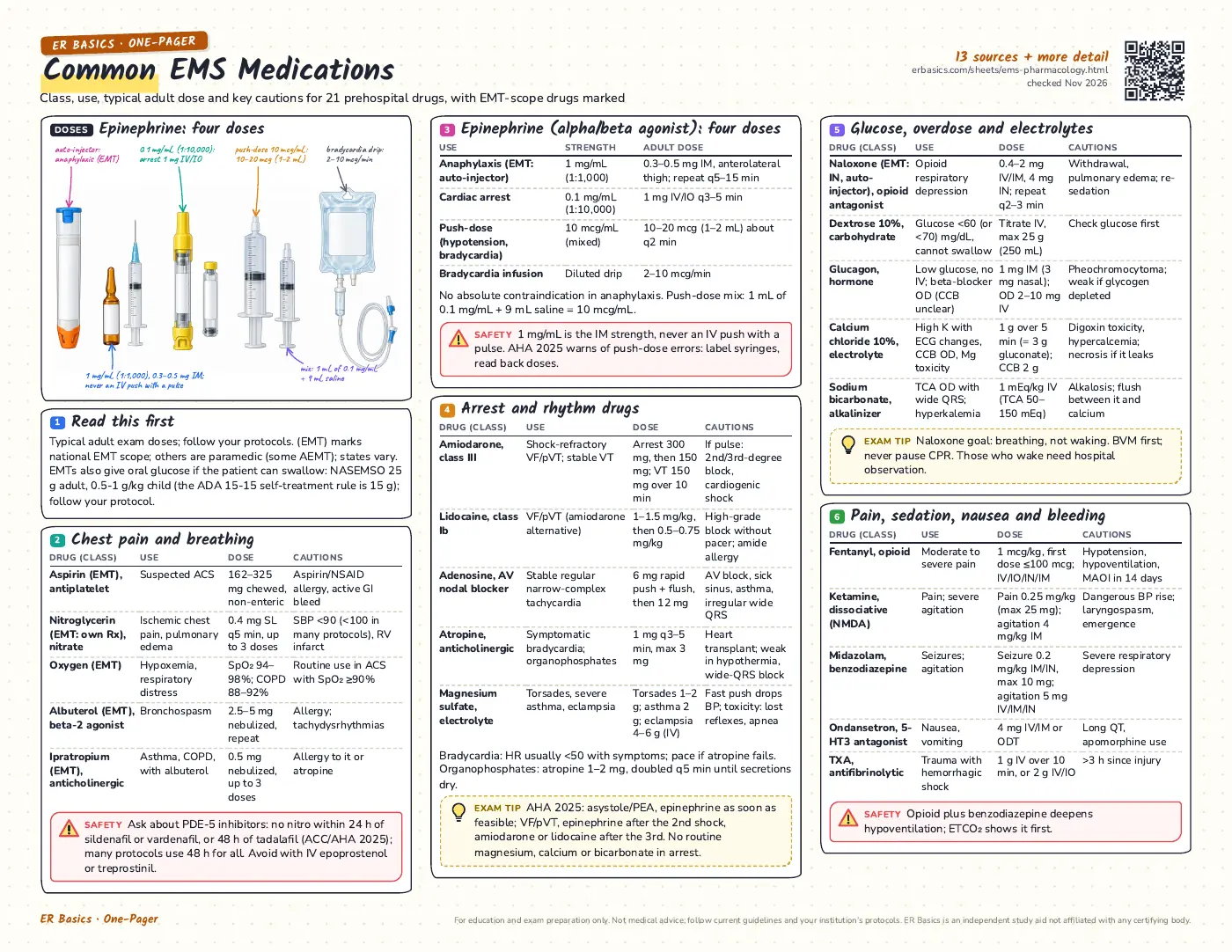
Common EMS Medications
Class, use, typical adult dose and key cautions for 21 prehospital drugs, with EMT-scope drugs marked
Read this first
Typical adult exam doses; follow your protocols. (EMT) marks national EMT scope; others are paramedic (some AEMT); states vary. EMTs also give oral glucose if the patient can swallow: NASEMSO 25 g adult, 0.5-1 g/kg child (the ADA 15-15 self-treatment rule is 15 g); follow your protocol.
Chest pain and breathing
| Drug (class) | Use | Dose | Cautions |
|---|---|---|---|
| Aspirin (EMT), antiplatelet | Suspected ACS | 162–325 mg chewed, non-enteric | Aspirin/NSAID allergy, active GI bleed |
| Nitroglycerin (EMT: own Rx), nitrate | Ischemic chest pain, pulmonary edema | 0.4 mg SL q5 min, up to 3 doses | SBP <90 (<100 in many protocols), RV infarct |
| Oxygen (EMT) | Hypoxemia, respiratory distress | SpO₂ 94–98%; COPD 88–92% | Routine use in ACS with SpO₂ ≥90% |
| Albuterol (EMT), beta-2 agonist | Bronchospasm | 2.5–5 mg nebulized, repeat | Allergy; tachydysrhythmias |
| Ipratropium (EMT), anticholinergic | Asthma, COPD, with albuterol | 0.5 mg nebulized, up to 3 doses | Allergy to it or atropine |
Epinephrine (alpha/beta agonist): four doses
| Use | Strength | Adult dose |
|---|---|---|
| Anaphylaxis (EMT: auto-injector) | 1 mg/mL (1:1,000) | 0.3–0.5 mg IM, anterolateral thigh; repeat q5–15 min |
| Cardiac arrest | 0.1 mg/mL (1:10,000) | 1 mg IV/IO q3–5 min |
| Push-dose (hypotension, bradycardia) | 10 mcg/mL (mixed) | 10–20 mcg (1–2 mL) about q2 min |
| Bradycardia infusion | Diluted drip | 2–10 mcg/min |
No absolute contraindication in anaphylaxis. Push-dose mix: 1 mL of 0.1 mg/mL + 9 mL saline = 10 mcg/mL.
Arrest and rhythm drugs
| Drug (class) | Use | Dose | Cautions |
|---|---|---|---|
| Amiodarone, class III | Shock-refractory VF/pVT; stable VT | Arrest 300 mg, then 150 mg; VT 150 mg over 10 min | If pulse: 2nd/3rd-degree block, cardiogenic shock |
| Lidocaine, class Ib | VF/pVT (amiodarone alternative) | 1–1.5 mg/kg, then 0.5–0.75 mg/kg | High-grade block without pacer; amide allergy |
| Adenosine, AV nodal blocker | Stable regular narrow-complex tachycardia | 6 mg rapid push + flush, then 12 mg | AV block, sick sinus, asthma, irregular wide QRS |
| Atropine, anticholinergic | Symptomatic bradycardia; organophosphates | 1 mg q3–5 min, max 3 mg | Heart transplant; weak in hypothermia, wide-QRS block |
| Magnesium sulfate, electrolyte | Torsades, severe asthma, eclampsia | Torsades 1–2 g; asthma 2 g; eclampsia 4–6 g (IV) | Fast push drops BP; toxicity: lost reflexes, apnea |
Bradycardia: HR usually <50 with symptoms; pace if atropine fails. Organophosphates: atropine 1–2 mg, doubled q5 min until secretions dry.
Glucose, overdose and electrolytes
| Drug (class) | Use | Dose | Cautions |
|---|---|---|---|
| Naloxone (EMT: IN, auto-injector), opioid antagonist | Opioid respiratory depression | 0.4–2 mg IV/IM, 4 mg IN; repeat q2–3 min | Withdrawal, pulmonary edema; re-sedation |
| Dextrose 10%, carbohydrate | Glucose <60 (or <70) mg/dL, cannot swallow | Titrate IV, max 25 g (250 mL) | Check glucose first |
| Glucagon, hormone | Low glucose, no IV; beta-blocker OD (CCB unclear) | 1 mg IM (3 mg nasal); OD 2–10 mg IV | Pheochromocytoma; weak if glycogen depleted |
| Calcium chloride 10%, electrolyte | High K with ECG changes, CCB OD, Mg toxicity | 1 g over 5 min (= 3 g gluconate); CCB 2 g | Digoxin toxicity, hypercalcemia; necrosis if it leaks |
| Sodium bicarbonate, alkalinizer | TCA OD with wide QRS; hyperkalemia | 1 mEq/kg IV (TCA 50–150 mEq) | Alkalosis; flush between it and calcium |
Pain, sedation, nausea and bleeding
| Drug (class) | Use | Dose | Cautions |
|---|---|---|---|
| Fentanyl, opioid | Moderate to severe pain | 1 mcg/kg, first dose ≤100 mcg; IV/IO/IN/IM | Hypotension, hypoventilation, MAOI in 14 days |
| Ketamine, dissociative (NMDA) | Pain; severe agitation | Pain 0.25 mg/kg (max 25 mg); agitation 4 mg/kg IM | Dangerous BP rise; laryngospasm, emergence |
| Midazolam, benzodiazepine | Seizures; agitation | Seizure 0.2 mg/kg IM/IN, max 10 mg; agitation 5 mg IV/IM/IN | Severe respiratory depression |
| Ondansetron, 5-HT3 antagonist | Nausea, vomiting | 4 mg IV/IM or ODT | Long QT, apomorphine use |
| TXA, antifibrinolytic | Trauma with hemorrhagic shock | 1 g IV over 10 min, or 2 g IV/IO | >3 h since injury |
In depth
The one-page summary above is what the PDF prints. These sections go further.
Drip calculations
Every drip problem uses the same three steps: find the concentration in the bag, find the hourly pump rate, then convert to the unit the order uses. Write the units at each step; most errors are a missed conversion (mg to mcg, or hours to minutes).
| Step | Formula |
|---|---|
| Concentration | Drug in the bag ÷ bag volume (1 mg = 1,000 mcg) |
| Weight-based rate | mL/kg/h × weight in kg = mL/h |
| Dose per hour | mL/h × concentration (mcg/mL) = mcg/h |
| Dose per minute | mcg/h ÷ 60 = mcg/min |
| Per kilogram | mcg/min ÷ weight in kg = mcg/kg/min |
| Rate from an order | Ordered dose per hour ÷ concentration = mL/h |
Low-dose epinephrine infusion for refractory anaphylaxis (Resuscitation Council UK 2021): start it when breathing or circulation has not improved after two appropriate IM doses. Mix 1 mg of 1 mg/mL epinephrine in 100 mL of 0.9% sodium chloride, which is 10 mcg/mL, and run it on a pump through a dedicated line, not piggybacked onto another line unless an anti-reflux valve is used, and not in the arm with the BP cuff. Start at 0.5 mL/kg/h for moderate reactions (about 0.1 mcg/kg/min) or 1 mL/kg/h if hypotensive or hypoxic, and titrate to the lowest effective rate; steady state takes 5–10 min after each change. RCUK reserves IV epinephrine for experienced specialists in an appropriate setting; transport programs set their own scope for these infusions.
Worked example: a 60 kg patient at 0.5 mL/kg/h runs at 30 mL/h. At 10 mcg/mL that is 300 mcg/h, or 5 mcg/min, which is 0.083 mcg/kg/min. Keep monitoring with ECG, SpO₂ and a BP at least every 5 min; tachycardia, tremor or pallor with a normal or raised BP suggests too much epinephrine, so lower the rate. Until the infusion runs, IM epinephrine is repeated every 5 min.
Related cheat sheets
- EMT: Soft-Tissue and Musculoskeletal TraumaBleeding control, impaled objects, eviscerations, amputations, splinting, traction splints, pelvic binders, crush and mechanism of injury
- Prehospital Stroke and STEMIStroke and LVO screens, last known well, destination, 12-lead, STEMI times, and aspirin and nitro cautions for EMT and paramedic
Calculators for this topic
Sources
- Wigginton JG, Agarwal S, Bartos JA, et al. Part 9: Adult Advanced Life Support: 2025 American Heart Association Guidelines for Cardiopulmonary Resuscitation and Emergency Cardiovascular Care. Circulation. 2025;152(16 Suppl 2):S538-S577. doi:10.1161/CIR.0000000000001376 Link
- Cao D, Arens AM, Chow SL, et al. Part 10: Adult and Pediatric Special Circumstances of Resuscitation: 2025 American Heart Association Guidelines for Cardiopulmonary Resuscitation and Emergency Cardiovascular Care. Circulation. 2025;152(16 Suppl 2):S578-S672. doi:10.1161/CIR.0000000000001380 (read on cpr.heart.org, including Table 4) Link
- Rao SV, O'Donoghue ML, Ruel M, et al. 2025 ACC/AHA/ACEP/NAEMSP/SCAI Guideline for the Management of Patients With Acute Coronary Syndromes. Circulation. 2025;151(13):e771-e862. doi:10.1161/CIR.0000000000001309 Link
- National Association of State EMS Officials (NASEMSO) Medical Directors Council. National Model EMS Clinical Guidelines, Version 3.0. March 2022. Link
- National Association of State EMS Officials. National EMS Scope of Practice Model 2019: Including Change Notices 1.0 and 2.0 (Report No. DOT HS 813 151). Washington, DC: NHTSA; August 2021. Link
- Barrett WJ, Kaucher KA, Orpet RE, et al. Prehospital Trauma Compendium: Tranexamic Acid in Trauma - A Joint Position Statement and Resource Document of NAEMSP, ACEP, and ACS-COT. Prehosp Emerg Care. Published online 2025. doi:10.1080/10903127.2025.2497056 Link
- Kusumoto FM, Schoenfeld MH, Barrett C, et al. 2018 ACC/AHA/HRS Guideline on the Evaluation and Management of Patients With Bradycardia and Cardiac Conduction Delay. J Am Coll Cardiol. 2019;74(7):e51-e156. doi:10.1016/j.jacc.2018.10.044 Link
- O'Driscoll BR, Howard LS, Earis J, Mak V; British Thoracic Society Emergency Oxygen Guideline Group. BTS guideline for oxygen use in adults in healthcare and emergency settings. Thorax. 2017;72(Suppl 1):i1-i90. doi:10.1136/thoraxjnl-2016-209729 Link
- Adrenalin (epinephrine injection) 1 mg/mL prescribing information. Par Health USA; revised 6/2026. DailyMed. Link
- Glucagon for injection kit prescribing information. Amphastar Pharmaceuticals; revised 3/2025 (DailyMed version updated August 11, 2026). DailyMed. Link
- Sodium Bicarbonate Injection, USP 8.4% prescribing information. Civica, Inc. / Long Grove Pharmaceuticals; revised 01/2026. DailyMed. Link
- Ketalar (ketamine hydrochloride injection) prescribing information. Par Health USA; 2026. DailyMed. Link
- Resuscitation Council UK. Emergency treatment of anaphylaxis: Guidelines for healthcare providers. May 2021. Link