 ER Basics
Cheat Sheet
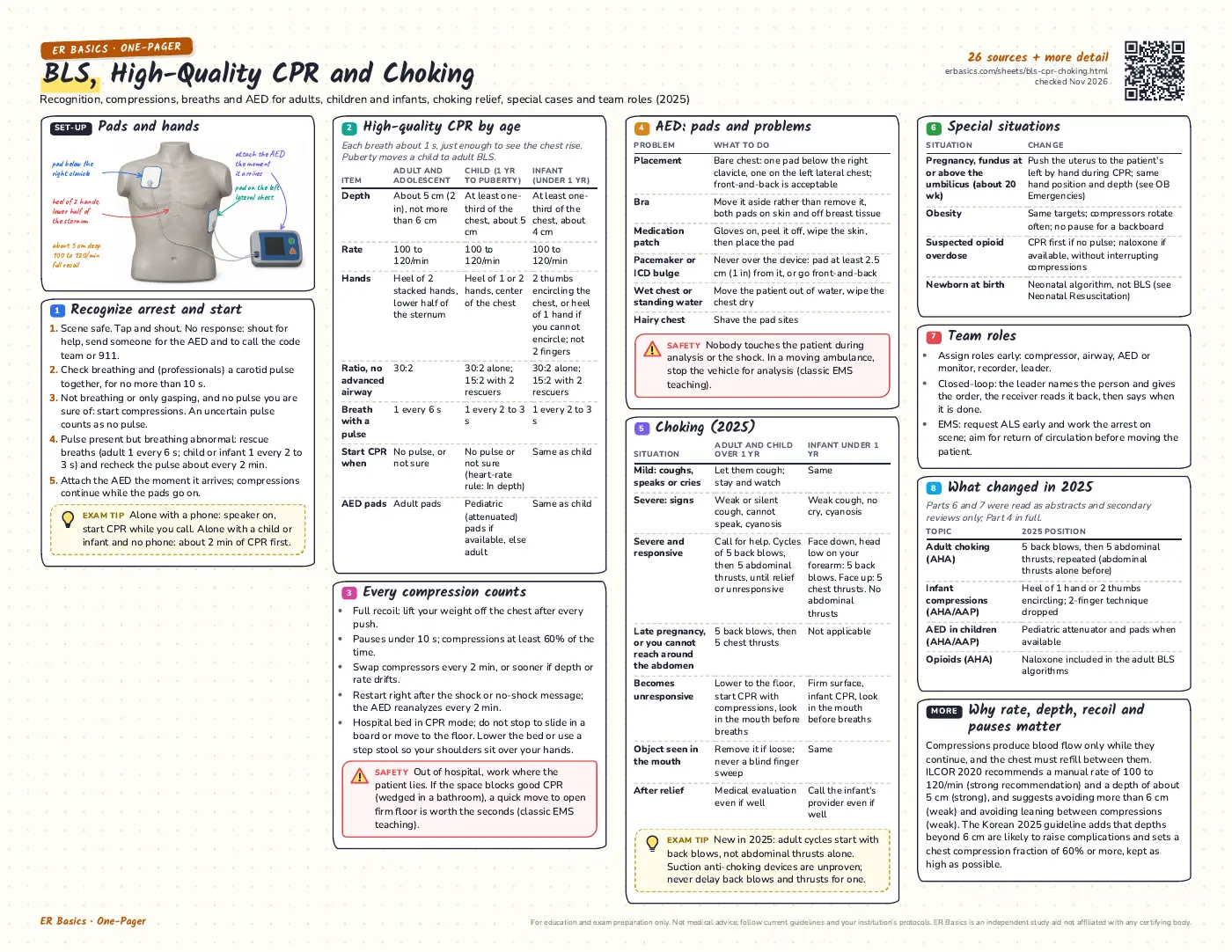
BLS, High-Quality CPR and Choking
Recognition, compressions, breaths and AED for adults, children and infants, choking relief, special cases and team roles (2025)
Practice 68 BLS, High-Quality CPR and Choking questions free
Recognize arrest and start
- Scene safe. Tap and shout. No response: shout for help, send someone for the AED and to call the code team or 911.
- Check breathing and (professionals) a carotid pulse together, for no more than 10 s.
- Not breathing or only gasping, and no pulse you are sure of: start compressions. An uncertain pulse counts as no pulse.
- Pulse present but breathing abnormal: rescue breaths (adult 1 every 6 s; child or infant 1 every 2 to 3 s) and recheck the pulse about every 2 min.
- Attach the AED the moment it arrives; compressions continue while the pads go on.
High-quality CPR by age
| Item | Adult and adolescent | Child (1 yr to puberty) | Infant (under 1 yr) |
|---|---|---|---|
| Depth | About 5 cm (2 in), not more than 6 cm | At least one-third of the chest, about 5 cm | At least one-third of the chest, about 4 cm |
| Rate | 100 to 120/min | 100 to 120/min | 100 to 120/min |
| Hands | Heel of 2 stacked hands, lower half of the sternum | Heel of 1 or 2 hands, center of the chest | 2 thumbs encircling the chest, or heel of 1 hand if you cannot encircle; not 2 fingers |
| Ratio, no advanced airway | 30:2 | 30:2 alone; 15:2 with 2 rescuers | 30:2 alone; 15:2 with 2 rescuers |
| Breath with a pulse | 1 every 6 s | 1 every 2 to 3 s | 1 every 2 to 3 s |
| Start CPR when | No pulse, or not sure | No pulse or not sure (heart-rate rule: In depth) | Same as child |
| AED pads | Adult pads | Pediatric (attenuated) pads if available, else adult | Same as child |
Every compression counts
- Full recoil: lift your weight off the chest after every push.
- Pauses under 10 s; compressions at least 60% of the time.
- Swap compressors every 2 min, or sooner if depth or rate drifts.
- Restart right after the shock or no-shock message; the AED reanalyzes every 2 min.
- Hospital bed in CPR mode; do not stop to slide in a board or move to the floor. Lower the bed or use a step stool so your shoulders sit over your hands.
AED: pads and problems
| Problem | What to do |
|---|---|
| Placement | Bare chest: one pad below the right clavicle, one on the left lateral chest; front-and-back is acceptable |
| Bra | Move it aside rather than remove it, both pads on skin and off breast tissue |
| Medication patch | Gloves on, peel it off, wipe the skin, then place the pad |
| Pacemaker or ICD bulge | Never over the device: pad at least 2.5 cm (1 in) from it, or go front-and-back |
| Wet chest or standing water | Move the patient out of water, wipe the chest dry |
| Hairy chest | Shave the pad sites |
Choking (2025)
| Situation | Adult and child over 1 yr | Infant under 1 yr |
|---|---|---|
| Mild: coughs, speaks or cries | Let them cough; stay and watch | Same |
| Severe: signs | Weak or silent cough, cannot speak, cyanosis | Weak cough, no cry, cyanosis |
| Severe and responsive | Call for help. Cycles of 5 back blows, then 5 abdominal thrusts, until relief or unresponsive | Face down, head low on your forearm: 5 back blows. Face up: 5 chest thrusts. No abdominal thrusts |
| Late pregnancy, or you cannot reach around the abdomen | 5 back blows, then 5 chest thrusts | Not applicable |
| Becomes unresponsive | Lower to the floor, start CPR with compressions, look in the mouth before breaths | Firm surface, infant CPR, look in the mouth before breaths |
| Object seen in the mouth | Remove it if loose; never a blind finger sweep | Same |
| After relief | Medical evaluation even if well | Call the infant's provider even if well |
Special situations
| Situation | Change |
|---|---|
| Pregnancy, fundus at or above the umbilicus (about 20 wk) | Push the uterus to the patient's left by hand during CPR; same hand position and depth (see OB Emergencies) |
| Obesity | Same targets; compressors rotate often; no pause for a backboard |
| Suspected opioid overdose | CPR first if no pulse; naloxone if available, without interrupting compressions |
| Newborn at birth | Neonatal algorithm, not BLS (see Neonatal Resuscitation) |
Team roles
- Assign roles early: compressor, airway, AED or monitor, recorder, leader.
- Closed-loop: the leader names the person and gives the order, the receiver reads it back, then says when it is done.
- EMS: request ALS early and work the arrest on scene; aim for return of circulation before moving the patient.
What changed in 2025
| Topic | 2025 position |
|---|---|
| Adult choking (AHA) | 5 back blows, then 5 abdominal thrusts, repeated (abdominal thrusts alone before) |
| Infant compressions (AHA/AAP) | Heel of 1 hand or 2 thumbs encircling; 2-finger technique dropped |
| AED in children (AHA/AAP) | Pediatric attenuator and pads when available |
| Opioids (AHA) | Naloxone included in the adult BLS algorithms |
In depth
The one-page summary above is what the PDF prints. These sections go further.
Why rate, depth, recoil and pauses matter
Compressions produce blood flow only while they continue, and the chest must refill between them. ILCOR 2020 recommends a manual rate of 100 to 120/min (strong recommendation) and a depth of about 5 cm (strong), and suggests avoiding more than 6 cm (weak) and avoiding leaning between compressions (weak). The Korean 2025 guideline adds that depths beyond 6 cm are likely to raise complications and sets a chest compression fraction of 60% or more, kept as high as possible.
- Hand position: lower half of the sternum in adults (ILCOR 2020, weak).
- Ratio: 30:2 in adults (ILCOR 2020, weak); EMS may use 30:2 or continuous compressions with positive-pressure breaths until an advanced airway is placed (strong).
- In hospital, once a tracheal tube or supraglottic airway is in, compressions continue without pausing for breaths (AHA teaching; ILCOR 2020 states this only for EMS systems, and the pediatric review says the same).
- Rhythm checks every 2 min (ILCOR 2020, weak); Singapore 2026 says to resume compressions immediately after the shock.
- Breaths: about 1 s each, just to visible chest rise; Korea gives 500 to 600 mL (6 to 7 mL/kg) as the adult target. Forceful, fast breaths push air into the stomach (classic teaching).
- Feedback devices are suggested as part of a quality program and suggested against when used alone (ILCOR 2020, weak).
- Precordial thump: recommended against (ILCOR 2020, strong).
Surface and rescuer position
ILCOR 2020 suggests compressions on a firm surface when possible, turning on the bed's CPR (mattress-stiffening) mode during in-hospital arrest, and not moving the patient to the floor to gain depth; it made no recommendation on backboards. The Korean 2025 guideline, built on the 2025 ILCOR review, says an existing backboard may stay but placing a new one is not recommended (weak, very low certainty), and that moving to the floor delays CPR.
Rescuer position changes depth. In a simulation trial (Mayrand 2015, 55 rescuers analyzed), compressing with the arms at 90 degrees to the chest gave a mean depth of 41.4 mm against 32.2 mm at a lesser angle; a lowered bed (64 cm against 74 cm) trended deeper, and using a step stool was linked to a correct shoulder position. Even the better group averaged under the 50 mm target, which is why a feedback device and a low bed or stool matter for shorter rescuers.
Obesity: the opened sources give no different depth or rate for patients with obesity. A thick chest wall and a soft mattress mean more force is needed to reach the same depth, and compressors tire faster, so rotate early and do not interrupt compressions for a board.
Recognition, pulse checks and starting early
Unresponsiveness with absent or abnormal (agonal) breathing is treated as cardiac arrest. Professionals check breathing and pulse together for no more than 10 s; Singapore 2026 and the 2025 pediatric guidance both say to start CPR if the pulse is absent or uncertain. ILCOR 2020 strongly recommends that lay people start CPR for presumed arrest without worrying about harming someone who is not in arrest.
- Telecommunicators should coach callers into CPR (AHA 2025 Part 4, class 1); compression-only instructions for adults (class 1), conventional CPR with breaths for children and infants (class 1).
- A two-question approach (unresponsive? breathing normally?) identified 92% of out-of-hospital arrests in Part 4's evidence.
- Telecommunicator CPR was linked to more than 5 times the likelihood of bystander CPR, started 7 min sooner.
- Rescue breathing with a pulse: Korea 2025 states 1 breath every 6 s for adults (expert consensus; Singapore 2026 says every 5 s). For children and infants the 2025 pediatric review gives 1 breath every 2 to 3 s (20 to 30/min) when an advanced airway is in place or the pulse is present with inadequate breathing.
- Heart-rate rule in children: Singapore 2026 starts CPR in an unresponsive child or infant with a pulse of 60/min or less. The 2025 pediatric review says to start CPR when pulse or breathing is absent, uncertain or hard to judge and gives no rate. AHA PALS teaching (not opened here) is a heart rate under 60/min with poor perfusion.
- For an unmonitored arrest, ILCOR 2020 suggests a short period of CPR until the defibrillator is ready, then analysis without further delay.
Defibrillation details
Anterolateral placement is reasonable and anteroposterior is an acceptable alternative (ILCOR 2020), which helps when a dressing, chest tube, device or breast tissue is in the way. Pads larger than 8 cm are reasonable. Korea 2025 says the pads go on the bare chest, and in women without loosening or removing the bra and avoiding breast tissue (expert consensus). Singapore 2026 lists the preparation steps: not on a metal or wet surface, chest wiped dry, hair shaved, jewelry removed, medication patches removed and wiped.
Implanted pacemakers and ICDs do not prevent defibrillation; keep the pad off the device, at least 2.5 cm (1 in) from its edge (Febrasgo 2026), or use front-and-back placement. Singapore 2026 gives a wider margin of about four finger breadths from a pacemaker, which is more than 2.5 cm; the two figures are not the same distance, and the page uses the 2.5 cm minimum that the bank also keys. Pediatric pads: Singapore uses energy-attenuated pads for children up to 8 years or under 25 kg and adult pads if none are available; the 2025 AHA/AAP guidance likewise prefers an attenuated AED when available.
Public access defibrillation is a class 1 recommendation in AHA 2025 Part 4. In the PAD trial, a structured lay responder program with CPR and AED training produced 30 survivors among 107 arrests against 15 among 128 with CPR training alone (relative risk 2.0).
Defibrillation for the code team: pads, oxygen and devices
These points go beyond BLS: they apply once a manual defibrillator and an advanced team are at the bedside. They come from Resuscitation Council UK 2025 (RCUK, whose guidelines are informed by ILCOR 2025 and the ERC 2025 guidelines) and the Korean 2025 guidelines.
| Situation | What to do | Why |
|---|---|---|
| Pads went on with "Sternum" and "Apex" swapped | Shock with the pads where they are | With a biphasic defibrillator the two electrodes may be interchanged, so repositioning should not delay the shock or interrupt compressions (Korea 2025) |
| Patient is prone and cannot be turned at once | Shock in the prone position, using an alternative pad position such as bi-axillary (one pad below each armpit) | RCUK 2025 names bi-axillary for the prone patient; Korea 2025 allows prone defibrillation when turning is not immediately possible |
| Transcutaneous pacing pads are on and VF appears | Start CPR, switch the device from pacing to defibrillation and shock through the pads already in place | Once applied, self-adhesive pads allow rhythm analysis, defibrillation, synchronized cardioversion and pacing (Korea 2025); front-and-back is an accepted shock position |
| Oxygen by mask, nasal cannula or bag-mask | Take it off and place it at least 1 m from the chest | Minimizes the risk of fire in oxygen-enriched air (RCUK 2025) |
| Tracheal tube or supraglottic airway in place | Leave the self-inflating bag or ventilator circuit attached; direct the ventilator's oxygen exhaust away from the chest | The 1 m rule is for masks, cannulas and bag-masks; a circuit on a tube or supraglottic airway stays connected (RCUK 2025) |
| Mechanical CPR device running | Deliver the manual defibrillator shock while the device keeps compressing | Safe, and it removes the pause before the shock (RCUK 2025) |
| A rescuer is compressing by hand | Hands off before the shock, even with clinical gloves on | Shocking during manual compressions is not safe for the rescuer (RCUK 2025) |
| AED already in use when the advanced team arrives | Follow its shock prompts; change to the manual defibrillator during a 2-minute CPR cycle | The change must not hold up a shock. Manual mode is for rescuers who can identify an arrest rhythm within 5 s (RCUK 2025) |
| Arrest during hemodialysis | A trained dialysis operator stops dialysis and returns the blood volume with a fluid bolus; disconnect the patient from the machine before the shock unless the machine is defibrillation-proof | Most hemodialysis machines are not defibrillation-proof, so disconnection comes before defibrillation (UKKA 2026). Beware wet surfaces. The dialysis access stays open and is used for drugs (RCUK 2025) |
Prone CPR is for a patient with an advanced airway who cannot be turned immediately or safely; invasive arterial pressure or ETCO₂ shows whether the compressions are working and helps decide when to turn. A prone patient in arrest without an advanced airway is turned supine at once (Korea 2025).
Persisting VF, P-wave asystole and filtered rhythms
VF that is still on the monitor at the next rhythm check has two possible histories. In true refractory VF the shock never terminated the rhythm. In recurrent VF the shock worked and VF returned during the 2 minutes of CPR that followed, unseen because the rhythm is not analyzed during compressions. Recurrence is far more common: in a review of defibrillator recordings from Victoria, Australia (Alhenaki 2026), 807 of 900 patients who had received three consecutive shocks (89.7%) had recurrent VF or pulseless VT and 93 (10.3%) had true refractory VF, and survival to discharge was higher with recurrence (32.2% against 14.0%).
So VF at a later check does not show that the pads or the energy failed. Keep shocking and compressing, give the antiarrhythmic on schedule (RCUK 2025 gives amiodarone after three shocks and again after five whether the VF is continuous or intermittent) and look for a reversible cause. A pad vector change or double sequential defibrillation may be considered for VF that persists after three or more shocks, but neither is routine (Korea 2025; RCUK 2025 does not recommend routine double sequential shocks).
- P-wave asystole (ventricular standstill): P waves continue with no QRS complexes and no pulse. Asystole is the absence of ventricular contraction whether or not atrial activity is present (Korea 2025), so this is a nonshockable arrest: CPR, epinephrine 1 mg as early as possible and a search for reversible causes.
- Check every apparent asystole for P waves: unlike true asystole, P-wave asystole is more likely to respond to pacing (RCUK 2025). Pacing is added to CPR and epinephrine, not used in place of them, and it is not routine in established arrest (see ACLS Algorithms in Brief).
- Artifact-filtered ECG: some defibrillators display the rhythm with compression artifact removed. When ILCOR reviewed these algorithms in 2020, no study had tested them during real resuscitation for patient outcomes, and it suggests against their routine use. RCUK 2025 lets the filtered display guide whether the 2-minute rhythm check needs a pause (none if it shows asystole). Neither source moves the check earlier on a filtered trace: compressions continue, and the rhythm that decides a shock is the one read at the scheduled 2-minute check.
- VF waveform analysis, such as amplitude, has no current role in choosing the moment to shock (RCUK 2025).
- What justifies an unscheduled pause is a combination of signs of ROSC: return of consciousness or purposeful movement, a pulsatile arterial waveform, a sharp rise in ETCO₂. A rise in ETCO₂ alone is not enough (RCUK 2025).
CPR-induced consciousness
Compressions can perfuse the brain well enough for a patient without ROSC to open the eyes, speak or move. It is uncommon but increasingly reported: 112 of 16,558 out-of-hospital arrests in Victoria, Australia (0.7%), most often as body movement (Korea 2025 evidence review).
- Awareness during compressions is not ROSC. The rhythm check and pulse decide the next step: a patient who is awake but in pulseless VF is still in cardiac arrest and gets the shock, continued CPR and drugs on schedule.
- Small doses of a sedative, an analgesic or both may be considered to prevent pain and distress (RCUK 2025). Korea 2025 words it as the lowest effective dose when the awareness interferes with CPR or puts the patient or rescuers at risk.
- Drug choice follows local protocol and critical care practice; RCUK 2025 gives small doses of fentanyl, ketamine or midazolam as examples.
- Never give a neuromuscular blocking drug alone to a conscious patient (RCUK 2025; Korea 2025).
Termination-of-resuscitation rules and their limits
Termination-of-resuscitation (TOR) rules help EMS crews recognize out-of-hospital arrests in which transport is futile. The BLS rule needs all three: arrest not witnessed by EMS, no shock delivered and no ROSC in the field. The ALS rule needs all four: arrest not witnessed, no bystander CPR, no shock delivered and no ROSC after ALS care in the field (Kashiura 2016).
- A rule applies only to the kind of patient it was validated in. The main validation studies enrolled adults with out-of-hospital arrest of presumed cardiac cause and left out non-cardiac causes. In a Japanese cohort of 11,505 arrests the ALS rule's specificity for a poor outcome was 0.963 in cardiac arrests and 0.833 in non-cardiac arrests, a group that included asphyxia and drug overdose. The authors advise caution there and say the rules should not be applied when a reversible cause is presumed; their study left out traumatic arrest (Kashiura 2016).
- So an overdose arrest, a traumatic arrest or an in-hospital arrest is not ended on a TOR rule alone. RCUK 2025: TOR rules should not be the sole strategy for stopping an in-hospital attempt.
- ETCO₂ of 10 mm Hg or less after 20 minutes of advanced life support carries a very poor prognosis in intubated patients. It is not applied to a patient without a tracheal tube and is never the only reason to stop (Korea 2025; RCUK 2025).
Anaphylactic arrest and epinephrine concentrations
Anaphylaxis collapses the circulation through vasodilation and capillary leak; up to one third of the circulating volume can be lost (RCUK 2021). While there is a pulse, the first drug is IM epinephrine: 500 mcg of the 1 mg/mL solution for an adult, repeated after 5 minutes if there is no improvement (RCUK 2021 and 2025).
- Once the patient is in cardiac arrest, IM epinephrine is not absorbed reliably and giving it distracts from CPR. Follow standard advanced life support and give epinephrine IV or IO at arrest doses (RCUK 2021).
- Fluid treats the cause: a rapid crystalloid bolus of 500 to 1,000 mL in an adult, IV or IO, then more as needed; severe anaphylactic shock can need 3 to 5 L (RCUK 2021). Korea 2025 gives at least 500 mL within 5 to 10 minutes.
- Antihistamines have no role in treating the respiratory or cardiovascular features, and routine corticosteroids are not recommended; neither is given ahead of epinephrine and fluid (RCUK 2021).
- Glucagon is considered for a patient on a beta-blocker whose anaphylaxis stays refractory to epinephrine and adequate fluid (RCUK 2021).
- Consider prolonged CPR, including extracorporeal CPR: the cause is sudden and potentially reversible in a previously well patient (RCUK 2021; Korea 2025).
| Epinephrine product | Concentration | Volume that holds the 1 mg arrest dose |
|---|---|---|
| Vial or ampule, 1:1,000 | 1 mg/mL | 1 mL |
| Prefilled syringe, 1:10,000 | 0.1 mg/mL | 10 mL |
Choking: the evidence behind the sequence
There are no randomized trials comparing choking interventions. The 2025 AHA adult change rests on a cohort of 709 obstruction cases in which back blows were associated with better outcomes than abdominal thrusts or chest compressions, together with case reports of fatal injuries from abdominal thrusts such as aortic dissection and gastric rupture (Tian 2026). The sequence also now matches the pediatric one, which makes it easier to teach. ERC 2025 uses the same 5 and 5 cycles.
The MOCHI registry (Igarashi 2025, 407 Japanese adults) compared each technique with no bystander intervention: abdominal thrusts relieved the obstruction in 30% and back blows in 27%; both were linked to better neurologic outcome, and back blows also to higher 30-day survival (adjusted hazard ratio 0.52). One of 24 patients given abdominal thrusts had a pneumothorax. It did not compare the two techniques head to head.
- Unresponsive: start CPR. Compressions raise airway pressure and can move the object. Look in the mouth each time the airway is opened and remove only what you can see; blind finger sweeps are suggested against (ILCOR 2020).
- Magill forceps under direct view are an option for skilled providers in an obstruction arrest (ILCOR 2020).
- Suction anti-choking devices: ILCOR 2020 suggested against routine use; the 2025 ILCOR list dropped that line (Tian 2026), Korea 2025 still does not recommend routine use, and no source shows them better than back blows and thrusts.
- After successful thrusts or compressions, ERC and ILCOR 2025 call for evaluation by a clinician because injuries can be hidden (Tian 2026). MedlinePlus adds: seek care for a cough, fever, trouble swallowing or wheeze in the following days.
- Infants: abdominal thrusts are avoided because of the risk of liver injury (Tian 2026). Back blows alternate with 5 chest thrusts (Lee 2026, Tian 2026). AHA 2025 uses the heel of one hand on the center of the breastbone, just below the nipple line, for infant chest thrusts and dropped the two-finger technique (AHA newsroom; AAP HealthyChildren); some older patient pages still show two fingers.
- Children over 1 year: 5 back blows alternate with 5 abdominal thrusts (Lee 2026, Part 6 abstract). Adult and child chest thrusts replace abdominal thrusts in pregnancy or obesity (MedlinePlus; Korea 2025).
Children and infants
Infants are under 1 year, children run from 1 year to puberty, and adolescents follow adult BLS (Lee 2026). A single rescuer uses 30:2 at every age; two rescuers use 15:2 before puberty. Compressions are at least one-third of the chest depth. The 2025 AHA/AAP guidance dropped the two-finger infant technique because it does not reliably reach depth; the heel of one hand or two thumbs with the hands encircling the chest are both acceptable, and the heel of one hand is used if you cannot encircle the chest. Depth in centimeters: MedlinePlus (2026) gives about 5 cm for a child and about 4 cm for an infant; the 2025 pediatric review gives only one-third of the chest, and Singapore 2026 uses 4 to 5 cm (child) and 3 to 4 cm (infant).
- With an advanced airway, or a pulse with inadequate breathing: 1 breath every 2 to 3 s (20 to 30/min).
- Rescue breaths with compressions improve survival in pediatric out-of-hospital arrest; lay rescuers should give them if willing and able.
- Lone rescuer without a phone: about 2 min (5 cycles) of CPR before leaving to call (MedlinePlus).
- Infant breaths: cover the mouth and nose with your mouth (classic teaching).
- Newborns at birth follow neonatal resuscitation, and Singapore does not use an AED under 1 month.
Pregnancy, opioids and drowning
Pregnancy: once the fundus reaches the umbilicus, at about 20 weeks, the uterus compresses the vena cava when the patient is supine. A rescuer moves the uterus by hand to the left throughout CPR; Febrasgo says lateral tilting is not recommended because it lowers compression effectiveness. Hands stay on the lower sternum at normal depth and rate, and defibrillation is the same as for any adult with fetal monitors removed first (Febrasgo 2026). The hospital team prepares for emergency delivery at the site of arrest; that decision belongs to advanced providers (see OB Emergencies).
Emptying the uterus does not have to mean a cesarean. When the arrest happens in the second stage of labor with the fetus engaged, an operative vaginal delivery with forceps or vacuum is appropriate if it can be completed within the same time limit; otherwise the team performs a resuscitative hysterotomy where the patient lies, not in the operating room (Febrasgo 2026). AHA 2025 uses the term resuscitative delivery (see OB Emergencies). Fetal monitoring is not used during CPR; once circulation and stability return, the fetus is assessed again (Febrasgo 2026), and temperature control follows the usual adult criteria with fetal monitoring attached (see Post-Cardiac Arrest Care).
Opioids: an estimated 1 in 6 to 1 in 3 out-of-hospital arrests are overdose-related (AHA 2025 Part 4). Without a pulse, CPR and the AED come first; naloxone is given if available without stopping compressions (MedlinePlus), and the 2025 adult BLS algorithms now include it (Part 7 abstract). Part 4 supports lay possession and use of naloxone with legal protection (class 1). With a pulse and poor breathing, ventilate with a bag-mask and give naloxone.
Drowning: ventilation matters. Korea 2025 has trained responders start with breaths and recommends standard CPR with ventilation, with compression-only CPR for untrained lay rescuers. Dry the chest before the AED pads go on.
Teams, transport and debriefing
- Out of hospital, prioritizing on-scene resuscitation toward sustained return of circulation before transport can be beneficial (Part 4, class 2a); survival to discharge was about twice as high without intra-arrest transport in adults.
- Termination of resuscitation on scene is an ALS and medical-direction decision, not a BLS one.
- An ALS-level clinician at the arrest (2a) and a team large enough for separate roles (2a) are beneficial; pit-crew style role assignment is discussed in the same evidence.
- In hospital, code teams should include members with ALS training (class 1); dedicated teams with defined roles can help (2a).
- Performance-focused debriefing (2a), using the device data (2a), immediate and delayed (2a).
- Closed-loop communication: the sender gives the message and the receiver repeats it back (Bhangu 2022, Arnold 2025); announcing completion is common team practice.
Exam pearls
- Gasping plus an uncertain pulse is cardiac arrest: compress, do not recheck.
- Choking, still coughing forcefully: watch and encourage, do not hit or thrust.
- Choking, cannot speak or cough: 5 back blows then 5 abdominal thrusts, repeated; chest thrusts in late pregnancy or a large abdomen; infants chest thrusts only.
- Choking patient goes limp: floor, compressions, look before breaths, no blind sweep.
- Medication patch under a pad: remove and wipe. Pacemaker under the pad site: move the pad away or go front-and-back.
- AED says shock delivered or no shock: compressions now, not a pulse check.
- High bed and a short rescuer: lower the bed or use a stool. Patient with obesity: same depth, no pause for a board.
- Witnessed shockable arrest with an AED working: stay and work on scene; let ALS come to you.
- Leader orders a drug: repeat it back, then report it given.
- Pads on the wrong sides with a biphasic defibrillator: shock, do not swap them.
- Mechanical CPR device running: shock through it. Manual compressions: hands off first, gloves or not.
- Tube or supraglottic airway in place: the circuit stays on for the shock. Mask or cannula: off and 1 m away.
- Awake during compressions with pulseless VF at the check: still an arrest. Shock, resume CPR, consider small-dose sedation.
- Anaphylactic arrest: IV or IO epinephrine and rapid fluid boluses, not IM epinephrine or an antihistamine.
Related cheat sheets
- Hemodynamic NormalsNormal adult values, key formulas and how to read the waveforms behind them
- Shock Types at a GlanceHemodynamic patterns, exam findings and first treatments for each shock type
- Vasopressors and InotropesReceptors, doses, SSC 2026 septic shock order, push-dose pressors and extravasation
- ACS and STEMITerritories, time goals, first drugs and complications
- Heart FailureHFrEF vs HFpEF, stages, GDMT pillars, warm/cold profiles, shock and diuretics
- Right Heart Failure and Pulmonary HypertensionRV physiology, recognition, PH groups, ICU causes, drugs, intubation risk and mechanical support
Sources
- Dezfulian C, Cabañas JG, Buckley JR, et al. Part 4: Systems of Care: 2025 American Heart Association Guidelines for Cardiopulmonary Resuscitation and Emergency Cardiovascular Care. Circulation. 2025;152(16 Suppl 2):S353-S384. doi:10.1161/CIR.0000000000001378 Link
- Kleinman ME, Buick JE, Huber N, et al. Part 7: Adult Basic Life Support: 2025 American Heart Association Guidelines for Cardiopulmonary Resuscitation and Emergency Cardiovascular Care. Circulation. 2025;152(16 Suppl 2):S448-S478. doi:10.1161/CIR.0000000000001369 (abstract record) Link
- Joyner BL, Dewan M, Bavare A, et al. Part 6: Pediatric Basic Life Support: 2025 American Heart Association and American Academy of Pediatrics Guidelines for Cardiopulmonary Resuscitation and Emergency Cardiovascular Care. Circulation. 2025;152(16 Suppl 2):S424-S447. doi:10.1161/CIR.0000000000001370 (abstract record) Link
- Olasveengen TM, Mancini ME, Perkins GD, et al. Adult Basic Life Support: 2020 International Consensus on Cardiopulmonary Resuscitation and Emergency Cardiovascular Care Science With Treatment Recommendations. Resuscitation. 2020;156:A35-A79. doi:10.1016/j.resuscitation.2020.09.010 Link
- Tian S, Wang Y, Zhang J. Evolution of guidelines for the management of foreign body airway obstruction from 2005 to 2025. World J Emerg Med. 2026;17(4):370-372. doi:10.5847/wjem.j.1920-8642.2026.070 Link
- Igarashi Y, Norii T, Nakae R, et al. Efficacy of abdominal thrusts and back blows for patients with foreign body airway obstruction: MOCHI registry analysis. Resusc Plus. 2025;25:101016. doi:10.1016/j.resplu.2025.101016 Link
- Lee JE, Kim M, Choi EK, et al. Updated pediatric cardiopulmonary resuscitation: a comprehensive review of the 2025 guidelines. Anesth Pain Med (Seoul). 2026;21(2):150-161. doi:10.17085/apm.26581 Link
- Lim SH, Leong BSH, Loke JH, Ng KC. Singapore Basic Cardiac Life Support and Automated External Defibrillation Guidelines 2026. Singapore Med J. 2026;67(7):406-413. doi:10.4103/singaporemedj.SMJ-2026-319 Link
- Jang YS, Cho GC, Cho Y, et al. 2025 Korean Guidelines for Cardiopulmonary Resuscitation: Part 3. Adult basic life support. Clin Exp Emerg Med. 2026;13(Suppl 1):S18-S31. doi:10.15441/ceem.26.095 Link
- Alves ALL, da Silva LB, Knobel R. Cardiopulmonary arrest and cardiopulmonary resuscitation in pregnancy (Febrasgo Position Statement No. 3, 2026). Rev Bras Ginecol Obstet. 2026;48:e-FPS3. doi:10.61622/rbgo/2026FPS3 Link
- Mayrand KP, Fischer EJ, Ten Eyck RP. A Simulation-based Randomized Controlled Study of Factors Influencing Chest Compression Depth. West J Emerg Med. 2015;16(7):1135-1140. doi:10.5811/westjem.2015.9.28167 Link
- Bhangu A, Notario L, Pinto RL, et al. Closed loop communication in the trauma bay: identifying opportunities for team performance improvement through a video review analysis. CJEM. 2022;24(4):419-425. doi:10.1007/s43678-022-00295-z Link
- Arnold E, Bulakali P, Burner E, et al. Effects of a pilot simulation training on interdisciplinary closed-loop communication and time to critical actions at an emergency centre in Burundi. Afr J Emerg Med. 2025;15(4):100893. doi:10.1016/j.afjem.2025.100893 Link
- MedlinePlus Medical Encyclopedia. Choking - adult or child over 1 year (reviewed 2/10/2026). US National Library of Medicine. Link
- MedlinePlus Medical Encyclopedia. Choking - infant under 1 year (reviewed 2/10/2026). US National Library of Medicine. Link
- MedlinePlus Medical Encyclopedia. CPR - adult and child after onset of puberty (reviewed 2/10/2026). US National Library of Medicine. Link
- MedlinePlus Medical Encyclopedia. CPR - young child (reviewed 2/10/2026). US National Library of Medicine. Link
- MedlinePlus Medical Encyclopedia. CPR - infant (reviewed 2/10/2026). US National Library of Medicine. Link
- Resuscitation Council UK. 2025 Resuscitation Guidelines: Adult advanced life support. Published 27 October 2025 (informed by the European Resuscitation Council Guidelines 2025 Adult Advanced Life Support). Link
- Resuscitation Council UK. 2025 Resuscitation Guidelines: Special circumstances. Published 27 October 2025. Link
- Resuscitation Council UK. Emergency treatment of anaphylaxis: Guidelines for healthcare providers. May 2021. Link
- Kim TY, Ahn GJ, Cha KC, et al. 2025 Korean Guidelines for Cardiopulmonary Resuscitation: Part 4. Adult advanced life support. Clin Exp Emerg Med. 2026;13(Suppl 1):S32-S60. doi:10.15441/ceem.26.073 Link
- Kim TY, Ahn GJ, Cha KC, et al. 2025 Korean Guidelines for Cardiopulmonary Resuscitation: Part 5. Cardiac arrest in special circumstances. Clin Exp Emerg Med. 2026;13(Suppl 1):S61-S74. doi:10.15441/ceem.26.074 Link
- Alhenaki A, Alqudah Z, Kennett T, et al. A comparison of the epidemiology and outcomes of true refractory and recurrent ventricular fibrillation out-of-hospital cardiac arrest: a retrospective study. Resusc Plus. 2026;29:101302. doi:10.1016/j.resplu.2026.101302 Link
- Kashiura M, Hamabe Y, Akashi A, et al. Applying the termination of resuscitation rules to out-of-hospital cardiac arrests of both cardiac and non-cardiac etiologies: a prospective cohort study. Crit Care. 2016;20:49. doi:10.1186/s13054-016-1226-4 Link
- Alfonzo A, Harrison A, Baines R, Chu A, Mann S, MacRury M. UK Kidney Association Clinical Practice Guidelines: Treatment of Acute Hyperkalaemia in Adults. Updated July 2026. Section 12.1.2, guidelines 24.1 and 24.2 (resuscitation and defibrillation in haemodialysis patients). Link